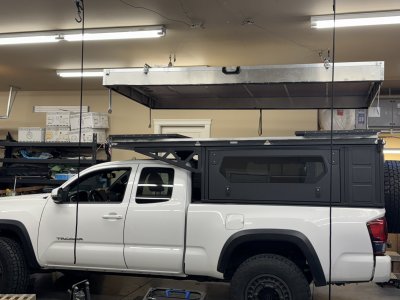
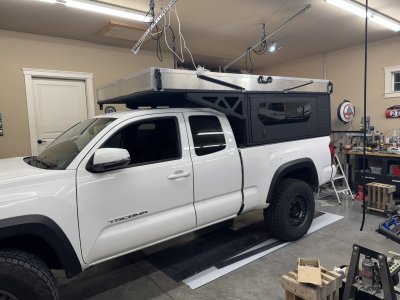
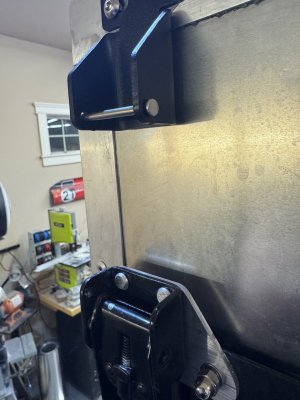
It's been a while since I last wrote an update, but things are still moving along— although at a slower pace than I'd like.
The good news is that everything works— at least in "bench" testing.
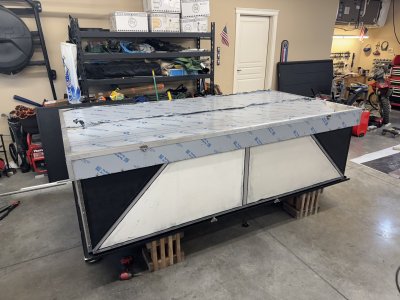
The roof and walls fully open and close without too much trouble, so I'm confident that the design is mostly sound at this point, but there are still a few bugs I need to work out. Among those are:
Roof Weight
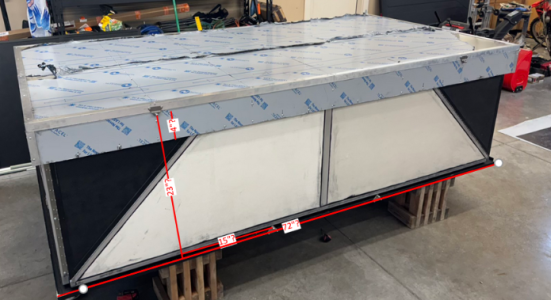
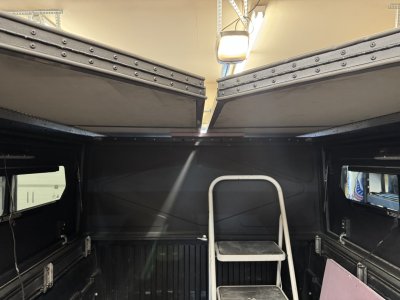
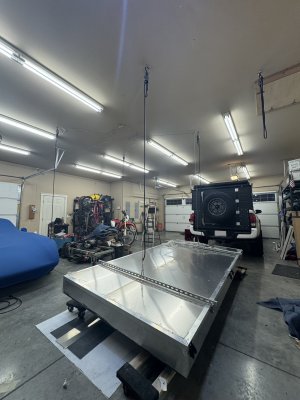
The roof is now finished and skinned in 0.040 aluminum, but I'm really surprised at how heavy it is. It comes in at roughly 100 lbs which is about 1.6 lbs per square foot. I suppose that isn't awful considering that not only does it have to provide cover from the elements, but also be strong enough to withstand pulling up the entire weight of the walls from very concentrated load points. Not really sure where I could shave weight, because there isn't much to it (as you may have seen from previous posts). My calculations showed that going with 0.030 aluminum skin wouldn't have really saved all that much weight and I wanted the roof to have a fair amount of impact resistance from branches and hail and stuff. If anyone has any pointers on how I might build it lighter (without having to go the fiber and epoxy route) would love to hear it!
Gas Struts
The gas struts I'm currently using are rated at 40lbs each which are more than plenty to push up 100 lbs of roof, but only when they get past a certain point. Since the gas struts are mostly providing force in the horizontal axis when the roof is folded, it takes an immense amount of effort (almost 100 lbs worth of effort) to get the roof pushed up to 12-18 inches. Beyond that, the struts provide more than enough force to lift the roof the rest of the way on their own as they start to exert more force in the vertical direction.
There are two obvious solutions here: 1) get stronger struts or 2) make a lighter roof. Well #2 is out for now since I'm not fully sure how I can make it lighter at this point, so that leaves us #1. But there are a few problems with going with stronger struts.
1. Once the roof is in the up position, it actually takes a reasonable effort (at least it's reasonable) to get it back down again since the struts are now pushing upwards with 160 lbs for a 100 lb roof. Stronger struts might turn this reasonable effort into unreasonable effort.
2. In the up position, if the struts are pushing up with much greater force than the weight of the roof, it results in a lot of pent up and useless force on the hinges and attachment points for long periods of time. These are highly concentrated structural points that I would prefer to only be under stress during the short period of time while the roof is opening or closing. When the roof is opened or closed, preferably the force would be distributed over a large surface area, like the the walls and the frame, not the strut and hinge attachment points. In a perfect world we could just make sure that the struts are at the end of their travel by the time the roof is fully extended, but that won't work. Due to the nature of how it folds— the roof goes slightly higher just before it's fully up, when it settles down an inch or so again.
In a perfect world we'd have struts that provide equal force in the vertical direction at all times and size them according to the weight of the roof and walls, but that's not really an option here. I've thought about a scissor jack type of arrangement, but any ideas I have there are too bulky, so I'm not fully sure what I'm going to do here and would love some suggestions. As of now, I've just decided that I'm going to live with having to struggle to push it up in the beginning while I work out a longer-term solution.
Possible Death Trap?
This is one of those things that unlocks a new fear of death that you never knew existed before

. This hard folding wall design— and not just my design, but I think any others out there who are using a similar folding method, Hiatus, etc.— could potentially be a guillotine. Let me explain.
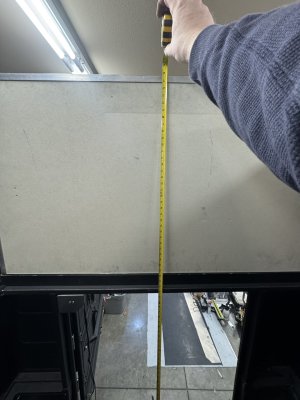
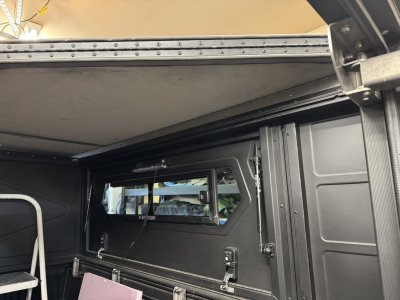
To get the maximum amount of height possible, the walls will end up being roughly half of the width of the camper when folded down. So imagine the walls start at 5 feet apart when the camper is fully popped up, but then as they fold towards the center, that 5 feet eventually becomes inches or millimeters where their tops meet in the center. If anything is caught between the point where those two walls meet, it's going to get mangled.
At one point I was inside the popup section ready to fold the walls down and using my hand to pull the roof down to overcome the initial force needed to start collapsing it, and an instant later my lizard brain jolted me and said my arm shouldn't be there— a quickly pulled my arm out and when I had a moment to reflect on it, I understood why. Any body part that is above where those two walls eventually meet is going to be crushed. My arm would be one thing, but if my head or neck was there— I don't even want to think about it.
The safest way to solve this issue would be to make sure that the walls never meet close enough in the middle to pinch any reasonably sized body part, but every inch you open this space up is one less inch you get in wall and ceiling height. I can't spare any.
The second safest way to solve this issue would be to make sure that if the walls do ever close on a body part, that it's very easy for you to push them back open again and unpinch it. The problem here is that this pinching action really only occurs near the end of the folding process, right when the gas struts are at their weakest point. So unfortunately the gas struts aren't going to provide much help at this stage. In our case you'd have to be capable of pushing up with 100 lbs of force while under severe distress. Not likely.
The third safest way to solve this issue would be to just make sure that you don't need to be anywhere near the walls as they are folding. Unfortunately this is difficult at the moment because it does require you to be inside the camper to start the process by providing the initial force to fold the walls and roof. This might not be an issue if I eventually ditch the gas struts and move to some sort of electric drive to open and close the roof.
The final way is to just treat it like a safety item— make sure I keep my hands and head clear while retracting the roof. I wouldn't stick my hands or head in between an RV slide-out when closing it, so I just need to approach this in a similar fashion. The only difference here is that it's not intuitively obvious at first that there is a safety risk, but now that I know it exists, I think it can be managed properly.
Dress Rehearsal
So now that I've proven the design works (at least in bench testing), there is still a major risk factor— will this actually work and function on my truck? To get this proven out, I decided to answer some questions in a few steps:
Step 1
Is the frame and gusset arrangement going to be able to support my weight in the cantilevered section over the cab?
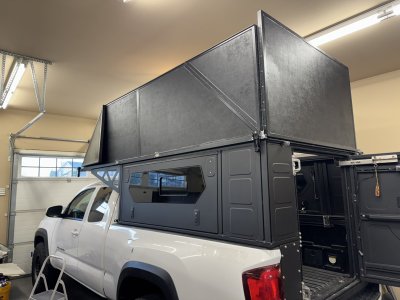
To accomplish this, I took the entire thing apart and mounted just the frame, gussets, and the sleeping platform floor to the top of the AluCab Modcap canopy. Then I gingerly climbed up on it and hoped and prayed it wouldn't break...
I was honestly expecting there to be a small amount of flex with my full 270 lb frame on it, but to my immense relief and surprise it did not budge at all under both static and dynamic loads (simulating tossing and turning in my sleep). So I'm happy to say this was a success!
Step 2
Is the unit waterproof in the down position?
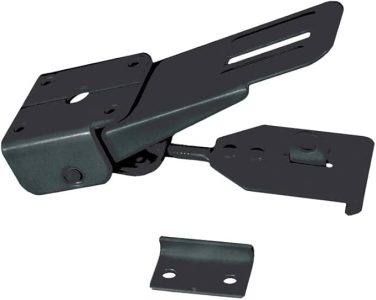
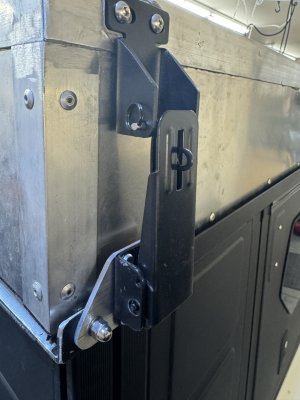
I figured the unit would be spending most of its life in the folded/down position, so it made the most sense to ensure it was watertight this way before I invested much more time finishing the rest of it up. So in this case, I added the weather seal to the bottom part of the roof where it meets the frame, stuck it up top, cinched up the latches, and hit it with the hose for a few minutes.
Happy to report there are no leaks! Although I'd really like to test it in more prolonged rain, and also while the truck is moving in order to put this part fully to rest.
One issue I did notice was that my "gutters" on the side seem to empty right into the driver and passenger side windows. I can imagine this will result in a getting drenched when entering or exiting the cab during heavy rain, so we'll have to figure out a way to reroute the flow a bit, but I don't think this will be a problem.
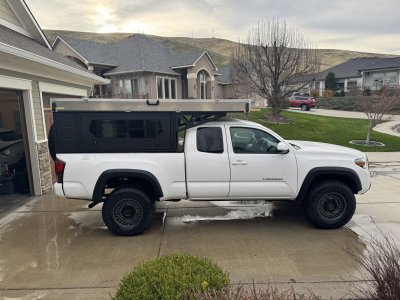
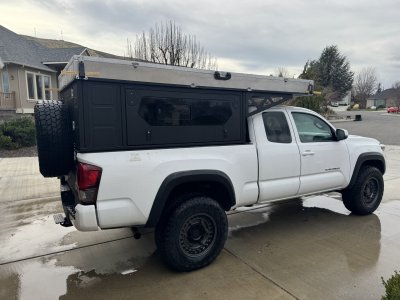
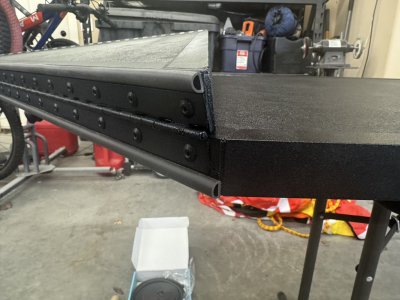
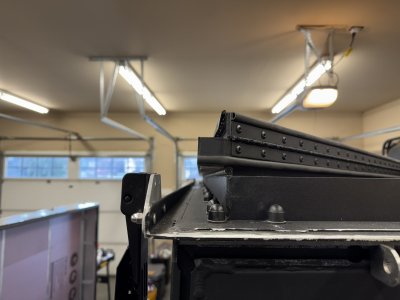
There is still one major problem I need to address, and that is where my "gutters" (aka L-bracket aluminum) attach to my main frame. These L-brackets provide a few functions:
1. The lower gas strut brackets attach to it.
2. The lower portion or the roof latching mechanism attach to it.
3. The bottom of the roof and weatherstripping rest on it.
Because of these functions, these L-brackets are under a fair amount of stress in both vertical directions. The weight of the roof and struts push down on them when the roof is up, and the brackets pull up on them when it's latched.
Right now these brackets are attached via interrupted butt welds every few inches. But I can already see that cracks are starting to form along the welds. So I'm either going to have to do a better job of welding (I really do suck welding aluminum still), or find another way to shore this up. You can see my paint sticks are providing some strain relief at the moment from twisting these L-brackets in the positive Y direction.
Step 3
I haven't gotten here yet, but this will be where I fully assemble the popup walls and check for leaks when the roof is up.
Anyway, thanks again for following along and hopefully my next update comes sooner rather than later!