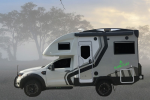
The handling, braking, fuel mileage and capabilities will all suffer drastically. Try to stop a 7,000 pound Tacoma on a gravel road from 35 MPH with factory wheels, tires, brakes and a 7 foot tall camper on the back and let me know how that works out.
I wholeheartedly agree with you but what's interesting to me is that the Tacoma and Hilux share some common parts, at least in design, such as brakes (both are still disc front, drum rear), front suspension, steering, similar family transmissions (gearing varies).
At a high level their main difference is the frame (Hilux being fully boxed, Tacoma being open 'C' from the front door rearward) and rear suspension (Hilux still is traditional compression shackle, Tacoma being flipped tension shackle like domestic trucks). I think the Hilux still has inboard shocks, the Tacoma's shocks got moved to the outside of the frame rails.
Point being the Tacoma brakes
do stink but in that respect the Hilux wouldn't really be any different and shouldn't on paper seem to deserve 2x the GVWR that they get anyway.
I think a factor in payload ratings is the relative expectation of use at very high speeds on good pavement. GVWR isn't simply a measure of suspension squat or frame deflection but handling dynamics factor in.
Loading a small/midsize pickup with 2,500 lbs of payload would make it very roll-over prone at Interstate speed. It's a routine refrain that Americans complain about not having enough engine power to cruise at even higher than posted speeds. Read threads in the Toyota specific subforum, the 4Runner's 270 HP V6 is routinely panned for not being a V8 capable of holding 75 MPH at 10,000' while in overdrive.
Giving a Tacoma Hilux-like GVWR would be suicide for Toyota. In fact when we
actually did effectively get a Hilux from 79-95 the GVWR was reduced. My made-in-Japan 1991 Toyota Truck door jamb said 5,350 lbs GVWR while a Hilux destined for Australia or elsewhere coming from the very same factory would have been rated 3,000 or more kg, so 6,600 lbs.