Load range vs load index

tacollie

Glamper
What's the difference between between the load range and load index ratings? The Internet says load range is out dated and to use the load index. I found a decent deal on some tires. They are load range F but the load index is 128. My current tires are load range E but the index is 129. I honestly don't think the Fs will be any worse. This does have me rethinking how I've been shopping for tires. Especially since there are a lot of E rated tires with a load index to low for me. Do the load ratings matter anymore?
 
@ruff I get that. Do the letter ratings actually mean anything anymore? Maybe they change the compound as you go down the alphabet to accommodate for heavier vehicles.
 
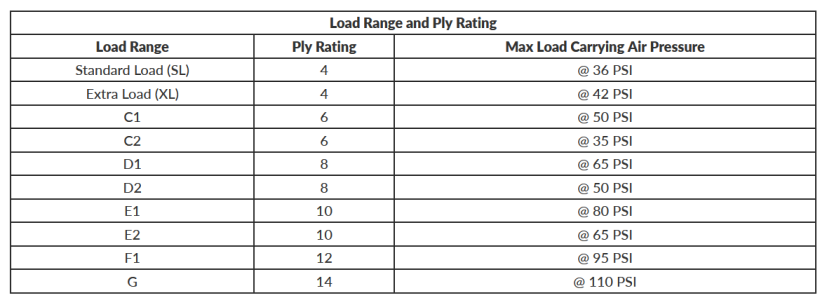
Load range is pressure and equivalent ply ratings. Between tires of the the same range but different sizes the load capacity will vary. The tire and wheel association defines what layers of reinforcement are needed for the equivalent ply rating (fabric equivalent plies). This is mostly sidewalls, but also affects tread belt reinforcement.

1764721331239.png

Load index is specific, and will tell you exactly that tires capacity is. Two tires of the same size and load range can have significantly different load index (and thus maximum carrying capacity). This can be very important when using oversize or non stock tires, and you are running near a tires max load. Choosing the same size and load range in that case may result in an overloaded tire. The OEM size and load range takes that into account, and they select typically for the lowest weight capacity for a given load range/size.
 
Last edited:
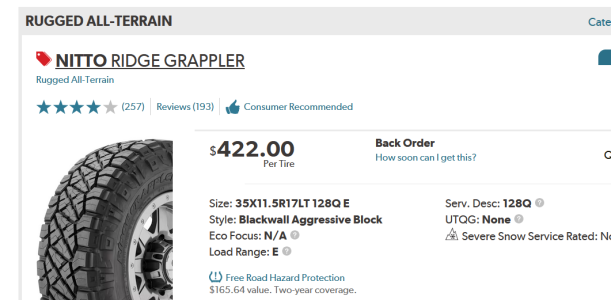
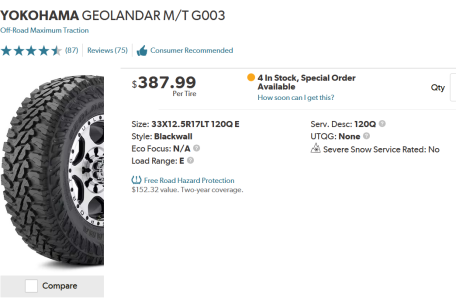
For example on the confusion with load range. In the 35" tire, a range E is 128 load index. While a smaller tire in the same range E is 120 index. A difference of nearly 900lbs per tire.

1764731558687.png
1764731674797.png
 
Yeah I still don't get the point of load range. The guy at the tire shop did tell me some manufacturers actually use a stiffer tread and center section on higher load range tires. He told me on the tires in question that the sidewall were the same for different load ranges. I'm not sure if that's accurate but he is the owner of the shop and a customer of mine so I'll give him a little more credit. He also sold me a set of KO3s cheap enough that if I don't like them in 6 months I can unload them and come out flush. Honestly I wasn't interested in them but I couldn't say no to the price.

I think from now on I'm just going to buy tires based on the load index.
 
As shown above, load rang (letters) need to be coupled with a specific tire size to be meaningful. Load index is more absolute.

i.e. A "C" rated 40" tire will have higher capacity than an "E" rated 32" tire. A load index 131 tire will ALWAYS carry more than a load index 121 tire, regardless of size.

To make things even more confusing, many 17" tires are artificially capped at 3195 lbs, even if it's a giant 37" E rated. Unless it's a "legacy" tire grandfathered in - Nitto Mud, Toyo Mud, etc. They have 4300 lbs payload in 37" E
 
As shown above, load rang (letters) need to be coupled with a specific tire size to be meaningful. Load index is more absolute.

i.e. A "C" rated 40" tire will have higher capacity than an "E" rated 32" tire. A load index 131 tire will ALWAYS carry more than a load index 121 tire, regardless of size.

To make things even more confusing, many 17" tires are artificially capped at 3195 lbs, even if it's a giant 37" E rated. Unless it's a "legacy" tire grandfathered in - Nitto Mud, Toyo Mud, etc. They have 4300 lbs payload in 37" E
I didn't realize a lot of the 17s were capped. There's a lot of 35x12.5r17 tires that are are f rated with a load index of 121. That's part of the reason I stayed with 18s. My new new f-rated tires ride better higher than my old e-rated tires even at 12 more PSI.
 
Load range usually refers to the ply rating, but that isn't as accurate anymore either. The Load Index is far more important. That said I have wheeled on P Rated Tires along with LT Rated C and E Tires. As long as you have a good quality tire and air down according, you will be fine.
 
Last edited:
As far as I know, Load Rating is/was based upon the old standard of Ply-Rating, which essentially isn't a thing any longer.
I will always run by Load Index if I am concerned about weight capacity.

The current setup uses the highest load rated LT (285/75r18) you will find, with a load index of 129 (4080lbs) @ 80PSI
 
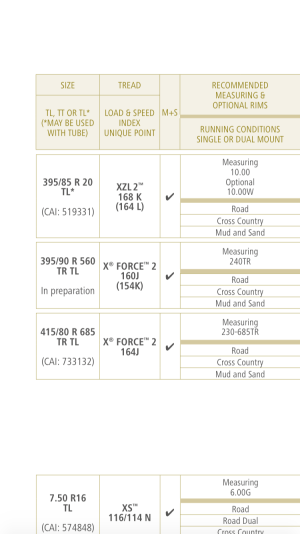
Michelin at least on some big military tires does a”singular point” thing:
Higher load capacity at slower speed, or lower load capacity at higher speed. Here’s an example:
The 395/85 R20 XZL2
IMG_0075.png
 
I run Michelin 305/70R19.5 XDE2 on our 4WD motorhome. It is intended as a semi trailer drive tyre.
They provide a wide range of load and speed data for this tyre. It is rated at 3075kg per tyre at 112psi for highway speeds but they also quote overload speed limited information.
It has a single steel sidewall ply (and 5 steel tread plies) which makes it brilliant for running in the desert at low pressures.
Cheers,
Peter
OKA196 motorhome
 

Forum statistics

Threads
190,879
Messages
2,932,852
Members
234,698
Latest member
OchoSolo
Top