Somewhere near Yuma

I thought the plastic drawers might creep or break, but they are holding up very well so far. You can customize the height to anything you want; for instance you make a 4 drawer 2x2 drawer or 4x1 drawer easily, if you make a cover or have them under a platform. Latches are good too... btw, if you want to install latches just pop off the cosmetic fronts of the drawers.

The crates under the couch just slide on carpet runner, and that works fine. Not like ball bearings, but simple. One of those cracked; not sure why... but at least they are cheap and available at any Walmart. I have 1x2s that pivot on a bolt to keep them from sliding out when driving. I have a plastic crates in the back seat as well, above and below a plywood platform. They are Plano crates which I think are more durable. They come with nice lids too, but I had to toss those.

Lightweight and durable drawers and crates can be made from thin marine ply with a layer of fiberglass... and that way you can customize the size and also have vertical sides for better space efficiency. I considered that, but decided to go the easy and cheap route.
 
Yeah I agree. I plan to build my inside out this summer and I think seeing @rruff's build gave me much better simplification ideas. One major thing I was contemplating was the drawers. I don't want metal due to condensation and wood gets heavy fast. So now I am thinking plastic bins for drawers with a wood frame to hold the drawers. Way easier, lighter, quicker to build, etc.
In addition to @rruff’s suggestions, you might also consider making drawers out of Coroplast. I have two I’ve been using with some heavy contents for about 4 years and they have stood up well. Super light weight.

Well, if weight is a top concern, you could consider make the drawers out of Coroplast with some added reinforcement. They don’t need runners if you have a flat bottom in the casing for them to slide on. Extremely tough material, but has some flex. you can load them up if well built.
View attachment 727457

View attachment 727456
This drawer has about 25lbs of crap in it. 25”x18”x7”

View attachment 727458
 
Here’s a previous post where I wrote up a “how to"
Very definitely, though if you use 1/4" (really 5mm) baltic birch plywood that's pretty light too and def stronger. Coroplast will give you rigidity along the flute/chanel lines, but can be flexible. If you anchor the walls on the side it would be pretty impact forgiving. It's just much easier, cheaper and quicker to work with. No sawing, dust, sealing, finishing, etc. I'm using 4mm but there is a stronger, still light 6mm available, but not at Home Depot.


Thanks! Not sure exactly how you mean "sheathing" WRT the drawer, but just to be clear, the drawers are actually completely made of coroplast, but with some corner and edge reinforcement which actually can be optional. There's no inside frame. The strength comes from the folding. Don't have construction process pictures, but I was garage cleaning this morning and found my cardboard drawer template so I marked it up quickly:
View attachment 700414

Here's a quick how to:

1) Layout and cut the drawer blank (I like a quick cardboard mock-up to verify it's gonna fit first)
2) Slit the top layer ONLY of the two fold lines that go in the direction of the channels/flutes
3) Lightly score with a utility knife the other two fold lines that go across the flutes. (I also run a rotary pizza cutter along the line using a straight edge to break down the little walls). ALL the cuts/scores of the fold lines are done inside the box only. Gives you smooth bottom edges and corners.
4) Fold it up and tape the corners.
You could stop here for a really light duty box if you use good tape. I've made boxes with 2" Gaffer tape that have held up for years. Read on for a more durable one . . .
5) Clean the inside corners with isopropyl alcohol and lightly scuff with ~120 grit sand paper (using the VHB primer as well is even stronger)
6) Apply VHB tape to the corners (dashed lines in the picture) and roll it or press for a good adhesion
7) Fit 4 corner braces of hardware store 3/4' alum angle that you've cut to the box height in the corners and roll/press again. Oh, first clean and scuff the alum angle too. No need for primer on it.
8) If you want real side rigidity, you can buy some hardware store/Home Depot 1/4"aluminum plywood trim channel for edging. You can just press fit this. It will be held by the alum corner braces plus the coroplast

No need for a frame otherwise. The bottom fold lines on each side give rigidity. The drawer I made for my back seat platform is holding 20lbs of stuff and I take it out to store in the house, so I VHB'd another full piece of coroplast on the inside bottom of the drawer for a little more bottom support as its quite long.

I made the drawer in the camper exactly as described and its quite rigid.

If you're gonna work much with coroplast, get one of these:
Amazon product ASIN B00DTNNTTY
Makes it real easy to cut either 1 or both layers along the flutes. You can also use it to make coroplast hinges, and you can make corner reinforcements with it.
 
Here’s a previous post where I wrote up a “how to"
Very interesting. I will add it to my list of considerations.

Did you ever make a drawer without using aluminum angle? Just VHB tape coroplast together. If yes, what made you start using the angle?
 
Oh, one more question. How does coroplast do in extreme heat? Plastic drawers like what rruff used don't last in the heat in the houston area. I have had some in my insulated garage get too hot and then they don't stay in the plastic frame properly so you end up trashing them. It will be even worse in a camper that is stored outside.
 
Plastic drawers like what rruff used don't last in the heat in the houston area.
How hot do you think they get? My camper has been outdoors in the sun for two summers where it's low 90s, but no warmer. And it cools to 60 at night, so I don't know how hot it gets in there.

PP should be good under a heavy load up to 120F at least.
 
Did you ever make a drawer without using aluminum angle? Just VHB tape coroplast together. If yes, what made you start using the angle?
Yes, I have. The long drawer from my back seat platform in the previous post pictures has coroplast corners in the back vs alu in the front. I put them outside to double as bumpers as the drawers have to go in at an angle and slightly rub a support going in — you can see the smooth outside radius. You can just as easily reverse the bend and get a sharp 90º and use as an inside reinforcement.

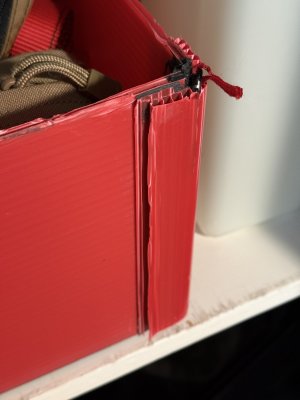
You can see it’s been beat up, but staying together perfectly — after 5 years of use. I used some Pelican divider "U” pins to reinforce that you can see with the red tag attached. With the channels Coroplast is great for dividers using those too.
1769875602712.jpegThis and my drawer inside the camper were the first Aluminum angle or any corners used, just for some extra rigidity. I wouldn’t hesitate to build a box with just Coroplast corner reinforcement. You just split one side of the channel and bend to 90º. You can also make hinges that way.
Oh, one more question. How does coroplast do in extreme heat?
Well, I live in Phoenix and don’t fit my garage. So the drawers were designed as easily removable for storage in the “camping closet”. Specifically for the contents, not the boxes.

My camper walls are faced with coroplast and I’ve measured 135º inside closed up in the summer. They do not deform or deteriorate. Coroplast IS heat formable, but it takes a heat gun on high which is kinda useful for some things. You wouldn’t have a problem.

Misc: You can use 100% silicon caulk/adhesive on coroplast. Good quality gaffer tape sticks really well. While VHB (5952 or LSE) sticks very well, I’ve found that some cheaper adhesives (less quality sticky velcro) will dissolve a bit and migrate in the heat as the coroplast releases minute amounts of plasticisers which dissolve the adhesive. Passing a flame lightly over the coroplast surface preps it well to avoid this with no ill effects on the coroplast.

You can finds tons of info on making things with coroplast on-line. I learned a lot from this guy:

 
How hot do you think they get? My camper has been outdoors in the sun for two summers where it's low 90s, but no warmer. And it cools to 60 at night, so I don't know how hot it gets in there.

PP should be good under a heavy load up to 120F at least.
The one i had in the garage was in direct sunlight on a 100 degree day. The camper isn't currently insulated so in the summer it is like an attic. 140 wouldn't surprise me. But i guess i insulate it first and that would help a lot.

Sent from my Pixel 9 Pro XL using Tapatalk
 
Mine has 1.5" PVC foam walls and top, and the windows are covered, no vents. Thinking of the places I've traveled, it probably has never been over 100 inside. On the other end, below freezing the plastic can get brittle. Pounding over rough roads at low temp might not be a good idea either.
 
Last edited:
Mine has 1.5" PVC foam walls and top, and the windows are covered, no vents. Thinking of the places I've traveled, it probably has never been over 100 inside. On the other end, below freezing the plastic can get brittle. Pounding over rough roads at low temp might not be a good idea either.
Did you mean your camper had pvc foam or coproplast wall/ceiling cover inside?
I am wondering what is the material. I believe both materials are rigid, it looked like you had used flexible material to me from the picture.
 
I had been using plastic drawers from Walmart, no issues, also the drawers stay shut without a need to add anything, cost me $15 on sale for large-ish drawers, easy to replace if needed.
 
How did you get such smooth looking junctions (I though the material was very rigid)? On the photo they look almost seamless
It's stiff for foam, but it will bend. The curved parts were made by bending and gluing two layers of 3/4".

There are definitely seams; it was built in pieces, then the parts brought together with wood frames holding them in position, joints filled with thickened epoxy, and fiberglassed inside and out.

The seams and imperfections are very clear up close. The outer left wall was the 1st thing I fiberglassed, and I used some 30" 1707 cloth I had leftover. I was surprised at how obvious a 0.5mm overlap is! I was going to put it on the inside, but when putting the pieces together I forgot, and didn't want to spend a whole day taking it apart and putting it back together.

I sanded just enough to minimally smooth the surface to remove sharp bits, and prep for paint. Even then, the amount of dust generated was a lot.
 
Last edited:
It's stiff for foam, but it will bend. The curved parts were made by bending and gluing two layers of 3/4".

There are definitely seams; it was built in pieces, then the parts brought together with wood frames holding them in position, joints filled with thickened epoxy, and fiberglassed inside and out.

The seams and imperfections are very clear up close. The outer left wall was the 1st thing I fiberglassed, and I used some 30" 1707 cloth I had leftover. I was surprised at how obvious a 0.5mm overlap is! I was going to put it on the inside, but when putting the pieces together I forgot, and didn't want to spend a whole day taking it apart and putting it back together.

I sanded just enough to minimally smooth the surface to remove sharp bits, and prep for paint. Even then, the amount of dust generated was a lot.
Oh I see! So it's fiberglassed over, this is why it looks so smooth. Well like they say about RVs: it only needs to look good from 20 feet away.

By the way since you seem to be experienced in fiberglass work, my factory fiberglass camper got some chips and scratches in few places. Do you think I could just use automotive paint scratch fix kit or better to use fiberglass boat chip/scratch kit? I need to sand it to nicely blend into very smooth factory gelcoat over fiberglass.
 

Forum statistics

Threads
191,128
Messages
2,933,350
Members
235,045
Latest member
Driftwood_seq
Top