Condensation in campers and how to avoid it!

Victorian

Approved Vendor : Total Composites
Every year I'm getting calls from customers asking for advice on how to prevent condensation in a DIY / custom camper in winter condition.

I experienced this too on my personal camper. This is of course a WTH moment first, but when you start looking closer into thermal dynamics and understand how condensation forms, it all makes sense and can easily be avoided.

1. it's important to remember that any type of "insulation" that is in direct contact with the outside walls (cold surface) will act as an insulated barrier not giving the camper walls a chance to warm up. Key is to have air flow between the cushions/mattress. Ideally, although not easy to accomplish, is getting warm air flow from the heating system behind the "insulating" layers. At the same time, it's also important to avoid "dead air pockets" where moisture is trapped (storage hatches,behind cabinets etc). With all of this in place there will be no condensation on the panels or the pultrusions. This means, if the bed mattress is tightly fitting and won’t allow air flow around the edges and underneath, you will see condensation and a wet mattress for sure. The mattress acts like an insulating layer. The Goodside Bedslat system by Expedition Upfitter would be an excellent choice to help with this.
    • Heating source: We had great success with diesel heaters. These recirculate the interior air and produce a “dry “ heat. The air flow of these can be guided into the “right” places with ducting (storage hatches, entry ways etc).
    • Ventilation: I’m not a big fan of any forced ventilation contraption that is mounted on the roof… Not only do they ad a lot of overall height, most of them also don’t have the track record in reliability… Instead, I would rather open the windows for cross airflow and work with small efficient and quiet portable fans.

    • Another important detail to know when it comes to condensation: Because campers/RV's are such a small space with relatively minimal materials to absorb moisture (through breathing,cooking,showering etc) it is more likely that water droplets form on surfaces that are cold. For example: we have a huge walkthrough between the camper and drivers cab in our Ford Transit. We have never seen condensation anywhere inside the camper (except on the window frames), the drivers cab on the other hand gets hammered with water! What I want to say: the moisture will also find the weakest point to collect. In our case we can't avoid it, just minimize it with a heavy curtain. Bottom line is: warm air flow and avoiding cold dead air spaces. You can never have enough warm airflow!

    • Here is another thing I learned right in the beginning on my first TC camper 8 years ago. Back then, I only could afford a mister buddy gas heater. I had a window cracked at night and used a warm winter sleeping bag. I was very comfy that night. In the morning I had condensation in that camper you wouldn't believe. It was dripping of the ceiling! Needless to say how disapointed I was. Shortly after, I installed a diesel heater. What a difference!!!! I also learned that condensation forms at the dew point . This means your camper is most likely to form condensation if it gets too cold inside. When we go out in our camper, we only use summer blankets (year around). This forces us to turn the heater on instead of "bundling up".

Take away:
Allow for plenty of warm air circulation between seat cushions/mattresses. Remember the dew point and keep the interior warm with circulating air flow.

Hope this will be useful to some of you. Cheers

Air flow .jpeg
 
I've had good luck controlling condensation in my camper taking a cue from the automotive and marine industry. In a nutshell, I lined my walls with a fuzzy fabric.

The fuzz holds really small water droplets (can't be seen compared to condensed water that pools together like the inside of a cold window) that evaporate quickly when warmed air passes over the surface.

If when I build out a composite camper, I might try making removable interior panels with fuzzy material on the surface. If the fuzzy material gets dirty / mildewed I'll swap them out.

The other thing that helps is to not store water absorbent material in the camper in the winter when not in use. We remove our camping pad mattresses, bedding, clothes etc when we return from a trip and run the heat for a while to make sure the interior is really dry.

Regarding condensation and air flow, when cold incoming air warms up, it now has the capacity to hold more moisture like a sponge. The warm air will absorb moisture and then when it exits the space it takes moisture out with it and so continues the cycle of heating and drying.
 
He’s definitely right about the preference for a diesel fuel heater

It’s well known that, if you’re using propane for heat and cooking, you’re going to be generating quite a bit of moisture as a byproduct

But also, if there are any large mammals hanging out inside your small camp box, their exhalations also are unavoidably going to generate moisture 🤣

In the past in our campers we’ve used those super absorbent camping bath towels to wipe down wet surfaces in the morning (and then dried them out by putting them on the dashboard while driving)… also (a bit more old school) used school blackboard erasers for wipe downs!
 
Last edited:
Yes, the carpet like material on the walls and ceiling of my small Casita travel trailer does a great job of keeping condensation at bay. It somehow doesn't retain moisture, never has had mildew, etc. I do like having the ability to crack open the overhead fan cover. In my mind I see it letting warm, moisture heavy air escape. Of course like most of us I'm not qualified to talk about thermodynamics so it could be imaginary. The windows are another thing and don't need much encouragement to drip. I have both propane and electric heat. The propane combustion is entirely separate from the interior air so it doesn't increase condensation.
 
I do like having the ability to crack open the overhead fan cover. In my mind I see it letting warm, moisture heavy air escape.
True, humid air is lighter than dry air.

Having an unvented heat source (Buddy, Camco, stove, etc) is the biggest culprit, with 1 lb of propane combustion creating 1.6 pounds of water... no joke. Human respiration creates ~0.10 lbs/hr, so that can get significant also.

Diesel heaters are always vented and decent ones are quite cheap, so that seems like a good way to go. I don't use any heat at all, but I don't camp in "real winter" either... in winter I head to the southern CO river valley.

Another thing to note is that resting humans give off about 100W of heat, and a well insulated camper will warm up ~20 F just from that.
 
Thanks for this post! The idea of keeping our cabin warmer overnight to reduce condensation is worth exploring. Is this a trial-and-error process or could we use one of the online dew-point calculators? I've looked at them but remain uncertain on how to use it :-(

Edit: playing around with these calculators, it seems that lowering the inner cabin temperature also lowers the dew point whereas raising temp raises dew point...not the desired outcome! Again, I may be doing something wrong...
 
Last edited:
I really wish people would stop bundling ALL propane heaters into the single "Buddy Heater" type that create moisture.

If you are using a Propex propane heater (or similar type), these are NO different than the diesel heaters. They are heat exchanger type heaters, which keeps all of the combustion outside and only dry heat is circulated inside. The Propex and diesel heaters work exactly the same, it is the fuel source that is different. Not everyone wants to carry diesel and if I am already plumbing propane for other items, it limits how many different fuel sources I am using.

Once advantage to the Propex, there is no fuel pump to run (extra power draw and noise) as it is pressurized fuel source. Only power draw is the fan/controller.
 
- run a dehumidifier or have plenty of fuel to heat / vent (to the outside) air
- a hygrometer (humidity) meter shows the % of moisture the air (not the % in the air) can hold. In winter 30–40% is best.
- lower the humidity before circulating warm air into/onto cool compartments/surfaces or there will be condensation.
 
- run a dehumidifier or have plenty of fuel to heat / vent (to the outside) air
- a hygrometer (humidity) meter shows the % of moisture the air (not the % in the air) can hold. In winter 30–40% is best.
- lower the humidity before circulating warm air into/onto cool compartments/surfaces or there will be condensation.
As Alloy says, get a good dehumidifier. Use an AC 1500 watt heater (heats and moves air) combined with the dehumidifier in the camper after every outing.

Close all of the vents, windows, etc., block up the mattress a foot or so, pull all of the sofa cushions away from the wall and benches, open all of the cupboards and cubbies, crank the heater up to to 70+F (20+C)., turn on the dehumidifier, close the door and walk away for 12 to 24 hours or until the dehumidifier quits collecting water. Wiping obvious moisture up with microfiber cloths and drying them along with used dish/tea towels in the cab of the truck works in the short term while on the road but the dehumidifier/heater combo really draws the moisture out from every nook and cranny...... It takes very little time to set this up when you get home.
 
Last edited:
Thanks for this post! The idea of keeping our cabin warmer overnight to reduce condensation is worth exploring. Is this a trial-and-error process or could we use one of the online dew-point calculators? I've looked at them but remain uncertain on how to use it :-(

Edit: playing around with these calculators, it seems that lowering the inner cabin temperature also lowers the dew point whereas raising temp raises dew point...not the desired outcome! Again, I may be doing something wrong...
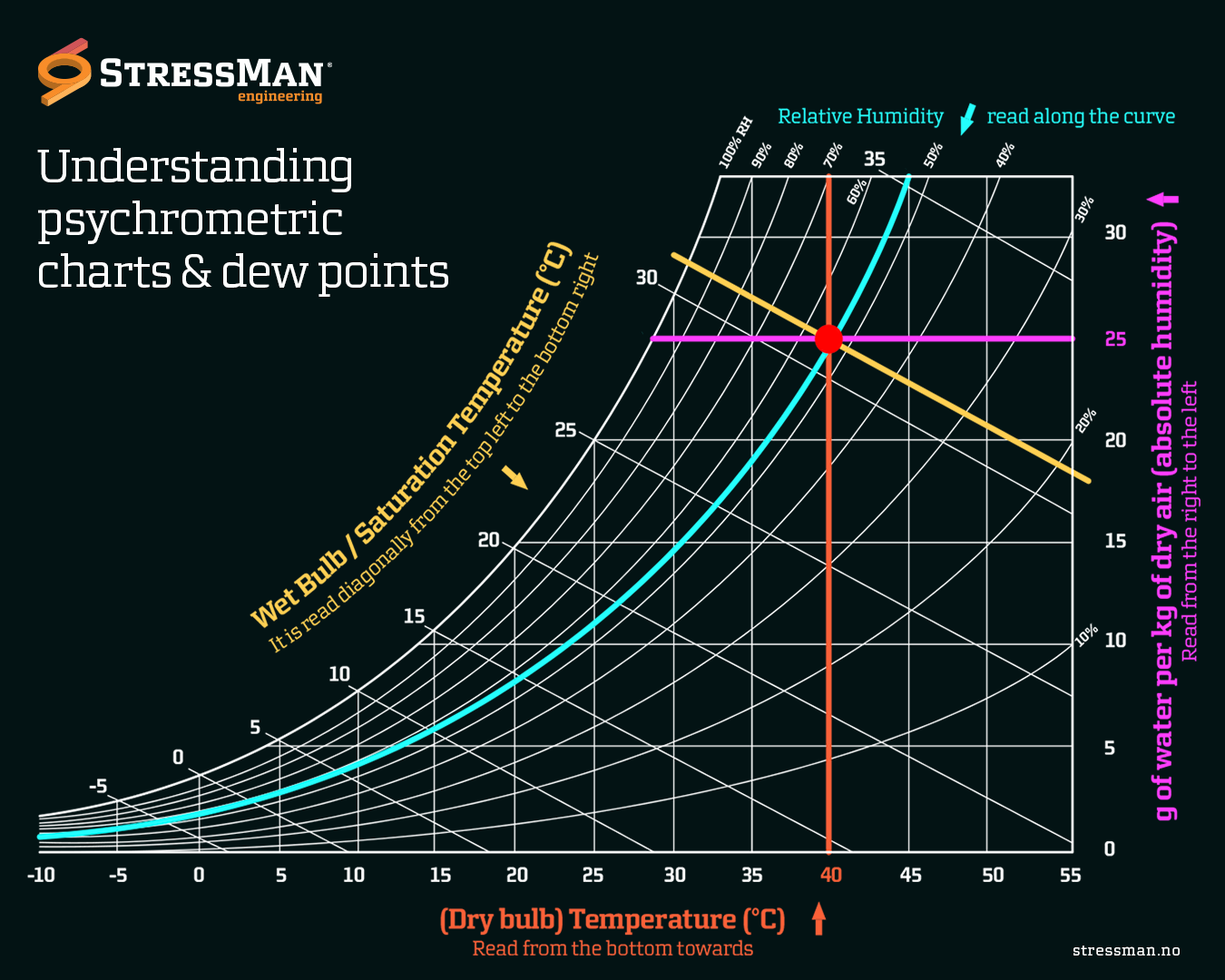
A chart might be easier to look at than a calculator.

1765559846142.png


Here is a link to the page I took the chart from and an explanation of the values on the chart.

 
I'm going to attempt to approach the problem from a humidity standpoint. How much water can air hold at a given temperature.

If I am reading the chart correctly it shows approximately air at 0C that is 100% saturated is only 15% saturated when heated to 20C.
The 100% saturated air at 0c holds 4g water per kilogram of dry air and heated to 20C, it holds up to 15g before 100% saturation (condensation).

In the case of a camper with a cooler surface like a window frame the dew point is lowered in that area. If you have 7g of water per kilogram of dry air the dewpoint is around 10C.

If you only heat the air on the inside, it will hold more water but wont fix the condensation problem on the window frame. Air needs to be brought in and heated so that the humidity is lowered allowing it to absorb moisture from the inside and then be exhausted out.

Looking at the math, it is likely to have a condition where it is not possible to avoid condensation but at the same time, the amount of condensation can be minimized.

On my mountain camper I plan to run 2 diesel heaters. One of them will draw air in directly from the outside and exhaust through a roof vent. It will burn more fuel heating colder outside air but will also dry everything on the inside.
 
Last edited:
As pointed out in post #7, whatever the fuel source, a proper heater will draw and contain air from the outside for combustion and exhaust it to the outside. Professionally designed RV heaters work like this. It should be common sense but bears repeating when folks consider jury rigging their own.
 
I'm going to attempt to approach the problem from a humidity standpoint. How much water can air hold at a given temperature.

If I am reading the chart correctly it shows approximately air at 0C that is 100% saturated is only 15% saturated when heated to 20C.
The 100% saturated air at 0c holds 4g water per kilogram of dry air and heated to 20C, it holds up to 15g before 100% saturation (condensation).

In the case of a camper with a cooler surface like a window frame the dew point is lowered in that area. If you have 7g of water per kilogram of dry air the dewpoint is around 10C.

If you only heat the air on the inside, it will hold more water but wont fix the condensation problem on the window frame. Air needs to be brought in and heated so that the humidity is lowered allowing it to absorb moisture from the inside and then be exhausted out.

Looking at the math, it is likely to have a condition where it is not possible to avoid condensation but at the same time, the amount of condensation can be minimized.

On my mountain camper I plan to run 2 diesel heaters. One of them will draw air in directly from the outside and exhaust through a roof vent. It will burn more fuel heating colder outside air but will also dry everything on the inside.

Thanks for the discussion, that is what my instincts told me. For winter camper applications, raising the interior temp also raises the amount of moisture suspended in the air, which encourages condensation at those points where cold is transmitted through from outside, ie, widows and doors. Frequent air exchange with dry outside air is the way forward but one must address the attendant need to heat that air. It brings me back to considering an HRV setup…
 
Calculating the amount of energy required for heating and exhausting moist air to minimize condensation is beyond me but there are some engineers that could come up with a fairly accurate number.

I'm guessing it's not a crazy amount more energy than what I would spend anyway wanting to exchange for fresh air to keep CO2 down.
 
On my mountain camper I plan to run 2 diesel heaters. One of them will draw air in directly from the outside and exhaust through a roof vent. It will burn more fuel heating colder outside air but will also dry everything on the inside.

I did this but with a Propex heater. The best way to destroy a diesel furnace is not running the combustion chamber hot.

Bringing in cold air through ducts (not a window/vent) = more condensation problems to solve.
 

Forum statistics

Threads
190,863
Messages
2,932,630
Members
234,650
Latest member
mbobhat
Top