
You are using an out of date browser. It may not display this or other websites correctly.
You should upgrade or use an alternative browser.
You should upgrade or use an alternative browser.
Drug Dealer?
- Thread starter howirolla
- Start date


Ray_G
Explorer
There's a reason almost every commercial vehicle uses an air ride suspension, and often without failure for many many years. If you are not servicing your coilovers regularly, I'd be very concerned about the rest of your vehicle as well.
Is that reason truly applicable to offroad vehicles? At best the answer is in part. I say that because the 85-90% of commercial vehicles in North America with air ride suspensions are on highways (point 1 of divergence), and they also have folks maintaining them as part of their job-which you note.
I just think that making the reference to the application in on road long haul trucking is no more pertinent than noting a M-ATV's TAK-4 double wishbone coiled suspension allows that thing to race through the desert quite well, therefore coils are superior for a Land Rover.
Every application should be examined for its specific circumstances, pros/cons, etc.

tdferrero
Active member
I see your point, and I acknowledge that I didn't offer a full argument either. But you also have to take into account, for example, the tens of thousands of logging trucks that have to access some pretty obscure and far reaching roads that honestly, some are more trying than what a lot on the forum would even drive on. Everything has its place.Is that reason truly applicable to offroad vehicles? At best the answer is in part. I say that because the 85-90% of commercial vehicles in North America with air ride suspensions are on highways (point 1 of divergence), and they also have folks maintaining them as part of their job-which you note.
I just think that making the reference to the application in on road long haul trucking is no more pertinent than noting a M-ATV's TAK-4 double wishbone coiled suspension allows that thing to race through the desert quite well, therefore coils are superior for a Land Rover.
Every application should be examined for its specific circumstances, pros/cons, etc.

Victory_Overland
Explorer
The AB ad was a joke taking the piss out of airbags. The kit’s existence highlights the failure and frustrations of air suspension. Where there’s a solution, there’s a problem. Without getting into why, I’d never run a coil conversion setup. Sounds like you’re putting a lot of thought into improving them. Good luck. I don’t have the patience anymore.
AB was designed as a replacement option from the commercial LR3 variant that came with coils. The little black box (Orange) is the actual purpose built component that does not require the ECU change and flash to an OEM built LR3.
LR3 came with coils from the factory; AB didn't crush innovation barriers by designing something. They offered a kit to install per the OEM specifications and then gave an upgrade option for spring rate with OME springs.
On that note, I completely agree on the points of coils; again I'm looking for a better option than just a cost consideration. If I can make both make sense then its a win win.
Ray_G
Explorer
I see your point, and I acknowledge that I didn't offer a full argument either. But you also have to take into account, for example, the tens of thousands of logging trucks that have to access some pretty obscure and far reaching roads that honestly, some are more trying than what a lot on the forum would even drive on. Everything has its place.
Valid point on the logging vehicles-which is where I concur about your point wholeheartedly about everything having a place...and a price.
Victory_Overland
Explorer
I probably started this mess of a tangent so I send my deepest apology to @howirolla for hijacking your thread and all of us getting off on tangents about air/spring wars.

howirolla
Campfire Passport
Wow, yea this started quite the debate! Sorry I haven’t been back in so long, stuff at work got crazy with all this virus stuff going around. My company is expecting a 40% loss in production needs and has cut staffing across then entire plant by 35%, I made the cut so far but got moved to night shift as well as 5 8’s a week rather than 4 10’s so I’ve been balancing adjusting to that and trying to keep moving projects wise. I also sold my only other operable vehicle the day after the bag blew out, luckily I have a buddy with extra cars so I borrowed one while I looked for another one, found and purchased one which cut into my project time as well but I think I’m back on track now.
Already got the 35s ?Time for a big lift and 35s.
Far as I can tell they are the original bags, so 12 years old, 106k miles, and I’m guessing have hardly, if ever, seen anything outside of street use in standard height. So my assumption is that rods and using offroad height were the straws breaking the camels back.Insert broken record (that's the level of technology) comments by @EricTyrrell here!
Meanwhile; productive conversation inserted below:
@howirolla what's the years/hours/mileage/usage type on those bags; general estimate?
Victory_Overland
Explorer
Far as I can tell they are the original bags, so 12 years old, 106k miles, and I’m guessing have hardly, if ever, seen anything outside of street use in standard height. So my assumption is that rods and using offroad height were the straws breaking the camels back.
Could be; much higher bag pressures in off-road height. Thanks for sharing and best wishes on the future with the employment; hope we are all coming out of this okay in the end.

EricTyrrell
Expo God
Could be; much higher bag pressures in off-road height. Thanks for sharing and best wishes on the future with the employment; hope we are all coming out of this okay in the end.
Pressure is constant, only volume changes. Rubber age is what killed them.
Victory_Overland
Explorer
Pressure is constant, only volume changes. Rubber age is what killed them.
He said rods "AND" off-road height. Your statement would be correct if it was rods at NORMAL; which means constant pressure with increased volume because the EAS ECU believes the bags are in normal position and "daily driving mode" at normal height due to the rods positioning the height sensors to normal. Therefore, Gallery Pressure changes and so does the bag pressure to raise the vehicle; temporarily in this case; gallery pressure then drops to normal in NORMAL mode after the EAS reaches its normal height registered by the height sensors. Normal is a much more cushy ride, less spring rate, which equals less bag pressure to allow for a NORMAL quality ride of the JLR design and where YOU would be correct as volume would change and pressure would not.
HOWEVER!
Just because a vehicle raises and lowers doesn't mean the designers did not input changes in spring rate at specific ride heights or traction control settings (equals pressure changes). JLR does this in not only ACCESS Mode, NORMAL Mode, and OFF-ROAD Mode, but they do this in RR with performance settings in SPORT Mode. Pressure and spring rates absolutely are changed in these various settings to include valve settings controlled by the EAS ECUs.
Now, since the OP said "rods AND off-road height" let's get back to reality. Off-road height is a higher spring rate for off-road performance; anyone who's driven their LR/RR in off-road height probably feels this change in ride quality at higher speeds on terrain; hence spring rate change. The same goes for the higher cycles from the massive shifts in weight distribution, etc. The bags are indeed at a higher pressure in OFF-ROAD setting which also increases heat inside the bag at higher rebound/compression rates in high-speed operation. If the OP is running with rods AND in OFF-Road height, then the bags are at higher pressure, higher heat, and reducing the life of the bags at a much higher rate than what JLR designed it for. Don't want to get into too much detail but the NEW NORMAL is surely not the NORMAL NORMAL that JLR or the bags were designed for.
Used in general terms. The same is for the SPORT mode in RR vehicles. Bag volume and pressure decrease to lower the vehicle to a decreased height for the variety of reasons that ride height matters. Bag pressure is then increased to change the spring rate to whatever the smart JLR engineers decided was optimum SPORT MODE performance satisfaction and spring rate.
I do not want to get into the valving or atmospheric conditions that are used to change the rebound and compression during this process as I'm trying to make this somewhat simple to explain.
Last edited:
EricTyrrell
Expo God
He said rods "AND" off-road height. Your statement would be correct if it was rods at NORMAL; which means constant pressure with increased volume because the EAS ECU believes the bags are in normal position and "daily driving mode" at normal height due to the rods positioning the height sensors to normal. Therefore, Gallery Pressure changes and so does the bag pressure to raise the vehicle; temporarily in this case; gallery pressure then drops to normal in NORMAL mode after the EAS reaches its normal height registered by the height sensors. Normal is a much more cushy ride, less spring rate, which equals less bag pressure to allow for a NORMAL quality ride of the JLR design and where YOU would be correct as volume would change and pressure would not.
HOWEVER!
Just because a vehicle raises and lowers doesn't mean the designers did not input changes in spring rate at specific ride heights or traction control settings (equals pressure changes). JLR does this in not only ACCESS Mode, NORMAL Mode, and OFF-ROAD Mode, but they do this in RR with performance settings in SPORT Mode. Pressure and spring rates absolutely are changed in these various settings to include valve settings controlled by the EAS ECUs.
Now, since the OP said "rods AND off-road height" let's get back to reality. Off-road height is a higher spring rate for off-road performance; anyone who's driven their LR/RR in off-road height probably feels this change in ride quality at higher speeds on terrain; hence spring rate change. The same goes for the higher cycles from the massive shifts in weight distribution, etc. The bags are indeed at a higher pressure in OFF-ROAD setting which also increases heat inside the bag at higher rebound/compression rates in high-speed operation. If the OP is running with rods AND in OFF-Road height, then the bags are at higher pressure, higher heat, and reducing the life of the bags at a much higher rate than what JLR designed it for. Don't want to get into too much detail but the NEW NORMAL is surely not the NORMAL NORMAL that JLR or the bags were designed for.
Used in general terms. The same is for the SPORT mode in RR vehicles. Bag volume and pressure decrease to lower the vehicle to a decreased height for the variety of reasons that ride height matters. Bag pressure is then increased to change the spring rate to whatever the smart JLR engineers decided was optimum SPORT MODE performance satisfaction and spring rate.
I do not want to get into the valving or atmospheric conditions that are used to change the rebound and compression during this process as I'm trying to make this somewhat simple to explain.
Sorry professor, but your lengthy explanation is wrong.
Given constant payload, bag pressure is constant at all ride heights. Pressure only varies when raising, lowering, or when payload changes. Spring rate actually decreases slightly at increased ride heights due to increased bag volume. The reason the ride feels more harsh in off-road height is the steeper angle of the control arms and how that change in geometry transfers forces into the body.
This series is helpful in understanding the physics of air suspenion.
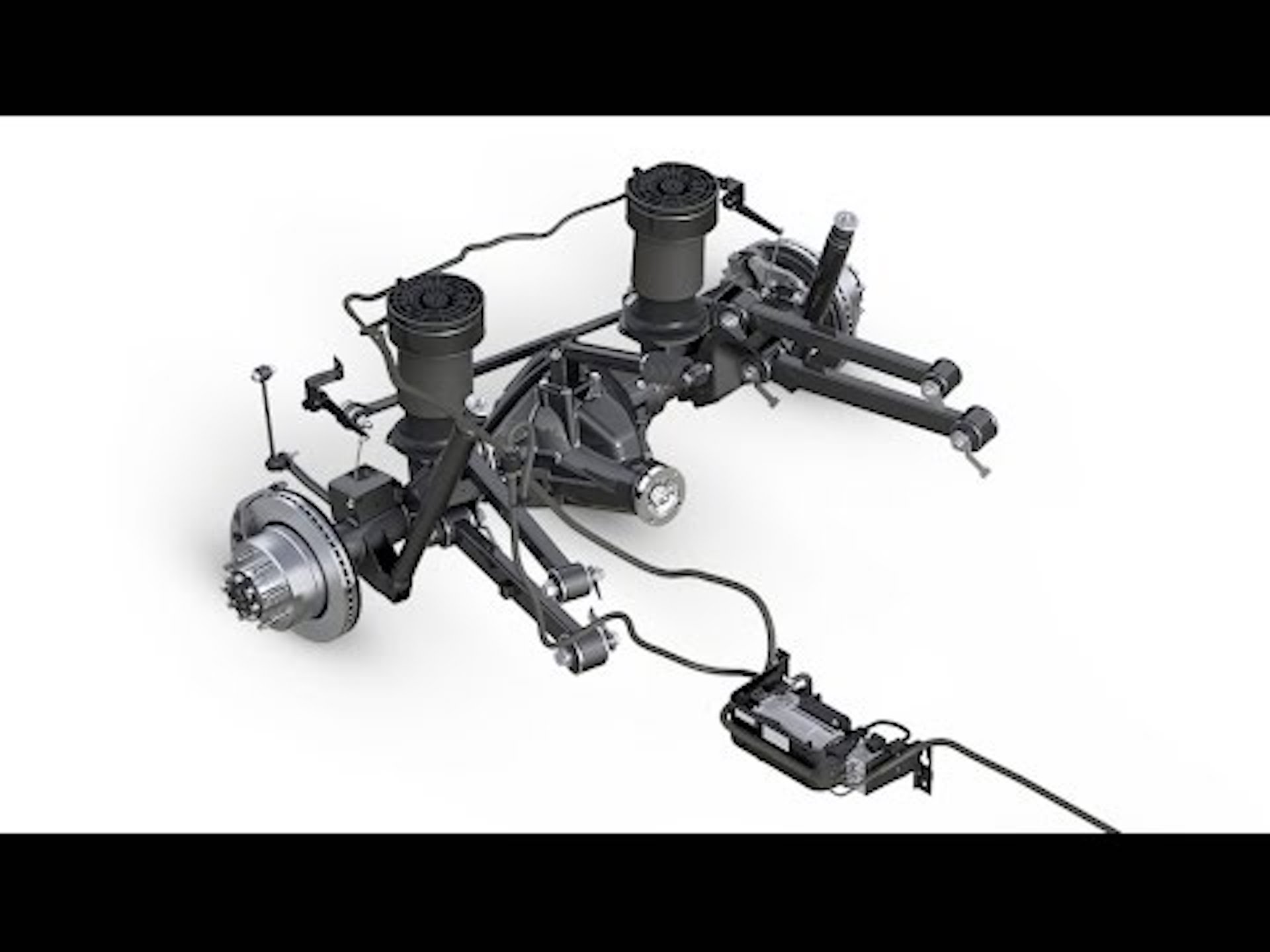
What factors change air suspension spring rates?
Just a week ago, we invited you to come along and learn about air suspension systems. Our friend Jason Fenske at Engineering Explained created a video discussing what air suspension is and how it works. Now he's back with a second video that dives a bit more deeply into the air ride world. This...
Victory_Overland
Explorer
You missed the point brotatochip; I agreed with you on constant but since you are so inclined, take a seat cuz school is in session!
Your example is from an airbag suspension that is not changing pressure for ride quality through electronics; your example, Captain Obvious, is that of a very basic Electronically Controlled Air Suspension (eCAS). I don't need you to regurgitate what a actual smart guy on the internet is telling us about an airbag that it filled up and raised and lowered and how volume works with pressure or given constant; that guy, unlike you, actually knows what he is talking about and what kind of system he is referencing. Since you obviously have been Googling a bit to prove me wrong, you would notice these eCAS systems have been around since the early 90's and RR actually used the Dunlop eCAS system on their first version RR.
Now, let's roll into this decade since you are clearly still stuck in the early 90's. The current LR and RR change pressure in the bags to control spring rates in the various "special programs" they offer; this is called a "Semi-Active Suspension Control System. A semi-active suspension is generally controlled through switch, a dial, or some sort of manually selected control that tells the computer what setting the user wants and then the computer does it. Similar to the eCAS which changes ride height, the semi-active control uses computer controlled valving to tune the suspension in specific settings to optimize performance for that specific setting or environment. Semi-active suspension controls such as the one in your LR3 allow the user to select what suspension mode they want by turning of the little shiny knob and then, the computers (ECU) set the pressure, volume, and electronic valving to the performance setting that the vehicle is pre-programmed and capable of. So, smart guy, the same exact system that is in your LR3, coincidently enough is also in the same year RR Sport. How does the RR Sport get SPORT MODE you ask? Through the semi-active suspension that JLR installed in both vehicles which allows them to electronically change how they want the suspension to act in a certain mode in a different vehicle. Does the RR Sport have a different suspension, NOPE, but the ECU flash and the hardware (special programs panel,) that allows SPORT MODE are put in that vehicle to work with the other hardware to make SPORT MODE, well, SPORT MODE; don't forget they added those nice and tight bushings in the control arms too. Examples you ask; look at your Special Programs dial on your LR3: SPORT MODE, OFF-ROAD MODE, NORMAL MODE! In the past, these systems operated as a standard eCAS and generally just raised height control of the suspension. Now we have cross-linking, traction control, ABS, and all the other bells and whistles tied into those smart little computers that smart guys like in your video designed to what we call Semi-Active Suspension; and in some cases Stability Control and Augmentation Systems which is something that Ford is planning for in the Bronco. There are lots of little things going on in the background and multiple systems working together to apply more travel here, more compression there, less wheel spin here, brake here, and blah blah blah. These are interfaces that you are clearly not aware of in modern suspension and traction control systems.
Are you still with me young Jedi? A Fully Active Suspension Control System is something that you might find in say a Bugatti, Ferrari, and I don't know Indy Cars, F1 cars. The car's software, hardware are computing in autonomous nature the various readings from the hundreds of sensors placed throughout the vehicle that measure wheel spin, G's, velocity, braking, speed, steering wheel angle, etc and then the computer does its magic and AUTOMATICALLY tunes the suspension without any function of the operator; it uses sensor inputs and outputs, parameters, and then algorithms to pull the rabbit out of the hat. It is said that today's F1 cars and GP bikes are impossible to control without the active suspension and traction controls put in place; all of which the driver/rider has absolutely no control over. However, these active systems are designed to work in unison with the operator so the vehicle's response is that of what the operator desires; hence putting the operator in control with thousands of activities going on in the background.
Cruise control is a form of "Semi-Active Autopilot"; push a button and the computer will maintain what it is told to do at a specific parameter. To change it, you must tell it what to do! Don't forget to steer and brake on your own! Have you heard of "Active Cruise Control"? I'll let you take a stab at that one and see if you can WOW us with your Google Knowledge.
Tesla Autopilot is what you call an "Active Autopilot"; push a button and the computer will actively drive the vehicle with no impute from the operator.
And then there are aircraft "Active Autopilots"; these systems will blow your mind on what they can do and how well they do it in a 3 dimensional environment.
Try finding a better example on your wikipedia and google searches that articulate sound knowledge of how semi-active systems in modern vehicles are actually designed. Just because the dial and name of the special program didn't change, doesn't mean the innovation, software, hardware, and performance interface of the systems didn't change. These Rovers do far more than raise and lower the volume in the bags when you turn that little dial Amigo!
I tried to keeping some of the definitions and explanations in simple terms so I hope I you understand the wave top views of passive and active systems for the rest of the forums you are spitting your knowledge on.
We can elaborate anytime you want to get more into specifics. Try a better Google search next time and read it before you post it!
No hard feelings man; you just make it too easy sometimes!
Your example is from an airbag suspension that is not changing pressure for ride quality through electronics; your example, Captain Obvious, is that of a very basic Electronically Controlled Air Suspension (eCAS). I don't need you to regurgitate what a actual smart guy on the internet is telling us about an airbag that it filled up and raised and lowered and how volume works with pressure or given constant; that guy, unlike you, actually knows what he is talking about and what kind of system he is referencing. Since you obviously have been Googling a bit to prove me wrong, you would notice these eCAS systems have been around since the early 90's and RR actually used the Dunlop eCAS system on their first version RR.
Now, let's roll into this decade since you are clearly still stuck in the early 90's. The current LR and RR change pressure in the bags to control spring rates in the various "special programs" they offer; this is called a "Semi-Active Suspension Control System. A semi-active suspension is generally controlled through switch, a dial, or some sort of manually selected control that tells the computer what setting the user wants and then the computer does it. Similar to the eCAS which changes ride height, the semi-active control uses computer controlled valving to tune the suspension in specific settings to optimize performance for that specific setting or environment. Semi-active suspension controls such as the one in your LR3 allow the user to select what suspension mode they want by turning of the little shiny knob and then, the computers (ECU) set the pressure, volume, and electronic valving to the performance setting that the vehicle is pre-programmed and capable of. So, smart guy, the same exact system that is in your LR3, coincidently enough is also in the same year RR Sport. How does the RR Sport get SPORT MODE you ask? Through the semi-active suspension that JLR installed in both vehicles which allows them to electronically change how they want the suspension to act in a certain mode in a different vehicle. Does the RR Sport have a different suspension, NOPE, but the ECU flash and the hardware (special programs panel,) that allows SPORT MODE are put in that vehicle to work with the other hardware to make SPORT MODE, well, SPORT MODE; don't forget they added those nice and tight bushings in the control arms too. Examples you ask; look at your Special Programs dial on your LR3: SPORT MODE, OFF-ROAD MODE, NORMAL MODE! In the past, these systems operated as a standard eCAS and generally just raised height control of the suspension. Now we have cross-linking, traction control, ABS, and all the other bells and whistles tied into those smart little computers that smart guys like in your video designed to what we call Semi-Active Suspension; and in some cases Stability Control and Augmentation Systems which is something that Ford is planning for in the Bronco. There are lots of little things going on in the background and multiple systems working together to apply more travel here, more compression there, less wheel spin here, brake here, and blah blah blah. These are interfaces that you are clearly not aware of in modern suspension and traction control systems.
Are you still with me young Jedi? A Fully Active Suspension Control System is something that you might find in say a Bugatti, Ferrari, and I don't know Indy Cars, F1 cars. The car's software, hardware are computing in autonomous nature the various readings from the hundreds of sensors placed throughout the vehicle that measure wheel spin, G's, velocity, braking, speed, steering wheel angle, etc and then the computer does its magic and AUTOMATICALLY tunes the suspension without any function of the operator; it uses sensor inputs and outputs, parameters, and then algorithms to pull the rabbit out of the hat. It is said that today's F1 cars and GP bikes are impossible to control without the active suspension and traction controls put in place; all of which the driver/rider has absolutely no control over. However, these active systems are designed to work in unison with the operator so the vehicle's response is that of what the operator desires; hence putting the operator in control with thousands of activities going on in the background.
Cruise control is a form of "Semi-Active Autopilot"; push a button and the computer will maintain what it is told to do at a specific parameter. To change it, you must tell it what to do! Don't forget to steer and brake on your own! Have you heard of "Active Cruise Control"? I'll let you take a stab at that one and see if you can WOW us with your Google Knowledge.
Tesla Autopilot is what you call an "Active Autopilot"; push a button and the computer will actively drive the vehicle with no impute from the operator.
And then there are aircraft "Active Autopilots"; these systems will blow your mind on what they can do and how well they do it in a 3 dimensional environment.
Try finding a better example on your wikipedia and google searches that articulate sound knowledge of how semi-active systems in modern vehicles are actually designed. Just because the dial and name of the special program didn't change, doesn't mean the innovation, software, hardware, and performance interface of the systems didn't change. These Rovers do far more than raise and lower the volume in the bags when you turn that little dial Amigo!
I tried to keeping some of the definitions and explanations in simple terms so I hope I you understand the wave top views of passive and active systems for the rest of the forums you are spitting your knowledge on.
We can elaborate anytime you want to get more into specifics. Try a better Google search next time and read it before you post it!
No hard feelings man; you just make it too easy sometimes!
Last edited:
EricTyrrell
Expo God
You missed the point brotatochip; I agreed with you on constant but since you so inclined, take a seat cuz school is in session!
Your example is from an airbag suspension that is not changing pressure for ride quality through electronics; your example Captain Obvious is that of an Electronically Controlled Air Suspension (eCAS). I don't need you to regurgitate what a actual smart guy on the internet is telling us about an airbag that it filled up and raised and lowered and how volume works with pressure or given constant; that guy, unlike you, actually knows what he is talking about and what kind of system he is referencing. Since you obviously have been Googling a bit to prove me wrong, you would notice these eCAS systems have been around since the early 90's and RR actually used the Dunlop eCAS system on their first version RR.
Now, let's roll into this decade since you are clearly still stuck in the early 90's. The current LR and RR change pressure in the bags to control spring rates in the various "special programs" they offer; this is called a "Semi-Active Suspension Control System. A semi-active suspension is generally controlled through switch, a dial, or some sort of manually selected control that tells the computer what setting the user wants and then the computer does it. Similar to the eCAS which changes ride height, the semi-active control uses computer controlled valving to tune the suspension in specific settings to optimize performance for that specific setting or environment. Semi-active suspension controls such as the one in your LR3 allow the user to select what suspension mode they want by turning of the little shiny knob and then, the computers (ECU) set the pressure, volume, and electronic valving to the performance setting that the vehicle is pre-programmed and capable of. So, smart guy, the same exact system that is in your LR3, coincidently enough is also in the same year RR Sport. How does the RR Sport get SPORT MODE you ask? Through the semi-active suspension that JLR installed in the vehicle which allows them to electronically change how they want the suspension to act in a certain mode. Does the RR Sport have a different suspension, NOPE, but the ECU flash and the hardware (special programs panel,) that allows SPORT MODE are put in that vehicle to work with the other hardware to make SPORT MODE; SPORT MODE. Example: SPORT MODE, OFF-ROAD MODE, NORMAL MODE! In the past, these systems operated as a standard eCAS and generally just raised height control of the suspension. Now we have cross-linking, traction control, ABS, and all the other bells and whistles tied into those smart little computers that smart guys like in your video designed to what we call Semi-Active Suspension and sometimes Stability Control and Augmentation Systems; lots of little things going on in the background and multiple systems working together to apply more travel here, more compression there, less wheel spin here, and blah blah blah. These are interfaces that you are clearly not aware of.
Are you still with me young Jedi? A Fully Active Suspension Control System is something that you might find in say a Bugatti, Ferrari, and I don't know Indy Cars, F1 cars. The car's software, hardware are computing in autonomous nature the various readings from the hundreds of sensors placed throughout the vehicle that measure wheel spin, G's, velocity, braking, speed, steering wheel angle, etc and then the computer does its magic and AUTOMATICALLY tunes the suspension without any function of the operator; it uses parameters and then algorithms to pull the rabbit out of the hat.
Try finding a better example on your wikipedia and google searches that actually compare to an electronically controlled air suspension that changes for performance measures and not just ride height; i.e Semi-Active Suspension Systems.
Cruise control is a form of "Semi-Active Autopilot"; push a button and the computer will maintain what it is told to do at a specific parameter. To change it you must tell it what to do!
Tesla Autopilot is what you call "Active Autopilot"; push a button and the computer will actively drive the vehicle with no impute from the operator.
I tried to keep it pretty simple in simple terms so I hope I you understand the wave top views of passive and active systems.
We can elaborate anytime you want to get more into specifics. Try a better Google search next time!
You're repeating a common EAS misconception, at great length. The video was for you. Don't take it personally. This topic has come up before, and been corrected before.
Unless you can point to a reference that states otherwise, LR has never implemented a system that modulates airbag pressure dynamically. Again, pressure only changes slightly and briefly with height adjustment, or when leveling for payload changes. Yes, the ECU, compressor, and valves control this. That's obvious, and doesn't change anything stated. The RRS Sport Mode modifies throttle response, transmission shift-points, and on models with Dynamic suspension, modulates shock damping dynamically (perhaps this is what you're referring to). Sport Mode does not have any effect on the EAS system.
howirolla
Campfire Passport
Well I did some things to my project and I’d hate to muck up the EAS argument thread with updates on that but I’m gunna anyway lol
made up a mount for the cb and external speaker
gotta figure out where I wanna mount the antenna and run the coax and that project will be wrapped up.
and now a picture from before the blowout, just for fun

made up a mount for the cb and external speaker
gotta figure out where I wanna mount the antenna and run the coax and that project will be wrapped up.
and now a picture from before the blowout, just for fun
Similar threads
- Replies
- 2
- Views
- 564

- Replies
- 1
- Views
- 585


- Replies
- 2
- Views
- 614


- Replies
- 6
- Views
- 2K