Expedition trailer air conditioning? What to get? Why? Etc. ...

Sid Post

Observer
As most probably know already, I am shopping for a new Expedition Trailer to pull with a Tacoma off-grid off-road with Alaska and the Dempster Highway being the near term goals for this Summer and Fall since my trip planning to Central and South America is currently on hold due to Venezuela being a hot topic right now.

For discussion considerations, I am primarily looking at the Kingdom Campers and Arkto Campers options with a Kimberly Kube somewhere in the distance as my primary picks this morning, subject to change for many reasons due to political turmoil, economic considerations, and fickleness on my part!

So, while I have spent a great deal of my life without air conditioning in the Desert Southwest and in Oklahoma wheatfields during the Summers of my youth, I am getting older, and I despise humidity with high heat like I see a lot these days!

I am debating possibly a 12Vdc Air Conditioning unit to knock the edge off of sweating heavily, with a bit of cooling to possibly a higher output 110Vac option with more total cooling capacity. What I don't want to do is kill my batteries or generally abuse the batteries I will have on board.

What words of wisdom do users have regarding air conditioning an Expedition Trailer in terms of overall costs (not just initial installation costs) and complexities versus the benefits with experience in various parts of the world, or CONUS?

TIA,
Sid
 
We have a 12 volt minisplit, 800w solar, 600ah of storage, and a 50a DC|DC charger. We never have issues running the AC continuously in the summer southwest or having them recharge quickly (solar, DC|DC, or some combo depending on the itinerary).

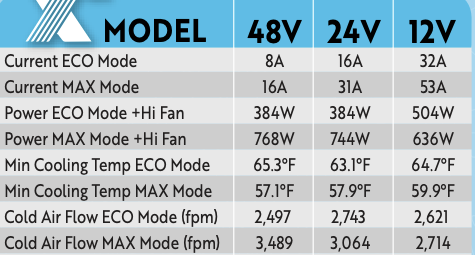
My personal beef with our current 12 volt minisplit is that it is pretty loud; in addition, the total cooling capacity is somewhat limited due to the low voltage. I don’t know if other units are similarly loud although I imagine they are since they all probably originate from the same area. I would suggest moving to 24 or 48 volt for AC. Higher voltage runs at lower amperage - most of the time, that means you can run smaller conductors throughout to save money and weight. However, higher voltage also allows slightly more headroom at the maximum end of operation parameters which essentially adds a little more cooling capacity (or it will cool your space slightly faster, all things being equal). Below is a chart from the Nomadic site. I’m not recommending them, per se - their chart shows that while their units all have the same cooling capacity based on the amount of refrigerant and condenser/evaporator size, the higher voltage units are able to run at a higher wattage. The wattage is the work the device can do.

Screenshot 2026-01-05 at 14.07.43.png

Generators are for poorly designed systems.

Costs are variable but installing AC is easy. So is installing the electrical. I did it all myself and the AC install was one easily one of the easiest phases of the project. Challenges usually arise in the amount of customization needed to get the parts installed into a specific space or constraint.

I would argue you can’t "kill or abuse” a well designed system if you are using it as you designed it to be used.
 
We have a 12 volt minisplit, 800w solar, 600ah of storage, and a 50a DC|DC charger. We never have issues running the AC continuously in the summer southwest or having them recharge quickly (solar, DC|DC, or some combo depending on the itinerary).

My personal beef with our current 12 volt minisplit is that it is pretty loud; in addition, the total cooling capacity is somewhat limited due to the low voltage. I don’t know if other units are similarly loud although I imagine they are since they all probably originate from the same area. I would suggest moving to 24 or 48 volt for AC. Higher voltage runs at lower amperage - most of the time, that means you can run smaller conductors throughout to save money and weight. However, higher voltage also allows slightly more headroom at the maximum end of operation parameters which essentially adds a little more cooling capacity (or it will cool your space slightly faster, all things being equal). Below is a chart from the Nomadic site. I’m not recommending them, per se - their chart shows that while their units all have the same cooling capacity based on the amount of refrigerant and condenser/evaporator size, the higher voltage units are able to run at a higher wattage. The wattage is the work the device can do.

<snip>

I have a lot of personal experience with solar power, especially off-grid applications.

I almost exclusively run 48Vdc battery systems with solar panel runs in series at ~400Vdc or higher to the charge controllers. Small system run ~150Vdc and 24Vdc for the batteries.

Solar solutions other than vehicle voltages are pretty rare unless you do a custom installation. I will stick with either Victron, preferred, or Redarc automotive solutions. It is unlikely I will end up with solar runs from the panels exceeding 40A. From the charge controllers to the battery banks, the runs will be short and properly sized with appropriate bus bars as well. We have a system that will run a steady 600A and surge to well over 1,000A, so wire sizing, cut-offs, etc., are pretty well understood.

Regarding noise and cooling capacity, that depends largely on the Air Conditioning unit and the space you are attempting to cool. Add air tightness (no drafts), insulation from the outside (~R7), the ambient outside temperature, and sun exposure. So many variables, I am simply trying to understand the pros and cons of ~7K BTU 12Vdc units versus larger, higher capacity 110Vac systems. Cooling capacity needs are still under consideration, however, ~7,000 BTUs is probably good for my cooled volume.

My space in the Expedition Trailer is not super large, so a smaller capacity 12Vdc system is probably a reasonable option. In addition to the volume to be cooled, I am also not shooting for 68F either, and an ~80F day would see the windows open with a simple fan running to ensure good venting, if needed.

The other thing often overlooked, is that "IF" your cabinets and other stuff in the trailer are already cool, the Air Conditioner load will be much less than if everything is "Hot" at the start.
 
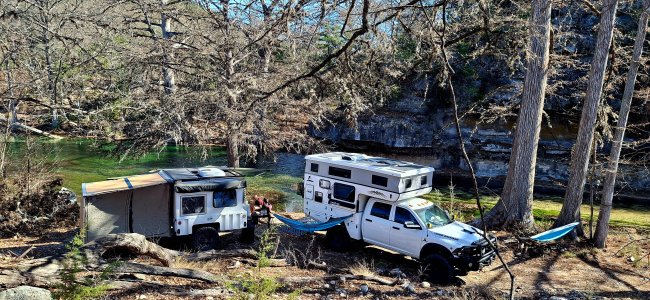
On my kids trailer we currently have a 300ah battery, and 700w of solar on the roof. During summer there has always been enough for them to have AC every time they need it, and sleep at night, recharges to 100% during the days. Never any issues. Its using a Velit 2000, and it has been a great unit.

20260102_130607.jpg
 
Our camper is exactly as you describe - well insulated, airtight, etc. Even our relatively undersized unit has no trouble getting it to the mid-60s in the 100s ambient. We travel in mostly arid climates so it does not have to battle much humidity apart from what we make as occupants (we can be a lot to be fair).

I’d love to hear about your trailer based electrical system that runs at a steady 600 amps. It sounds like will exceed any demand a residential or even commercial system would require.

Anyhow, it is relatively easy to know how many BTUs you’ll need to condition your space. Our experience with 12 volt ACs were offered above - we’d do it again but when that day comes, I’m considering switching to 24 or 48 volts. My advice would be to start there if you choose DC. Residential 110v units are cheaper and easier to find, which is worth something when abroad.
 

Forum statistics

Threads
190,960
Messages
2,930,878
Members
234,813
Latest member
rocksandtrails
Top