ExPo Homebrewers

file-348.jpg
 
Priming

I like to keep about 1.5-2 liters back when I brew to use for priming. Extract from the wort just before adding the yeast, place in a few swing top bottles and keep in a dark place until bottling. It reduces the "cidery" flavour you get when using sugar for priming and makes the finish a fair bit smoother.

I think there is an actual formula for calculating the exact amount you should keep back, based on the OG of the brew, but my batches have all turned out well using the above #'s.

Cheers, and enjoy a homebrew!
 
I've read about using DME for priming and people's opinions seem to be scattered. A lot of people say that is all they ever do because the taste and texture is so much better as you have stated, but a lot of other people say they never do it because it takes so much longer to fully carbonate. But it seems to me like the extra time to carbonate might be an advantage because you normally want your beer to condition for a while to improve quality any way.
 
Priming

I've tried the DME as well, I still prefer using the bottled wort for priming. I leave it all in the primary for 5 days then transfer to a secondary fermenter for up to a month, then add the bottled wort and bottle the brew. I like to let it bottle condition for at least a month anyways, so using the priming sugar doesn't really matter for me. I guess if you really had to have it carbonated in a week it would make a difference, but if speed was a concern, I would just go to the beer store.

Anyways, it's about time for me to start a good cream ale for drinking this spring, and a cloudy wheat beer for the summer. MMMM:chef:
 
Just bottled my Cascadian Dark Ale. Tried a bit of it, and it may be the best I'd done. I used and existing recipe as a guideline, but added more hops and fermented it longer than the original recipe had called for. Part of this was also a bit of an experiment.

I'd been getting some yeast flavors that I had not wanted in my beers. I think it was because I had been fermenting at too cold of a temperature. We moved the carboy into the other room, which we keep warmer, and fermented it longer. At first taste (during bottling), I did't get that yeasty flavor. Let's hope that worked. I have heard of people using a heating pad or electric blanket to keep the carboy warmer during fermentation.

- Andy
 
Just bottled my Cascadian Dark Ale. Tried a bit of it, and it may be the best I'd done. I used and existing recipe as a guideline, but added more hops and fermented it longer than the original recipe had called for. Part of this was also a bit of an experiment.

I'd been getting some yeast flavors that I had not wanted in my beers. I think it was because I had been fermenting at too cold of a temperature. We moved the carboy into the other room, which we keep warmer, and fermented it longer. At first taste (during bottling), I did't get that yeasty flavor. Let's hope that worked. I have heard of people using a heating pad or electric blanket to keep the carboy warmer during fermentation.

- Andy

I've used an electric blanket successfully in the winter to do my lagers in the garage. Going to build a lagering box soon though.
 
My dad uses a chest freezer as a temperature controlled fermentation environment. We put together a temperature controller that has two 110V outlets-one for heat and one for cool. The freezer gets turned down to its coldest setting then plugged into the "cool" side of the controller, then a heating element (plastic sheet with flat copper ribbons in between the layers) plugs into the "heat" side. Set the temperature and the threshold, his goes down to 0.3 degrees, and let the fermentation begin. The freezer is big enough to hold two 5 gallon carboys and two 1 gallon carboys. He was going to add a second unit for lagers, not sure if he has done that yet or not.
 
Well, I've brewed and drank the Whitehouse Honey Porter and it was the best I've made yet. I don't want to say I'm getting bored with extract brewing, I just think I'm ready to move on, so thats what I'm doing. Yesterday I brewed my first all grain batch using the Everyday IPA recipe from the Brooklyn Brew Shop Beer Making Book.
IMG_0957.jpg

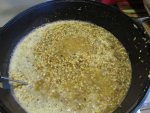
I don't have enough pots that are big enough to mash and sparge and heat up sparging water all at the same time, so I had to break out two dutch ovens for the process. I cleaned out the pots really well and made sure there was no residual oil or anything left in them that might affect flavor or mouth feel.
IMG_0958.jpg

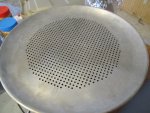
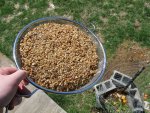
I found a pizza pan at a thrift store that I thought would work really well for evenly distributing the sparge water.
IMG_0959.jpg

A couple of pounds of spent grain for the compost pile.
IMG_0961.jpg

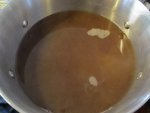
From here on the rest of the process is exactly the same as extract brewing.
IMG_0962.jpg

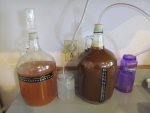
On the left is a batch of hard cider I started a couple weeks ago and is probably ready to be bottled (3 quarts cider, 1 quart water, 9.6 ounces brown sugar, english ale yeast), and the unfermented beer is on the right. Now 24 hours later the froth has gone up into the blow off hose and its fermenting like mad.

Things I learned from my first all grain batch:
1. A whisk is basically useless for stirring your mash.
2. Your mash heats up a lot faster than it cools down.
3. You can never have enough pots and thermometers.

 
Last edited:
I built a little mash tun out of a 2 gallon beverage cooler and that seems to work a lot better. I boiled about 5 quarts of water and prewarmed the mash tun while I heated up my mash water, then proceeded as normal and so far so good. My beer is ready to rack to secondary and should be ready to bottle in a week or so. I'm beginning to see that this is a lot of work for only 1 gallon of beer, so as soon as funds allow I think I'm going to invest in a couple of 3 gallon carboys and a bigger boil kettle so I can use my shiny new mash tun and start doing partial mash brews.

I've also started a second project in fermentation: KOMBUCHA!!! I found a video on youtube about how to start a SCOBY using cultures from a couple bottles of store bought kombucha and did that last week. This pic is how it is today and within another week or so I should be ready to do a full batch. My wife is on a kombucha bender and drinking 1 bottle a day, at $3 a bottle that is pretty expensive. I can make this for pennies, so the savings are obvious.

IMG_1104.jpg

This weekend I'm heading for the hills to pick some local free range huckleberries. I've got some D-47 wine yeast that I want to try using to make a 100% huckleberry must wine. I haven't seen any commercially available huckleberry wines that don't have the majority of it being a sweet rose or white wine so this will be something special. Thats probably because the going cost for a gallon of hucks is about $40 these days so it just wouldn't work for big wineries.
 
Niiice! I'm thinking that once we are moved to a more permanent housing situation I'm going to jump up to a 5 gallon HERMS setup and get into kegging.
 

Forum statistics

Threads
190,877
Messages
2,932,746
Members
234,650
Latest member
mbobhat
Top