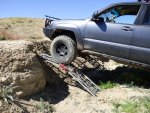
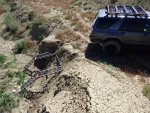
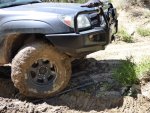
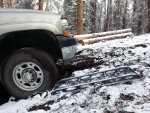
On the other hand of the weight and bulk issue though. So you have to double most other mats to be suitable for bridging but even then don't perform as well. The weight of 4 mats is comparable to a pair of the bridging ladders. Now one can say 4 mats is better than two since in sand it could be beneficial to have one for each tire or the extra length... Well I have never had much issue with front wheels sinking anywhere as near as bad as rear. Few vehicles have an equivalent weight on all 4 tires, most all end up with more on the rear.
The other side of the weight issue is by carrying bridging ladders you can increase the capability of a vehicle. So say you only run 30-31" tires and a mild or no lift. You can supplement that a lot with the bridging ladders and experience to go the same places as somebody with 34" tires and larger lift. The weight savings from having 5 tires 3-4" smaller and much less lift is far greater than the weight of even 4 bridging ladders. Not to mention lower centre of gravity, better fuel efficiency requiring you to haul less weight in fuel, braking and axle impacts of larger tires, etc. etc...
So there is a lot of my motivation. If you just look at bulk and weight numbers it doesn't tell the full story, where if a system is designed and integrated where all the limiting factors are really balanced out you can get a substantial weight savings by building a vehicle where something like these are utilised than overbuilding....