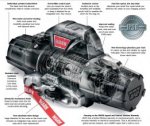
New Warn Zeon

Brian,

I believe Metcalf is not asking about the how the line is secured, but how the winch applies a Brake to the Drum so the line cannot be pulled out. In the current warns this is like a Brake Drum on an old car and is inside the Line Drum. On the Superwinches and some others, there is a conical brake assembly on outside the drum and on the end of the winch near the actuation handle.

Ah right, I was thinking of something else entirely.
I'll find out about the brake.

Regards,
Brian
 
Last edited by a moderator:
Good to see that Warn is moving completely to contactors instead of solenoids. I like the shielded/covered cables as well. Looks like another good choice for a planetary winch.
 
Yup, more concerned about having the brake outside of the drum completely....that is a NICE feature for synthetic line use.
 
Yup, more concerned about having the brake outside of the drum completely....that is a NICE feature for synthetic line use.

Yep, which is another reason I'll be keeping my 34-year-old 8274 instead of buying a new Zeon.
 
Weird, they are not offering the synt. line option in 12K rating. Seems like an oversight for those of us who need the capacity but don't want the weight or issues of steel cable. Guess I stay with my current plan of a Superwinch Talon in 12.5K synt.
 
Weird, they are not offering the synt. line option in 12K rating. Seems like an oversight for those of us who need the capacity but don't want the weight or issues of steel cable. Guess I stay with my current plan of a Superwinch Talon in 12.5K synt.

Some winch manufacturers don't like synthetic line on their large winches due to concern about drum damage. Steel line supports itself better than synthetic and there have been reports of synthetic line damaging drums on 12k and up winches.
 
A follow up on my earlier post and questions regarding the brake.
I came across this diagram in my materials and the brake is an automatic brake located inside the drum.

Screen shot 2012-10-14 at 8.16.53 PM.jpg
 
Is it possible that the heat issue is more of a web wheeling problem than a real world problem? I run amsteel on my xd9000i and have had NO issue with the brake generating enough heat to melt the line, not even close. Last year I had to do a nearly full pull running the winch in reverse because the forward solenoids took a dump. Still not enough heat generated to be concerned about.

Don't get me wrong I'm sure it's possible in the right, extreme circumstances. Brake in drum is a consideration but probably low on my list of priorities.
 
Is it possible that the heat issue is more of a web wheeling problem than a real world problem? I run amsteel on my xd9000i and have had NO issue with the brake generating enough heat to melt the line, not even close. Last year I had to do a nearly full pull running the winch in reverse because the forward solenoids took a dump. Still not enough heat generated to be concerned about.

Don't get me wrong I'm sure it's possible in the right, extreme circumstances. Brake in drum is a consideration but probably low on my list of priorities.

It is an issue, and can cause degradation of line strength, even melting your line, but I don't see it as being as much of a problem as it is made out to be at times. If you don't spool out under power (ie: lowering a broken rig down a hill) then you should be A-OK. With that being said an external brake is better than an internal brake. I love my 8274 on my FJ55 but the M8000 on my FJC hasn't had a problem with synthetic line yet getting too hot.
 
It depends on the winch. Generally powering out with an automatic brake in the drum will cause the most issues. I watched a friend roast some line on a Tabor winch doing just that a few years back.....
 
During one of the field demonstrations a Jeep was winched up a steep incline. After the winch was unloaded I was able to touch the edge face of the winch drum with my bare hand and it was warm but not hot to the touch.
 
If you buy a ZEON with our Spydura synthetic rope (ZEON8-S or ZEON10-S), the rope comes with a heat-resistant sleeve on the first layer to guard against heat.

- Andy
 
During one of the field demonstrations a Jeep was winched up a steep incline. After the winch was unloaded I was able to touch the edge face of the winch drum with my bare hand and it was warm but not hot to the touch.

Most of the heat issues come from winching out, under load, where the brake builds up heat on the inside of the drum. Winching in does not create nearly as much heat.
 

Forum statistics

Threads
190,888
Messages
2,933,012
Members
234,709
Latest member
empireoverlandza
Top