Get your tickets to THE BIG THING 2026!

You are using an out of date browser. It may not display this or other websites correctly.
You should upgrade or use an alternative browser.
You should upgrade or use an alternative browser.
Power systems (fuel) - help me decide
- Thread starter Chorky
- Start date

shade
Well-known member
That would be the trick. I haven't looked into fuel cells much, but one powered by unleaded gasoline would be easier to feed. I think it's pretty cool that 50 years after the moon landing, I can buy a powerful, suitcase sized fuel cell for my camper.Those aren't terribly expensive to operate if you can find a way to get the ultra pure methanol on the cheap. The EFOY branded methanol is crazy expensive.

Chorky
Observer
Out of left field, a methanol fuel cell is another option. Size the battery bank & fuel cell to complement each other, and you could go all-electric, even if solar charging isn't reliable enough, and you want unattended operation (no alternator charging).
If starting from scratch, I really think electrical power is becoming the way forward for everything, with the possible exception of space heating. A powerful LFP battery bank can be carried by even smallish vehicles, and it can be coupled to solar & alternator charging (or fuel cell) to meet most power demands. Especially when solar power is the primary charge source, electrical power comes with no fuel penalty, and it's the most flexible form of power available.
This is quite interesting and intriguing. But does this not seem to further complicate matters? Why not just consider a genset to charge batteries? Aside from the fact these are more efficient of course. I have long wondered when fuel cell tech will reach the automotive market.. It still seems to be years off which is a shame really. I guess with what seems to be a stage of still in development, I would be hesitant to try something so costly.
As for the solar. Yes I agree that solar is a great option, especially if battery banks are built sufficiently. However, I know that solar charging in winter months, when my usage would be highest, would be quite low.
-- Toilet - dump. Our composting toilet needs to dump about once a week.
How do yo like the composting? I've read mixed reviews...
Nothing wrong with LPG, but it gets heavy with the weight of large ASME style tanks. Its also large, as the density of the fuel is lower than diesel.
If you are planning on leaving this rig unattended for long periods, you need to address the risk of a heating failure. This can be with a water system that is tolerant of freezing. This would include lines/fittings which can tolerate it, or a system that will self purge. Or you need some type of backup heat.
This loop would heat all underbody tanks (interior tanks are the most desirable though).
For cooking you could just opt for a portable LPG bottle in a storage box for safety. You could also go with induction, but that requires significant charging/batteries, or a genset running. In the winter solar charging would be signficantly reduced, and getting a lead bank to full several times a week will be challenging without regular shore power. If you went down the route, and plan to keep the cabin warm 95% of the time or more, I would suggest a lithium bank, as that eliminates the rapid degradation a lead bank would see due to abusive partial charge cycling.
The weight and bulk, and danger, of LPG is what makes me wanting to look at another idea, even though it's 'easiest'. I do like the loop idea and already was thinking of something similar. It would be awesome to have a radiant floor heating effect, and also keep tanks/pipes warm in sub zero temps. As for the cooking, I really am thinking that induction/electric for cooking is opening up more complications that will work. In the winter, I basically would have to run a genset every time I cooked. That would probably get a bit annoying. I already plan on having to do so when using a micro - which would be the biggest electrical consumer I have (other than AC in summer). I would hope that the power consumption from 2 12v fridges, a heater (whether it be LPG or diesel), and other normal things, would be 'easy' to manage via solar/genset. Adding induction just seems to require much more robust systems. But, DiploStrat clearly does it and it works great! So I will consider it more before making a decision.
May I ask if any of you utilize the diesel heat, LP cooking, 12v fridge combination, and how well it works? Also, what kind of electrical provisions would be necessary to run a computer frequently? I believe the input (consumption) is 1.3a. But use it extensively between work/fun planning.

DiploStrat
Expedition Leader
...
How do yo like the composting? I've read mixed reviews...
... Also, what kind of electrical provisions would be necessary to run a computer frequently? I believe the input (consumption) is 1.3a. But use it extensively between work/fun planning.
We are on our second camper with a composting toilet - did a lot of work to get rid of the cassette in the 917. "Mixed" reviews? The only bad reviews I have ever heard have been from people who have never actually used one. And yes, that is a snarky comment, but I get a bit tired of people telling me how composting toilet "can't work." After a few years, I confess I have stopped listening. And I will admit to posting a bit too much about this.
Computer? I can't even measure the power needed for a computer. Take care of your refrigerator, heat, maybe your cooktop and you get your computer for free.
All the best.
shade
Well-known member
This is quite interesting and intriguing. But does this not seem to further complicate matters? Why not just consider a genset to charge batteries? Aside from the fact these are more efficient of course. I have long wondered when fuel cell tech will reach the automotive market.. It still seems to be years off which is a shame really. I guess with what seems to be a stage of still in development, I would be hesitant to try something so costly.
I believe you could set up a fuel cell for unattended charging triggered by a battery management system when the battery reached a desired state of charge. A generator could do that, but not at the same size, weight, and noise level. Having another type of fuel to carry would be a complication. Portable fuel cells have been available long enough that their pitfalls should be easy to find with a little research.
Honda has had a fuel cell car available for lease for a few years now.
Vehicle Electrification – Benefits and Technologies | Honda
Discover the advanced technologies and benefits of a Honda electrified vehicle. Compare the stylish and elegant electrified lineup from Honda and take our quiz to see what electrified vehicle is right for you.
 automobiles.honda.com
You say a/c in summer, so do you mean from a genset or batteries? If the latter then all other battery draws will be tiny compared to that!
Our diesel camper will have;
- A composting toilet, so no external black tank or too small cassette.
- An internal grey tank sunk in the insulated floor. This not only hopefully stops the water freezing but keeps shower water heat in the camper. Vented outside of course!
- Room for two but probably just one 12kg propane bottle just for a marine hob+grill, giving six months cooking. So spare heat source too. No oven apart from an omnia, maybe a dutch oven too. Sealed but internal gas locker directly under the hob so minimal plumbing. Externally vented locker of course.
- Espar hydronic heater with calorifier and air blown heat exchangers for camper and cab. No engine connection. I think there's a post here somewhere proving that underfloor heating can't provide enough heat from the floor area available in a camper so you need another source too?
- Modest fridge/freezer 12/24v only. I think compressor fridges can tolerate not being level when parked, lpg/12v ones less so.
- Mains a/c maybe added later depending on solar and battery performance.
- Washing machine from batteries.
- A portable mains induction hob. Cheap, additional cooking space if needed, can use it outside, if the glass top breaks not a deal breaker.
- Whole roof solar.
- Small petrol/gas genny to charge batteries and run a small heater if required. Lithiums I believe can't be charged when very cold.
- 400l of water.
That was pretty much the set up in our last camper which we lived in full time for three years and worked well. That did have external waste tanks which were an issue when cold, as was an Espar without the altitude kit which coked up at and above 1000m altitude. Cleaning out is easy but a faff. We did have a 24v microwave to start with but that was very power hungry so got ditched.
Our diesel camper will have;
- A composting toilet, so no external black tank or too small cassette.
- An internal grey tank sunk in the insulated floor. This not only hopefully stops the water freezing but keeps shower water heat in the camper. Vented outside of course!
- Room for two but probably just one 12kg propane bottle just for a marine hob+grill, giving six months cooking. So spare heat source too. No oven apart from an omnia, maybe a dutch oven too. Sealed but internal gas locker directly under the hob so minimal plumbing. Externally vented locker of course.
- Espar hydronic heater with calorifier and air blown heat exchangers for camper and cab. No engine connection. I think there's a post here somewhere proving that underfloor heating can't provide enough heat from the floor area available in a camper so you need another source too?
- Modest fridge/freezer 12/24v only. I think compressor fridges can tolerate not being level when parked, lpg/12v ones less so.
- Mains a/c maybe added later depending on solar and battery performance.
- Washing machine from batteries.
- A portable mains induction hob. Cheap, additional cooking space if needed, can use it outside, if the glass top breaks not a deal breaker.
- Whole roof solar.
- Small petrol/gas genny to charge batteries and run a small heater if required. Lithiums I believe can't be charged when very cold.
- 400l of water.
That was pretty much the set up in our last camper which we lived in full time for three years and worked well. That did have external waste tanks which were an issue when cold, as was an Espar without the altitude kit which coked up at and above 1000m altitude. Cleaning out is easy but a faff. We did have a 24v microwave to start with but that was very power hungry so got ditched.

luthj
Engineer In Residence
May I ask if any of you utilize the diesel heat, LP cooking, 12v fridge combination, and how well it works? Also, what kind of electrical provisions would be necessary to run a computer frequently? I believe the input (consumption) is 1.3a. But use it extensively between work/fun planning.
I use diesel for air and water heating. I plan on adding some plumbing to my hydronic heater so I can keep my gray water tank from freezing. The rest of my plumbing is inside the heated envelope. I would not use anything but a 12V fride for our usage. The space and weight sacrifices for an LPG fridge would be too significant.
Running a laptop uses between 20-80W on average. Generally its not a problem with a decent solar array. Note that solar arrays are more efficient in lower temperatures. Assuming you have clear skies, and you aren't near the arctic circle, you should be able to get 4 hours of decent solar output, even in the winter. This requires tiltable panels. At 50 degrees latitude, you may need 65 degrees of panel tilt.
Look here for solar estimates for various US locations.
For example.
PVWatts
Estimates the energy production and cost of energy of grid-connected photovoltaic (PV) energy systems throughout the world. It allows homeowners, small building owners, installers and manufacturers to easily develop estimates of the performance of potential PV installations
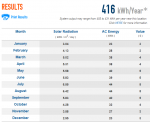
In Billings MT, a 300W premium system tilted at 60 degrees would yield about 900 watt-hours per day in January.
With your needs, it makes sense to use a lithium battery pack, assuming you can keep the interior warm when you need to charge. A lithium pack would charge very quickly from the genset, and will not need long tapering absorb to keep it from dying an early death. It will also take maximum advantage of any solar charging you have available.
Attachments

Joe917
Explorer
Composting toilet, never read a bad review from someone who lives with one. We have lived with ours 5 years.
We have Webasto diesel heat, NovaKool 12v full size fridge freezer and a Smeg propane cooktop. The cooktop is next to go, replacing with induction.
Propane tanks are heavy(we have two 55l tanks,it requires inspections and makes shipping difficult. I do like cooking on propane but for us its not worth it.
The fridge is the biggest draw. In summer it Draws a lot more but we are also making more solar power so it evens out.
If you are going to use a coolant heater the only reason to not connect to the engine coolant is a de-mountable camper, even in that case you can use hydraulic quick disconnects.
We have Webasto diesel heat, NovaKool 12v full size fridge freezer and a Smeg propane cooktop. The cooktop is next to go, replacing with induction.
Propane tanks are heavy(we have two 55l tanks,it requires inspections and makes shipping difficult. I do like cooking on propane but for us its not worth it.
The fridge is the biggest draw. In summer it Draws a lot more but we are also making more solar power so it evens out.
If you are going to use a coolant heater the only reason to not connect to the engine coolant is a de-mountable camper, even in that case you can use hydraulic quick disconnects.
Chorky
Observer
You say a/c in summer, so do you mean from a genset or batteries? If the latter then all other battery draws will be tiny compared to that!
Our diesel camper will have;
- A composting toilet, so no external black tank or too small cassette.
- An internal grey tank sunk in the insulated floor. This not only hopefully stops the water freezing but keeps shower water heat in the camper. Vented outside of course!
- Room for two but probably just one 12kg propane bottle just for a marine hob+grill, giving six months cooking. So spare heat source too. No oven apart from an omnia, maybe a dutch oven too. Sealed but internal gas locker directly under the hob so minimal plumbing. Externally vented locker of course.
- Espar hydronic heater with calorifier and air blown heat exchangers for camper and cab. No engine connection. I think there's a post here somewhere proving that underfloor heating can't provide enough heat from the floor area available in a camper so you need another source too?
- Modest fridge/freezer 12/24v only. I think compressor fridges can tolerate not being level when parked, lpg/12v ones less so.
- Mains a/c maybe added later depending on solar and battery performance.
- Washing machine from batteries.
- A portable mains induction hob. Cheap, additional cooking space if needed, can use it outside, if the glass top breaks not a deal breaker.
- Whole roof solar.
- Small petrol/gas genny to charge batteries and run a small heater if required. Lithiums I believe can't be charged when very cold.
- 400l of water.
That was pretty much the set up in our last camper which we lived in full time for three years and worked well. That did have external waste tanks which were an issue when cold, as was an Espar without the altitude kit which coked up at and above 1000m altitude. Cleaning out is easy but a faff. We did have a 24v microwave to start with but that was very power hungry so got ditched.
The AC would only be used during hot summer days when needing to cool things off for a bit in the afternoon, or after cooking (if inside) and would have to be ran of gen or shore of course. I dont think batteries could even reliably run AC.
You have a washing machine? Wow thats pretty cool... Surprised it runs off batteries though. Curious what kind of rig you are dealing with. Thinking its of the big truck series of options.
I use diesel for air and water heating. I plan on adding some plumbing to my hydronic heater so I can keep my gray water tank from freezing. The rest of my plumbing is inside the heated envelope. I would not use anything but a 12V fride for our usage. The space and weight sacrifices for an LPG fridge would be too significant.
Running a laptop uses between 20-80W on average. Generally its not a problem with a decent solar array. Note that solar arrays are more efficient in lower temperatures. Assuming you have clear skies, and you aren't near the arctic circle, you should be able to get 4 hours of decent solar output, even in the winter. This requires tiltable panels. At 50 degrees latitude, you may need 65 degrees of panel tilt.
Look here for solar estimates for various US locations.
For example.
PVWatts
Estimates the energy production and cost of energy of grid-connected photovoltaic (PV) energy systems throughout the world. It allows homeowners, small building owners, installers and manufacturers to easily develop estimates of the performance of potential PV installationspvwatts.nrel.gov
In Billings MT, a 300W premium system tilted at 60 degrees would yield about 900 watt-hours per day in January.
With your needs, it makes sense to use a lithium battery pack, assuming you can keep the interior warm when you need to charge. A lithium pack would charge very quickly from the genset, and will not need long tapering absorb to keep it from dying an early death. It will also take maximum advantage of any solar charging you have available.
Thank you for the link! Billings is quite a ways east of me. I'm on the western side. Still more sun than my old home are of WA, but quite cloudy so the locals say. I have not been here through a winter yet, but excited to!! Would it not be easier to just put some of your air heater directed toward your water tank? Or is it exposed? I do like that idea, but seems having it enclosed and insulated, just having some of the hot air going that direction would be easier than plumbing more lines. Less chance for leaks or problems as well?
Not long ago I was diehard set on 12v compressor fridge. The one thing that has me guessing that, and the only thing, probably not worth the argument either, is the ability for a LP fridge to run unattended for a good long while. But then again, those darn things are so temperamental. I've had several failures of my LP fridge, and only 2 with the 12v compressor. The only worry is battery bank - but again, it seems like i did math wrong and need to reassess.
Composting toilet, never read a bad review from someone who lives with one. We have lived with ours 5 years.
We have Webasto diesel heat, NovaKool 12v full size fridge freezer and a Smeg propane cooktop. The cooktop is next to go, replacing with induction.
Propane tanks are heavy(we have two 55l tanks,it requires inspections and makes shipping difficult. I do like cooking on propane but for us its not worth it.
The fridge is the biggest draw. In summer it Draws a lot more but we are also making more solar power so it evens out.
If you are going to use a coolant heater the only reason to not connect to the engine coolant is a de-mountable camper, even in that case you can use hydraulic quick disconnects.
I might have been reading old reviews, or reviews from people who were using them wrong. One thought though is how they do bouncing around off highway. Aside from dumping the liquids tank, maybe theres no real issue at all, and was all just subjective comments from using them incorrectly. I do love the idea of not messing with a black tank. I always worry about my current tank cracking, or leaking, or the dump hose ripping apart mid emptying. That would be SO bad.... and a bio hazard for wherever I dumped it too. However, the one benefit is being able to use a mensuration pump to pump the waste into a pit toilet. Then again, I see no reason you can't do the same with a composting unit.
For those that use diesel heat. Would you also consider a diesel 'stove' for quieter heating at night? I have heard, and seen videos, of the diesel heaters/pumps being quite noisy. Never experienced, so not sure if its even an argumentative point. Then again, if using a dual system, not running the heater means not having hot water, and possibly cold/freezing pipes. And, do you notice any functional differences or problems between running summer or winter blend fuels?
I know so many are pro lithium. However, in my situation, knowing they do have sensitivities/dangers to charg/discharg with temperature fluctuations, and knowing I would desire a system that could at least provide the 'house' with heat and fridge operation while gone for a month, would a large led acid bank be a 'safer' way to go? Or would you still opt/recommend for lithium? I also am aware that lithium is more expensive (although a large led bank would probably equal out), is harsher on the environment, and is also not recyclable. I do believe the idea of fragility off highway has been somewhat busted though.
But, if I did decide on the led route, and if considering I will need a genset regardless, and if running a diesel system, would likely opt for a diesel genset to use the same tank, would it be advisable to just set the genset to start and run more frequently as necessary to prevent discharge problems of led's?
As always, thank you for entertaining my questions and sharing your knowledge.
luthj
Engineer In Residence
Gen charging a lead bank will use lots of fuel. It takes 6 hours or more to get to nearly full charge, and another 3 for a true 100%. With short days you will be struggling to get the batteries full regularly with just solar and gen I think. Lithium packs don't need full charges for longevity, and they will soak up all the current your gen has to offer.
If you intend to let your interior freeze, you can opt for pack heaters, or just let the system delay charging until it warms up.
Lithium needs to be above freezing to charge at rates above 0.1C. Discharge is fine when cold. If you need to keep your interior above freezing, it's a non issue. There are even units with built in heaters or you can add your own as backup.
If you intend to let your interior freeze, you can opt for pack heaters, or just let the system delay charging until it warms up.
Lithium needs to be above freezing to charge at rates above 0.1C. Discharge is fine when cold. If you need to keep your interior above freezing, it's a non issue. There are even units with built in heaters or you can add your own as backup.
Joe917
Explorer
It is misleading to say generator charging lead takes a lot of fuel. In the real world nobody (sane) fully charges a lead bank with a generator. A well balanced system will get the batteries back to full charge on solar alone on a daily basis. When you get a few days of sub par solar the generator is used early in the day for bulk charge only. The batteries can be brought the rest of the way by the solar. Lithium is still far more expensive than lead per usable amp hour, Its pros are many but cost is not one of them.
luthj
Engineer In Residence
I agree, but with only 4 hours of decent sun in the winter, and limited in solar wattage, longer gen runtimes will likely be common. 3 hours or more, much of it running at low load. This type of partial cycling usage is the enemy of lead. Now if you are okay with replacing batteries more often, a ~400ah bank using GC2 sized flooded bats is cheap enough to replace every other year.
Have a look at the different outputs from perhaps a 5KW compared to a 9/10KW Espar for instance. The 5 we did have does either full power or half, the 9 we now have will drop down to 1KW. The more heat your system can soak up the less cycling it will do, the start up will eat more current on the glow plug, then run up to max, cycle a bit from full to half to full to half until it decides to shut down for a bit again while the system water pump keeps pumping until the coolant temp drops enough to start again (shower has emptied the calorifier perhaps, or camper air temp has yet to reach that required) My 9 will still do that but I hope will sit at 1 rather than cycling too much. All still a build in progress though. Following some other folks I'm aiming at when it's hot with the sun shining I'll have enough sun to run some sort of domestic a/c a while. If it doesn't work we do have too much solar!
Edited to add- and so the Espar cycling will give you more noise and I think a more annoying noise. You can put two silencers on, or there is a tube type silencer that is supposed to be quieter than the cigarette packet sized ones.
Edited to add- and so the Espar cycling will give you more noise and I think a more annoying noise. You can put two silencers on, or there is a tube type silencer that is supposed to be quieter than the cigarette packet sized ones.
Chorky
Observer
Gen charging a lead bank will use lots of fuel.
It is misleading to say generator charging lead takes a lot of fuel.
Both excellent points - edited to shorten quote length....
Hmm...it almost seems as if a dammed if you do dammed if you dont situation. With lithium, your cost is very high and seems, from my understanding which could be wrong, high maintenance - in terms of monitoring temps when charging. This could be difficult when physically not there to make sure something amiss doesn't happen. Especially for someone who is potentially gone significantly. Which is the case this year for sure, next year who knows. But the need to self sustain is significant. However, with led, it sounds like it would require potentially significant run time of a genset and still not fully charge (which I already knew), which sort of negates the whole battery powered utilities anyway since the cost in fuel and genset maintenance would then skyrocket and also knowing batteries may only last a year or two. This was the partial reason for the argument of a LP fridge (even though I know they have tons of problems themselves, and hardly work half the time). The reality, like luthj said, is in the winter, when charging abilities would be least, and when automated systems would be most required, solar charge time would be at best 4 hours a day. I can only imagine parking in the compound, leaving for work, and the next day a big snow storm hits, fully covering the solar cells meaning zero solar charging for the length of time I'm gone, and temps drop to -20 at night - which is a very real possibility from weather histories I have researched. Which would mean 100% reliance on genset charging for any electrical load. At that rate, the batteries would be sure to be dead when I returned, and likely a genset that has run out of fuel as well, with frozen pipes and interior. Not a good situation.
But as mentioned, another option is to drain tanks, eat up all refrigerated food, and let it all freeze over while gone. However, that would mean taking a long time for things to get unfrozen again for only 5 days of use until the next job of being gone for a month. Which honestly would be super annoying and would make me want to just rent a hotel room at that point even though that would be expensive... So maybe I didnt mention it before, but between work times, I may be 'home' for only up to 5 days, and then gone for another month or so, but theres also no guarantee that work would continue, meaning could very well be essentially laid off for a day, for 6 months, who knows - all due to weather. Sure is difficult having a job that makes you travel so much.
Now, if you did let things freeze over, and used the lithium route, would that in itself cause damage to the batteries so long as you warmed them up prior to charging? Of course that means you would either need to use them to run the diesel heater, or get the genset going for a hour or so until the interior and cubbies are warm.
Last edited:
shade
Well-known member
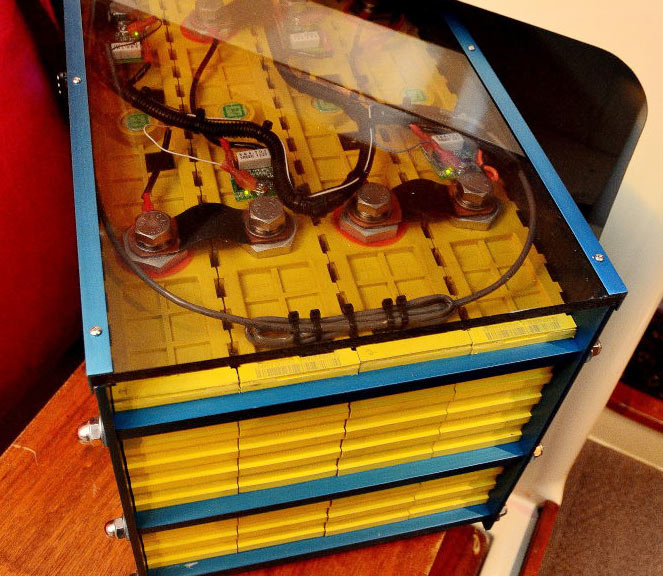
Since LFP batteries are on the table, this is a good primer.
DIY LiFePO4 Batteries On Boats - Marine How To
DIY LiFePo4 On Boats Last edit;3/26/23:The base of this article was written a number of years ago (2010) but this does not mean the information here is outdated. We have been keeping it updated and have added to it when ever we had the time. This article deals
marinehowto.com
Similar threads
- Replies
- 12
- Views
- 815

- Replies
- 31
- Views
- 8K

- Replies
- 5
- Views
- 2K
