

ramblinChet
Well-known member
Solar System Six Month Validation Report
30.Aug.2025 thru 28.Feb.2026
30.Aug.2025 thru 28.Feb.2026
After decades working as a technician, technologist, and engineer focused on mechanical and electrical systems, efficiency, and reliability, I retired and transitioned to full-time overland travel. A key question I had was whether a properly engineered solar power system could sustain daily needs without relying on a generator, shore power, or frequent interventions. The data shows that it can - and reliably so.
To my knowledge, no other full-time overland traveler has publicly documented a continuous six-month period using only solar power across such varied conditions: snow in the Northeast, heavy rain, extended overcast, broken clouds, full sun, dense tree canopy, shadowed backcountry roads, and open routes. I have tracked solar production, energy consumption, battery state-of-charge (SOC), and related metrics month by month, sharing the detailed findings. The average daily consumption over these 182 days was approximately 560 Wh (102 kWh total / 182 days = 0.560 kWh/day). My intent is to provide practical, data-backed information that may assist others in designing or refining their own systems.
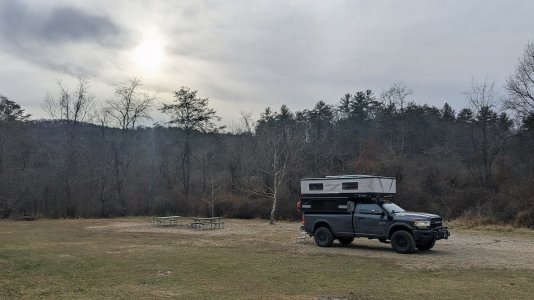
During this period, the solar system supported 4,752 miles of primarily off-pavement travel with no significant issues:
- Mid-Atlantic Backcountry Discovery Route
- PA Wilds Pennsylvania BDR-X
- MABDR-NEBDR Connector
- North East Backcountry Discovery Route
- Trans Maine Overland Trail
- TMOT - East Extension
- Trans-Mass Trail
- Skyline Drive
- South East Backcountry Discovery Route (incomplete)
- Alabama
- Connecticut
- Florida
- Georgia
- Maine
- Maryland
- Massachusetts
- New Hampshire
- New York
- North Carolina
- Pennsylvania
- Tennessee
- Vermont
- Virginia
- West Virginia
The February report is included here as the most recent update.
This report presents the system validation and verification results for my solar power system and battery bank after 182 days of off-grid travel. The sole power source consisted of two 250-watt solar panels (Rich Solar) connected to a solar charge controller (SmartSolar MPPT 100/30) and a 200 Ah battery bank (two LiTime 12V 100Ah Group 24 Deep Cycle LiFePO4 batteries). Neither the AC-DC charger (Blue Smart IP22 Charger 12V-30A) nor the DC-DC charger (Orion XS 12/12-50A) was used during this period. The objective was to evaluate the adequacy of the solar system and battery bank capacity to support off-grid travel demands.
System validation and verification for a vehicle’s solar-based electrical system involves confirming that the setup meets design specifications and performs reliably under anticipated operating conditions. Validation ensures the system addresses the intended purpose (e.g., providing consistent power for off-grid requirements), while verification confirms proper integration and functionality of components. This process is critical for my setup, where approximately 50% of operation occurs under forest canopy (reducing solar input) and 50% in semi-open areas with partial sunlight, enabling early identification of inefficiencies.
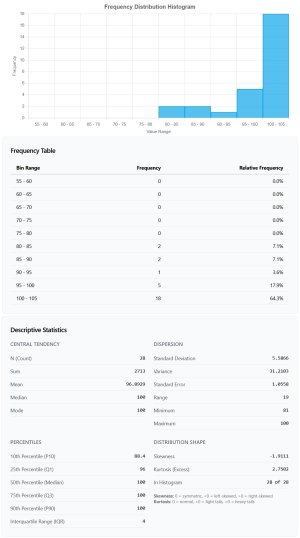
The histogram of maximum daily SOC over the most recent 28 days (February) shows values ranging from 81% to 100%, with 24 days between 90% and 100%. Full charge (100% SOC) was often reached around midday. These results confirm adequate solar capacity under February conditions - one of the lower-yield periods due to shorter days, lower sun angles, and frequent overcast. Performance should improve in March and April as insolation increases. The system met and exceeded the design objective of providing at least seven days of autonomy using solar alone, sustaining operation for the full 182 days.
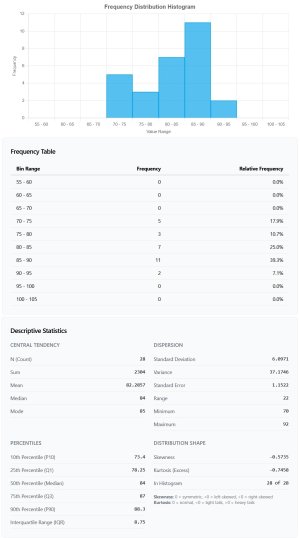
The histogram of minimum daily SOC for the same period ranges from 70% to 92%, with 18 days between 80% and 90%. Minimums typically occurred just before sunrise. The design target was to keep SOC above 25% under normal use; the lowest recorded value of 70% (with all others higher) indicates strong margin and reliable performance.
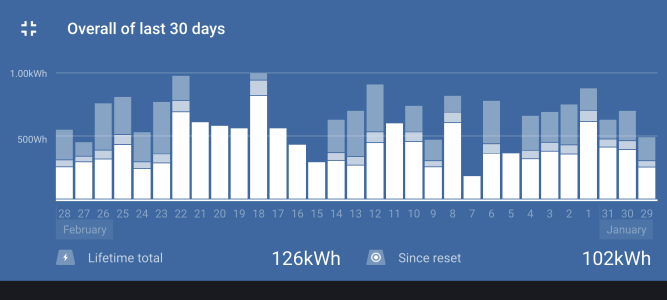
The screenshot below, captured from the Victron Energy solar charge controller, displays the energy collected by the system over the past 28 days. The white portion of each column represents the percentage of time spent in Bulk charge mode, while light blue indicates the Absorption phase and medium blue denotes the Float phase. The data shows that the system reached the Float phase on 79% of the days. This indicates that the system was fully charged for approximately four-fifths of the time.
This period represents one of the lower solar resource times of the year, with reduced exposure duration, oblique rays, and higher chances of overcast skies further diminishing power production from solar panels.
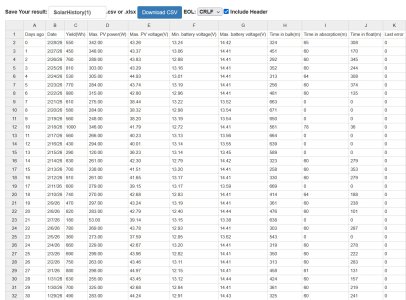
This data is associated with the chart above. I attempted to attach the CSV file to this post for further review but the uploaded file does not have an allowed extension.
Daily consumption averages by month:
- 0.600 kWh/day (18 kWh / 30 days) in September
- 0.516 kWh/day (16 kWh / 31 days) in October
- 0.500 kWh/day (15 kWh / 30 days) in November
- 0.548 kWh/day (17 kWh / 31 days) in December
- 0.581 kWh/day (18 kWh / 31 days) in January
- 0.621 kWh/day (18 kWh / 29 days) in February
- National Luna 80L refrigerator = 100%
- Wallas Nordic DT diesel heater/cooktop = 35%
- Charge laptop (500w inverter) = 35%
- Charge cellular phone = 30%
- Four LED lights inside camper = 25%
- Maxxfan inside camper = 20%
- Charge Bluetooth speaker = 5%
- Operate ExtremeAire Magnum compressor = 0.1%
- Two LED flood lights outside = 0.1%
I will continue periodic monitoring and publish similar updates to track long-term performance against design expectations.
Bottom line: Solar power for full-time off-grid travel relies on sound engineering, appropriate sizing, effective load management, and realistic expectations for variable weather. It performs reliably, even under suboptimal conditions. If you're considering a similar setup, I'm open to discussing details or sharing more data.
If you spot any errors in the report, please let me know with specifics. For questions, check my build/travel thread for answers and picture or simply ask here. Thank you.
Last edited:


