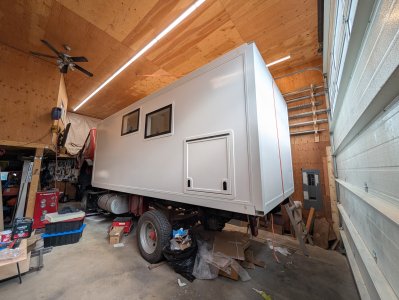
Unicorn on the Ocean - 1120AF Coming to Canada

Very interesting project (I think we can call this a dream project!). I look forward to following along.
You obviously have the skills to get this done.
Please keep documenting, we enjoy watching!
 
I have really enjoyed following this thread! Please continue posting and don't be discouraged by the high number of "lurkers" who don't comment on your work.
Re: interior buildouts, I have seen two options which stood out on forums:
Coosa - https://forum.expeditionportal.com/threads/1993-hiace-firetruck-build-thread.234258/post-3215026
Impressive welded frame - https://forum.ih8mud.com/threads/70...edition-build-frame-off.1275367/post-15981923
(I also really like the airline aluminum drawers)
Then of course you have the "traditional" baltic birch plywood, which would probably not be so exciting for you.
 
I have really enjoyed following this thread! Please continue posting and don't be discouraged by the high number of "lurkers" who don't comment on your work.
Re: interior buildouts, I have seen two options which stood out on forums:
Coosa - https://forum.expeditionportal.com/threads/1993-hiace-firetruck-build-thread.234258/post-3215026
Impressive welded frame - https://forum.ih8mud.com/threads/70...edition-build-frame-off.1275367/post-15981923
(I also really like the airline aluminum drawers)
Then of course you have the "traditional" baltic birch plywood, which would probably not be so exciting for you.
Really interesting ideas, thank you for the motivation and inspiration.

I was thinking about using more metal for interior stuff, especially as I have a good deal on laser cut, cnc formed and powder coated metals. And I actually was wondering about old aeroplane stuff for the "garage" area, light weight, durable, compact. All the right things.

I'm currently leaning towards some kind of lightweight laminated plywood, white up top and grey for the lower cupboards. But I've done zero research on if that's a thing. I'm worried that too much wood will feel dated quickly, it seems wooden interiors do that. Whereas our 87 westfalia with laminated ply and grey trimmings seems modern by comparison to any regular 80s RV.
 
Pre-finished plywood, CNC cut especially, is popular for production cabinetry. It can be bought in a wide range of natural wood finishes, as well as laminate skinned in various patterns/colors. High quality material is light and dimensionally stable (for wood at least). Using bonded and through threaded metal brackets allows for good impact/accident strength, and overall weight can be quite low if you use appropriate thicknesses. I suggest avoid putting backs on the cabinets. They don't need to have full structural strength on their own. Use the attachment to the box, and the box itself to give them the necessary rigidity. This also allows them to flex with the box.

Aluminum/plastic/aluminum composite panels (used for signage often) are light, and decently strong. They can be used for cabinetry. They can be bonded with urethane or epoxy adhesives, but often are attached using fasteners/brackets.

Formed metal cabinetry works just fine. It is a unique look. It can be difficult to rework though. If combined with aluminum extrusions, cabinets can be built up very quickly. If you don't mind exposed fasteners, laser cut aluminum panels combined with extrusions allows for low labor, but strong and adjustable cabinetry. It will be a bit heavier than purpose built aluminum framed cabinets, or well designed wood. Though the difference isn't a problem for most trucks with payload to spare.
 
Last edited:
As a furniture maker I always like seeing "wood" cabinetry in my personal campers. It gives it a cozy feel like home. At the same time it's more sound suppressing and easier to replace if needed. Metal cabinets always remind me of garage tool cabinets...
I just replaced a couple doors in my camper with a different wood decor after (thanks to me stupidness) they got trashed from loose stuff on a 5 hour logging road excursion. Thanks to Ikea, I had 3 replacement doors within a couple days.
If you know how to re-enforce IKEA cabinets they are a very cool and a cost effective way of outfitting your camper... although not lightweight.
One thing to remember when installing any type of cabinets in a Habitat: Always allow for a 4" raiser/kick under your cabinets. That way, in case of a spill (Leaking waterline, spilled dog water bowl etc) your cabinets won't be rotting away/discolour. I build my kicks out of FRP materials and use the 4" voids under the cabinets for heater ducting and for storing items that are rarely needed.
 
Thanks so much @luthj and @Victorian for your insight and ideas. Really helpful to have other perspectives as I rattle around in my own head so much it's quite a mess in there.

Acoustics is really something that is so often overlooked, and being inside one camper that did have metal upper cabinets it was a complaint of theirs. So I am learning away from that. I As much as I don't love woodworking as I'm not typically careful enough and don't have the experience, it does seem like I'm going to have to learn.

I did purchase a Maslow 4 CNC router sled thingy, and a track saw. The Maslow isn't accurate enough for the edge cuts of cabinets, but it can hog out material and make panels much lighter in a neat way.

I will look into the Ikea offerings, it does have a lot of positives. Combined with added strength and removing material where I don't need it perhaps it would be both quicker, cheaper and easier to repair than a fully custom cabinet build. But the dimensions would have to be really close to what I need as I would rather design cabinets around the interior layout I want than a layout that fits standard cabinets.

And a good shout on raising the cabinets. I was considering bonding a waterproof skin onto any cabinets that get within a couple of inches of the floor, but as you suggest perhaps it's smartest to just make a platform out of something waterproof. I should keep electrical connections up higher too! Or at least, waterproof any that are low.

Lots to think about, thanks again for chiming in.
 
With some tuning, and a good frame, the Maslow can be accurate enough I think. Any edge features can be fine tuned by hand typically. Commercial CNC cut panels can be reasonable, or insanely expensive depending your your local supplier.

If you are decent with CAD, you can model entire cabinets with tab/slot features, and holes for fasteners. Then order laser cut and bent brackets for the interior joints that need extra strength. You will have some visible fasteners, but it requires less woodworking skill and materials.

Glued joints between wood parts have pretty low toughness. That is the energy required to bring the joint to ultimate failure. Adding through bolts and metal brackets helps tremendously. Plywood in general can be sufficiently strong with fasteners like that. For areas where even more strength is needed, you can use bonded in metal sleeves to get greater tear out resistance.

For durable finishes, bonded laminate is hard to beat. Heat, chemical, and abrasion resistant to levels higher than powdercoat. Factory bonded laminate is best. However you can bond it yourself, and trim with commonly available tools. This can be done to both metal or plywood with a good surface finish. Edges can then be left bare, or covered with more laminate depending on the look you need.

You can engage a local cabinet builder. One who works with boats will be the best option. They will need to be willing to adjust materials/processes for your build, as you don't want or need the 3/4 plywood (heavy) cabinets they will build for residential applications.

If you want ultralight, but highly custom, you can build skin on frame cabinets. These are build using solid wood frames, skinned with ~1/4" high quality plywood. They are light, strong, and stiff, but time consuming to build. They are somewhat vulnerable to puncture damage on the sheeting of course.
 
The rattling can be brutal. Though 0.070-ish aluminum panels are a bit better than thinner steel etc.
Not so much a rattle, but yes, a plate rattling in a metal cabinet is brutal, it is the overall tin can affect.

If aesthetics rule the day, the euphoria cabinets look excellent.
 
Thanks so much @luthj and @Victorian for your insight and ideas. Really helpful to have other perspectives as I rattle around in my own head so much it's quite a mess in there.

Acoustics is really something that is so often overlooked, and being inside one camper that did have metal upper cabinets it was a complaint of theirs. So I am learning away from that. I As much as I don't love woodworking as I'm not typically careful enough and don't have the experience, it does seem like I'm going to have to learn.

I did purchase a Maslow 4 CNC router sled thingy, and a track saw. The Maslow isn't accurate enough for the edge cuts of cabinets, but it can hog out material and make panels much lighter in a neat way.

I will look into the Ikea offerings, it does have a lot of positives. Combined with added strength and removing material where I don't need it perhaps it would be both quicker, cheaper and easier to repair than a fully custom cabinet build. But the dimensions would have to be really close to what I need as I would rather design cabinets around the interior layout I want than a layout that fits standard cabinets.

And a good shout on raising the cabinets. I was considering bonding a waterproof skin onto any cabinets that get within a couple of inches of the floor, but as you suggest perhaps it's smartest to just make a platform out of something waterproof. I should keep electrical connections up higher too! Or at least, waterproof any that are low.

Lots to think about, thanks again for chiming in.

Working with IKEA is pretty straight forward as most of the kitchen cabinets are based on a systems approach that allows them to be mixed and matched. In my case I combined standard lower drawer cabinets that are 24" deep with 30" deep "fridge" cabinets above to get to the desired overall height. Overall, I would do this again any day.

Here are a couple images. They are about a year old... Since then we have added more decoration :-)
gmc int.01.jpeggmc int.02.jpeggmc int.03.jpeg
 
With some tuning, and a good frame, the Maslow can be accurate enough I think. Any edge features can be fine tuned by hand typically. Commercial CNC cut panels can be reasonable, or insanely expensive depending your your local supplier.

If you are decent with CAD, you can model entire cabinets with tab/slot features, and holes for fasteners. Then order laser cut and bent brackets for the interior joints that need extra strength. You will have some visible fasteners, but it requires less woodworking skill and materials.

Glued joints between wood parts have pretty low toughness. That is the energy required to bring the joint to ultimate failure. Adding through bolts and metal brackets helps tremendously. Plywood in general can be sufficiently strong with fasteners like that. For areas where even more strength is needed, you can use bonded in metal sleeves to get greater tear out resistance.

For durable finishes, bonded laminate is hard to beat. Heat, chemical, and abrasion resistant to levels higher than powdercoat. Factory bonded laminate is best. However you can bond it yourself, and trim with commonly available tools. This can be done to both metal or plywood with a good surface finish. Edges can then be left bare, or covered with more laminate depending on the look you need.

You can engage a local cabinet builder. One who works with boats will be the best option. They will need to be willing to adjust materials/processes for your build, as you don't want or need the 3/4 plywood (heavy) cabinets they will build for residential applications.

If you want ultralight, but highly custom, you can build skin on frame cabinets. These are build using solid wood frames, skinned with ~1/4" high quality plywood. They are light, strong, and stiff, but time consuming to build. They are somewhat vulnerable to puncture damage on the sheeting of course.
I've had some mixed results with the Maslow 4, although it was almost a year ago and I know they're busy with the firmware. I've got some very solid anchors into a concrete slab. It was stretching things in X one way, and in Y the other. Circles were not round, squares were rectangles. But it was consistent, and I think they've added fudge-factors. I also sort of know someone with a 5x10 router table so perhaps I just trailer a stack of materials over to their place one weekend once I have my designs "final". My CAD is certainly stronger than my welding and woodworking, that's for sure. I've leant on that for all of the metal parts so far and they've turned out just how I hoped.

Durable is certainly a major consideration with two kids under 4 and a Labrador! As well as my own inability to be careful with things. I think a balanced weight approach will work for us, we don't need ultra-lightweight but I'd like to avoid massive overkill. Plenty strong without taking months and months to put together. It does also form part of the composite box structure once glued in, so I think ultra-lightweight would run the risk of reducing the overall strength of the unit. If I go for my own custom cabinets, I am leaning towards (if I can get it) a mix of 3/4, 1/2 and maybe even some 3/8 factory bonded laminate panels with the plywood grain exposed on the ends. I need to find a supplier, they probably don't have that many options and I'll have to take what I can get.

Working with IKEA is pretty straight forward as most of the kitchen cabinets are based on a systems approach that allows them to be mixed and matched. In my case I combined standard lower drawer cabinets that are 24" deep with 30" deep "fridge" cabinets above to get to the desired overall height. Overall, I would do this again any day.

Here are a couple images. They are about a year old... Since then we have added more decoration

Thanks Andreas, you've certainly inspired me to go through the Ikea catalogue and have a proper look. I like the idea of just ripping down some parts and reinforcing others without weeks of design and months of sanding! And my design is still "rough" enough that I can shuffle things around a little to accommodate. With the bonus of being able to buy replacements should they be needed without having to store a stock of my custom material.

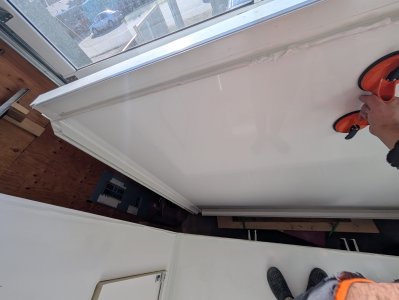
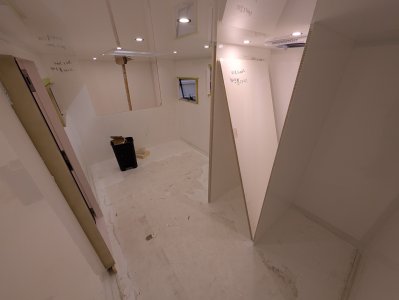
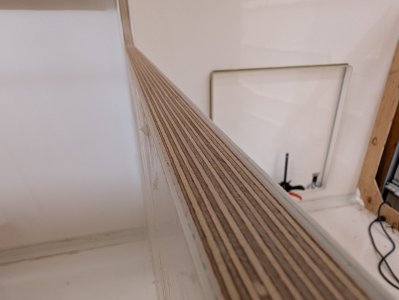
Would you mind sharing more details on the FRP/Plywood laminate you used for the bulkhead and the bed side? Is that the honeycomb core with a 1" plywood inserted and glued along the edge? That was my plan for making a bathroom door and the bulkhead that I got from you with the wall panels, but I haven't quite figured out the best way to do it yet. Whatever you've done, it looks ace.

Thanks again everyone, this is really helpful stuff (and presumably for others too)
 
I've had some mixed results with the Maslow 4, although it was almost a year ago and I know they're busy with the firmware. I've got some very solid anchors into a concrete slab. It was stretching things in X one way, and in Y the other. Circles were not round, squares were rectangles. But it was consistent, and I think they've added fudge-factors. I also sort of know someone with a 5x10 router table so perhaps I just trailer a stack of materials over to their place one weekend once I have my designs "final". My CAD is certainly stronger than my welding and woodworking, that's for sure. I've leant on that for all of the metal parts so far and they've turned out just how I hoped.

Durable is certainly a major consideration with two kids under 4 and a Labrador! As well as my own inability to be careful with things. I think a balanced weight approach will work for us, we don't need ultra-lightweight but I'd like to avoid massive overkill. Plenty strong without taking months and months to put together. It does also form part of the composite box structure once glued in, so I think ultra-lightweight would run the risk of reducing the overall strength of the unit. If I go for my own custom cabinets, I am leaning towards (if I can get it) a mix of 3/4, 1/2 and maybe even some 3/8 factory bonded laminate panels with the plywood grain exposed on the ends. I need to find a supplier, they probably don't have that many options and I'll have to take what I can get.


Thanks Andreas, you've certainly inspired me to go through the Ikea catalogue and have a proper look. I like the idea of just ripping down some parts and reinforcing others without weeks of design and months of sanding! And my design is still "rough" enough that I can shuffle things around a little to accommodate. With the bonus of being able to buy replacements should they be needed without having to store a stock of my custom material.

Would you mind sharing more details on the FRP/Plywood laminate you used for the bulkhead and the bed side? Is that the honeycomb core with a 1" plywood inserted and glued along the edge? That was my plan for making a bathroom door and the bulkhead that I got from you with the wall panels, but I haven't quite figured out the best way to do it yet. Whatever you've done, it looks ace.

Thanks again everyone, this is really helpful stuff (and presumably for others too)
I used full 4x8 sheets our factory custom made for me. Same 1.5mm Lamilux FRP on both sides and marine plywood. Has some weight to it, but worth the look and durability. I treaded the edges with 1/8 radius router, sandpaper and hardwax oil. I used the same materials for the table and it's holding up against scratches etc quite well.

I have a couple extra at my shop if you are interested.
 

Forum statistics

Threads
190,796
Messages
2,931,789
Members
234,541
Latest member
jasper.mullins
Top