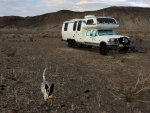
"The Revcon could’ve been built better for the off-road conditions they wanted it to handle."
Haha! You said it!
So one thing I have tried to engineer in as things get repaired, rebuilt, etc. is to make it easy to disassemble and reassemble. Machine screws instead of glue or rivets in strategic places. No hard-to-get-to fasteners. Easily accessed decking or gold drywall screws for straightforward disassembly. Exposed fastener heads (no extraordinary efforts to hide fasteners). Be prepared to re-do things as reality imposes itself. It's called iterative engineering, and it's less stressful to be mentally and physically open to the possibility. Gets ya on the road faster, too. Carry plenty of tools on the road! Every trip will be a shakedown cruise more or less, hopefully less as time and experience go on . . .
BTW when you get to electricals, do not trust the factory wiring or crimp-on lugs. Many bad crimps, and corroded connections could haunt you. While you have the walls off, the investment in re-doing the wiring will pay off. Most of the old wires could be OK to re-use, but they are often routed past sharp edges and screw tips and such.
When it comes to coach power, the Phoenix has (3) parallel 100Ah AGMs, and we have never run out of juice. AGMs are superior for this application. They are sealed, don't leak, and can be deep discharged without being killed. The Phoenix's are charged via a Morningstar controller channeling 200W of solar panels mounted on the front fiberglass cap, or the engine alternator, or from shore power when plugged into AC. It all goes into the controller, each input isolated by diodes, so no overcharging.
Amazon product ASIN B00S1RT58C
But when these crap out (the Morningstar solar controller gives them lots of charging TLC, so that won't be for years, hopefully) I would like to replace with LiFePO4 or something similar if affordable. Lead is heavy!!
The Phoenix has a shunt starter relay to connect the engine and coach batteries together. Under normal conditions, the two power systems, engine and coach, should be isolated so that the engine starting battery is not inadvertently discharged. That's a sticky wicket. However, on really cold mornings the coach batteries could help get the engine started. When the engine is running, closing that relay allows the engine alternator (having a high-capacity aftermarket alternator is a good idea) to charge the coach batteries at a much greater rate than the Morningstar can handle (but it is unmanaged, so to not overdo it, the Phoenix has a dash-mounted high-current meter on the alternator output).
And the generator is started from the coach batteries. Heavy gauge wiring for high currents is a must. I solder my battery lugs onto the heavy wiring - even a fraction of an ohm resistance can be a problem. Circuit breakers will save batteries if battery wire insulation is violated by off-road conditions. Ugly story about how I know...
Ah well, when y'all get back into it, I'm happy to answer questions. Still curious about awning solutions . . .
- Hellwinger