
ramblinChet
Well-known member
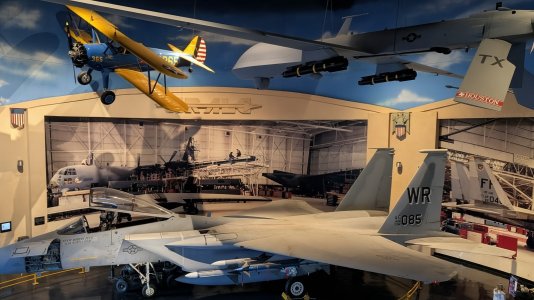
The Museum of Aviation sits right next to Robins Air Force Base in Warner Robins, Georgia. It’s the second-largest U.S. Air Force museum and one of the most visited in the Department of Defense. The 51-acre site includes four climate-controlled exhibit buildings housing over 85 historic Air Force aircraft, missiles, cockpits, and interpretive displays covering more than a century of aviation history. Best of all, admission and parking are free.
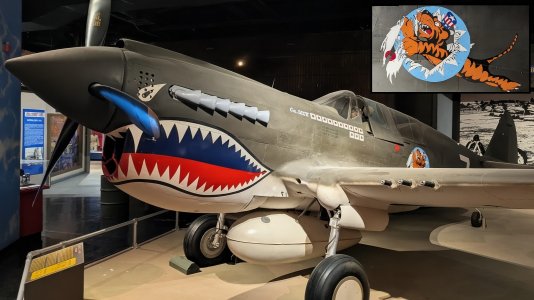
The American Volunteer Group - better known as the Flying Tigers - was a remarkable outfit formed in 1941 with President Roosevelt’s approval to help China defend against Japanese invasion during the Second Sino-Japanese War. It consisted of volunteer American pilots and ground crew (pulled from the Army Air Corps, Navy, and Marines) who flew Curtiss P-40 Warhawks under the Chinese Nationalist Air Force banner. Those P-40s, with their famous shark-mouth nose art and Chinese insignia, racked up impressive combat scores with innovative tactics that played to the aircraft’s strengths in diving attacks and toughness. This pre-Pearl Harbor effort was really an early proxy war: U.S.-authorized, indirectly funded and supported, yet kept at arm’s length to preserve official American neutrality until the war began.
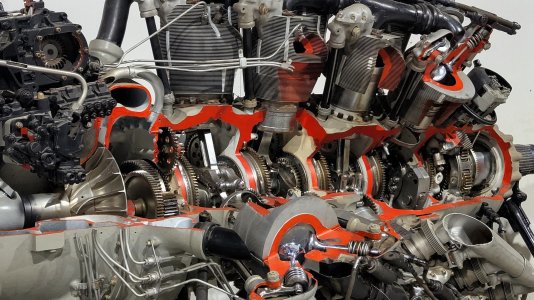
With my mechanical background, I’ve always been pulled toward displays that let you see inside complex machinery. The cutaway of the Pratt & Whitney R-4360 Wasp Major radial engine is a perfect example: it lays bare the 28 air-cooled cylinders arranged in four staggered, semi-helical rows (hence the “corncob” nickname for excellent cooling), along with the big crankcase, geared supercharger, and propeller reduction gearing - all in one clean cross-section. At 4,362.5 cubic inches and up to 4,300 horsepower, this was the largest-displacement piston aviation engine the U.S. ever mass-produced, and it marked the high point of big radial technology from late World War II onward. For someone who still thinks in three dimensions, these sectioned views turn dry specs into something you can almost feel working.
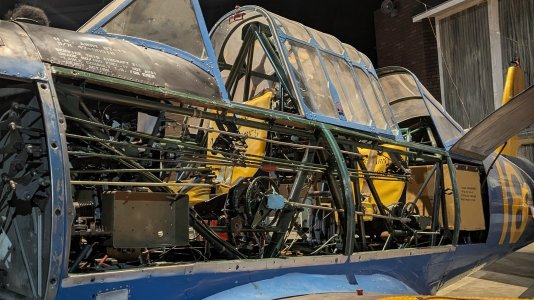
The Vultee BT-13B Valiant has its port-side cockpit panels removed, exposing the complete set of internal control linkages - rods, bellcranks, cables, pulleys, and torque tubes - that carry pilot inputs out to the flight surfaces. It’s a straightforward, rugged mechanical setup, built to hold up under constant vibration and the inevitable rough handling that came with student pilots.
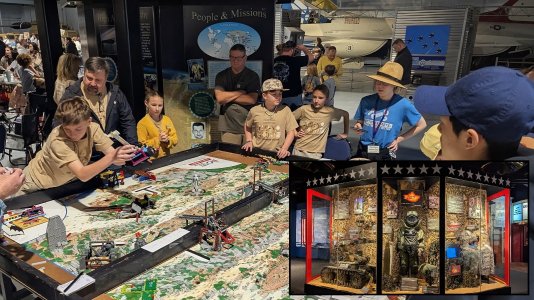
While I was visiting, the museum was hosting a student robotics tournament in the Century of Flight Building. Middle and high school teams showed off their FIRST LEGO League and similar robots, competing on innovation, performance, and core values while tackling engineering and problem-solving challenges. An inset photo shows the Explosive Ordnance Disposal display upstairs, with gear, uniforms, a bomb suit, training munitions, a robot, and photos.
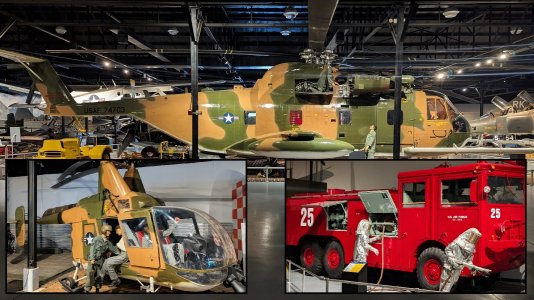
The main shot is of the Sikorsky HH-3E Jolly Green Giant - a tough, heavily armored combat search-and-rescue helicopter best remembered for Vietnam missions under the motto “That Others May Live.” Built on the S-61 airframe, it had self-sealing tanks, defensive guns, a rescue hoist, and in-flight refueling to pull downed crews out of harm’s way. The lower-left inset is the smaller Kaman HH-43F Huskie, a local-base rescue and firefighting bird with its distinctive intermeshing rotors and Fire Suppression Kit. The lower-right inset shows a USAF O-11A Crash Fire Rescue truck - classic ground-support equipment you’d see responding to emergencies on bases.
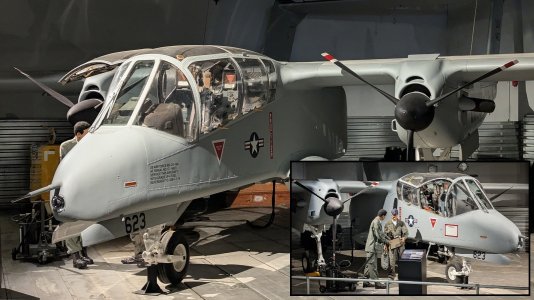
The North American Rockwell OV-10A Bronco is a twin-turboprop light attack and observation aircraft from the 1960s, designed for counter-insurgency and forward air control with excellent short-field performance, a high wing and twin booms, and a big greenhouse canopy for outstanding visibility. Powered by two Garrett T76 engines, it could haul guns, rockets, and bombs while staying agile at low speeds - perfect for Vietnam close air support. I’ve always thought it looked like a really enjoyable machine to fly: small, sporty, responsive, and with that panoramic view it must have felt like a high-performance aerial scout you could toss around the sky with real satisfaction.
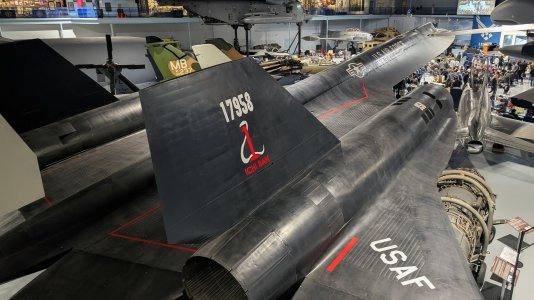
The Lockheed SR-71 Blackbird program, born in the early 1960s at Skunk Works, remains one of the greatest achievements in aerospace engineering for strategic reconnaissance. Its titanium airframe could sustain Mach 3.2+ at altitudes above 85,000 feet, driven by twin Pratt & Whitney J58 turbojets with afterburners and variable inlet geometry, while advanced sensors gathered electronic intelligence and the aircraft’s speed and tiny radar signature made it nearly untouchable. Tail number 17958 was the first operational SR-71A handed over to the Air Force in 1965. The “ICHI BAN” marking - Japanese for “number one” - and the red-and-white tail art of a white Habu snake coiled around a big red “1” were a quiet tribute to the fleet’s mission excellence.
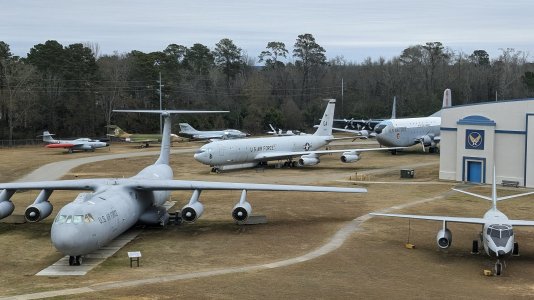
Looking out the back window of the museum, you see several big transport types parked outside, including the swept-wing C-141C Starlifter and the unmistakable C-124C Globemaster II with its clamshell nose. There may be an E-8C Joint STARS in the lineup as well. These outdoor static displays, spread across the 51-acre grounds, trace the long evolution of strategic airlift.
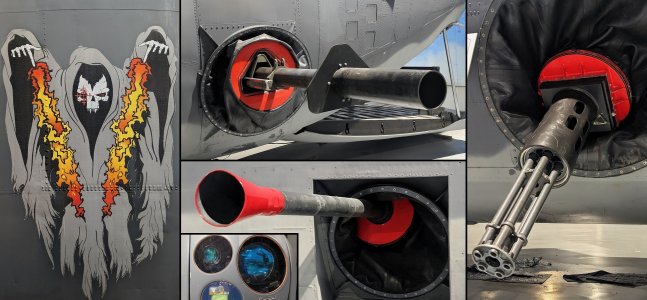
The Lockheed AC-130U Spooky gunship - derived from the C-130 Hercules and known across variants as Spectre, Spooky, Stinger II, or Ghostrider - combines side-firing guns and sensors to deliver precise, persistent close air support. The fuselage section displayed inside the Eagle Building shows the classic armament suite: the GAU-12/U 25mm Gatling for rapid suppression of soft targets, the 40mm L/60 Bofors for anti-armor and area work, and the M102 105mm howitzer for heavy, high-explosive strikes on bunkers and vehicles. All three weapons are synchronized by a fire-control computer so the aircraft can orbit in a pylon turn and pour concentrated fire onto one spot with very little scatter. The optical targeting pod, with its three spherical lenses (infrared, low-light TV, and laser rangefinder), provides day-or-night target acquisition, tracking, and illumination even in poor visibility. The whole system’s strength is its ability to loiter and deliver lethal, accurate firepower while keeping collateral damage low through sensor-guided corrections. I saw this capability up close years ago when I was stationed near Eglin AFB and would regularly drive over to Hurlburt Field, headquarters of Air Force Special Operations Command and home of the 1st Special Operations Wing, to watch AC-130s working the ranges. There was nothing quite like hearing the fast, rhythmic chatter of the 25mm Gatling followed by the heavy, deliberate booms of the 105mm howitzer kicking up dirt plumes, all while the crews sharpened their skills in close air support, interdiction, and armed reconnaissance. It was raw power married to remarkable precision, and it always left a lasting impression.
The American Volunteer Group - better known as the Flying Tigers - was a remarkable outfit formed in 1941 with President Roosevelt’s approval to help China defend against Japanese invasion during the Second Sino-Japanese War. It consisted of volunteer American pilots and ground crew (pulled from the Army Air Corps, Navy, and Marines) who flew Curtiss P-40 Warhawks under the Chinese Nationalist Air Force banner. Those P-40s, with their famous shark-mouth nose art and Chinese insignia, racked up impressive combat scores with innovative tactics that played to the aircraft’s strengths in diving attacks and toughness. This pre-Pearl Harbor effort was really an early proxy war: U.S.-authorized, indirectly funded and supported, yet kept at arm’s length to preserve official American neutrality until the war began.
With my mechanical background, I’ve always been pulled toward displays that let you see inside complex machinery. The cutaway of the Pratt & Whitney R-4360 Wasp Major radial engine is a perfect example: it lays bare the 28 air-cooled cylinders arranged in four staggered, semi-helical rows (hence the “corncob” nickname for excellent cooling), along with the big crankcase, geared supercharger, and propeller reduction gearing - all in one clean cross-section. At 4,362.5 cubic inches and up to 4,300 horsepower, this was the largest-displacement piston aviation engine the U.S. ever mass-produced, and it marked the high point of big radial technology from late World War II onward. For someone who still thinks in three dimensions, these sectioned views turn dry specs into something you can almost feel working.
The Vultee BT-13B Valiant has its port-side cockpit panels removed, exposing the complete set of internal control linkages - rods, bellcranks, cables, pulleys, and torque tubes - that carry pilot inputs out to the flight surfaces. It’s a straightforward, rugged mechanical setup, built to hold up under constant vibration and the inevitable rough handling that came with student pilots.
While I was visiting, the museum was hosting a student robotics tournament in the Century of Flight Building. Middle and high school teams showed off their FIRST LEGO League and similar robots, competing on innovation, performance, and core values while tackling engineering and problem-solving challenges. An inset photo shows the Explosive Ordnance Disposal display upstairs, with gear, uniforms, a bomb suit, training munitions, a robot, and photos.
The main shot is of the Sikorsky HH-3E Jolly Green Giant - a tough, heavily armored combat search-and-rescue helicopter best remembered for Vietnam missions under the motto “That Others May Live.” Built on the S-61 airframe, it had self-sealing tanks, defensive guns, a rescue hoist, and in-flight refueling to pull downed crews out of harm’s way. The lower-left inset is the smaller Kaman HH-43F Huskie, a local-base rescue and firefighting bird with its distinctive intermeshing rotors and Fire Suppression Kit. The lower-right inset shows a USAF O-11A Crash Fire Rescue truck - classic ground-support equipment you’d see responding to emergencies on bases.
The North American Rockwell OV-10A Bronco is a twin-turboprop light attack and observation aircraft from the 1960s, designed for counter-insurgency and forward air control with excellent short-field performance, a high wing and twin booms, and a big greenhouse canopy for outstanding visibility. Powered by two Garrett T76 engines, it could haul guns, rockets, and bombs while staying agile at low speeds - perfect for Vietnam close air support. I’ve always thought it looked like a really enjoyable machine to fly: small, sporty, responsive, and with that panoramic view it must have felt like a high-performance aerial scout you could toss around the sky with real satisfaction.
The Lockheed SR-71 Blackbird program, born in the early 1960s at Skunk Works, remains one of the greatest achievements in aerospace engineering for strategic reconnaissance. Its titanium airframe could sustain Mach 3.2+ at altitudes above 85,000 feet, driven by twin Pratt & Whitney J58 turbojets with afterburners and variable inlet geometry, while advanced sensors gathered electronic intelligence and the aircraft’s speed and tiny radar signature made it nearly untouchable. Tail number 17958 was the first operational SR-71A handed over to the Air Force in 1965. The “ICHI BAN” marking - Japanese for “number one” - and the red-and-white tail art of a white Habu snake coiled around a big red “1” were a quiet tribute to the fleet’s mission excellence.
Looking out the back window of the museum, you see several big transport types parked outside, including the swept-wing C-141C Starlifter and the unmistakable C-124C Globemaster II with its clamshell nose. There may be an E-8C Joint STARS in the lineup as well. These outdoor static displays, spread across the 51-acre grounds, trace the long evolution of strategic airlift.
The Lockheed AC-130U Spooky gunship - derived from the C-130 Hercules and known across variants as Spectre, Spooky, Stinger II, or Ghostrider - combines side-firing guns and sensors to deliver precise, persistent close air support. The fuselage section displayed inside the Eagle Building shows the classic armament suite: the GAU-12/U 25mm Gatling for rapid suppression of soft targets, the 40mm L/60 Bofors for anti-armor and area work, and the M102 105mm howitzer for heavy, high-explosive strikes on bunkers and vehicles. All three weapons are synchronized by a fire-control computer so the aircraft can orbit in a pylon turn and pour concentrated fire onto one spot with very little scatter. The optical targeting pod, with its three spherical lenses (infrared, low-light TV, and laser rangefinder), provides day-or-night target acquisition, tracking, and illumination even in poor visibility. The whole system’s strength is its ability to loiter and deliver lethal, accurate firepower while keeping collateral damage low through sensor-guided corrections. I saw this capability up close years ago when I was stationed near Eglin AFB and would regularly drive over to Hurlburt Field, headquarters of Air Force Special Operations Command and home of the 1st Special Operations Wing, to watch AC-130s working the ranges. There was nothing quite like hearing the fast, rhythmic chatter of the 25mm Gatling followed by the heavy, deliberate booms of the 105mm howitzer kicking up dirt plumes, all while the crews sharpened their skills in close air support, interdiction, and armed reconnaissance. It was raw power married to remarkable precision, and it always left a lasting impression.