
Get your tickets to THE BIG THING 2026!

Hard-Side Truck Camper Nose Aerodynamics

ReluctantTraveler

Well-known member
I've noticed four common nose cap shapes in hard-side truck campers (both commercial and custom built), and I'm curious which one y'all think is the most aerodynamic?
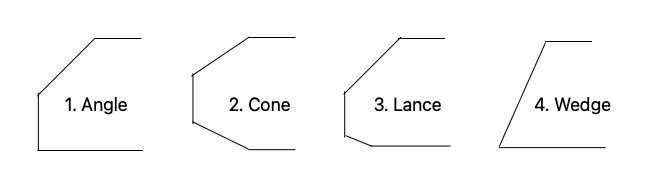
Camper Nose Shapes.jpg

Obviously a hard-side truck camper is always going to add a ton of drag and reduce MPG significantly, but a couple of MPG over the length of a trip or life of a camper can really add up.

I tried to research this, but came up pretty short.

Reference:

  1. Angle is what I see in camper boxes like from Total Composite
  2. Cone is the shape I see from Cascadia Composite
  3. Lance is literally used by Lance Campers
  4. Wedge is common in a lot of older and class C campers
 
Aerodynamics is a 3D issue. The above are just part of the 2D.
None are any good.
My existing is "4", which matches the front of the truck windscreen for aesthetics. Our new build will be "1" which is the whole front of the truck, but it will also be tapered (narrower at the front) but that is primarily to impact fewer trees and bushes, but might improve aerodynamics a touch.

The best way to reduce fuel consumption is to "lift-um foot".
Cheers,
Peter
OKA196 motorhome
 
The best way to reduce fuel consumption is to "lift-um foot".
This article is about trailers rather than campers mounted onto a truck so not everything in here is relevant, but the basic conclusion is the same as yours: the best way to improve aerodynamics is to slow down.


How is your new build coming along? I remember seeing some photos about water tank location/design a year or two ago, but haven’t been following along very closely otherwise.
 
This article is about trailers rather than campers mounted onto a truck so not everything in here is relevant, but the basic conclusion is the same as yours: the best way to improve aerodynamics is to slow down.


How is your new build coming along? I remember seeing some photos about water tank location/design a year or two ago, but haven’t been following along very closely otherwise.
That (lifting off the gas) isn't completely true. A horizontal tear drop shape at the back is proven to improve aerodynamics. Also, I forget what they are called but there are "wind deflectors/channelers" that big rigs use on the back of their trailers (I think I created a post on the topic a while back). The reason it has such a big impact is it eliminates/mitigates air turbulence at the back of the vehicle, which improves overall efficiency and gas mileage.
 
Just ask NASA… Yes, that NASA.

This is a really great, although a bit dated, article on big box truck aerodynamics if you can believe it from NASA. Its based on actual experiments in design on box trucks and 18 wheelers that directly measured drag.

Thought that trailer article you posted is really good too.
 
That (lifting off the gas) isn't completely true. A horizontal tear drop shape at the back is proven to improve aerodynamics. Also, I forget what they are called but there are "wind deflectors/channelers" that big rigs use on the back of their trailers (I think I created a post on the topic a while back). The reason it has such a big impact is it eliminates/mitigates air turbulence at the back of the vehicle, which improves overall efficiency and gas mileage.
The article talked about all of that, actually. It also mentioned that speed has an outsized impact on aerodynamics.

It’s a “both,” not one vs. the other.

And of course, a completely flat front would be far worse than a taper or curve.

The impression I get, though, is that unless you have access to a wind tunnel, and the money to run lots of experiments on lots of prototypes, pinpointing which design is “best“ is pretty much impossible.
 
Just ask NASA… Yes, that NASA.

This is a really great, although a bit dated, article on big box truck aerodynamics if you can believe it from NASA. Its based on actual experiments in design on box trucks and 18 wheelers that directly measured drag.

Thought that trailer article you posted is really good too.
I saw this one discussed in another thread here, a while back.
Thanks for digging it back up. If my memory is correct, they started with essentially a giant box on wheels and made lots of small iterations?
 
The article talked about all of that, actually. It also mentioned that speed has an outsized impact on aerodynamics.

It’s a “both,” not one vs. the other.

And of course, a completely flat front would be far worse than a taper or curve.

The impression I get, though, is that unless you have access to a wind tunnel, and the money to run lots of experiments on lots of prototypes, pinpointing which design is “best“ is pretty much impossible.
I probably should have indicated I did not read the article.

I completely agree with that last statement. My early forays into this surprised me when I discovered wind resistance has a much higher relation to poor fuel mileage than weight. I could tow a flatbed with flat steel at say 6,000 pounds of total weight and get better fuel mileage than My 1,600 pound empty cargo trailer.
 

Forum statistics

Threads
191,311
Messages
2,935,524
Members
235,317
Latest member
5mouse
Top