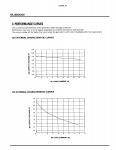
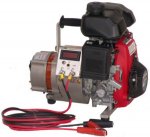
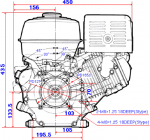
@luthj, is the engine's lb/HPh fuel consumption linear? Honda specs it at 0.51 but doesn't say if that's at maximum HP.
Its probably roughly linear with engine output, at least withing 50-90% of rated. My estimate it pretty rough, as the actual efficiency of these engines varies quite a bit. I would say 1/3gal is likely optimistic based on some quick searching I just did.
Yes I should have specified a inverter type generator with a 120 VAC charger attached.
Forsake of organization let's consider the two most common types first the Flooded Cell and AGM. We can discuss Li later.
The portable alternator as it stands would make a great bulk charger for these two battery types. To carry charging further is going to take like you said a smart regulator or additional hardware. For those of us that might be interested this portable alternator and making full use of it, could some links to the recommended additional hardware be added to the discussion? There are some highly intelligent people in the group that have more knowledge of batteries and charging systems than most of us.
I can see this setup being left unattended and when a complete charge cycle is finished shutting itself off. No need to sit around the camper just to wait to shut the alternator down. A simple isolated relay shorting the spark plug to ground will shut down the motor.
Here is one regulator example.
https://www.amazon.com/STERLING-Pro...ocphy=9009976&hvtargid=pla-570016601165&psc=1
Balmar makes a couple good ones as well.
Honestly if you are just bulk charging, you can just adjust the regulator to about 14.4-14.7V. Assuming the battery bank in question is not terribly small, it should have no problem with 80-100A charge rates initially.
Depending on the alternator being used, you may need to just run the 2 field wires outside the case, and the external regulator does all the work.
As far as auto shutdown, you could easily rig a voltage sensing relay. They are commonly available for industrial applications. Adjust it to kick out the ignition at a certain voltage. If desired, an timer module can be wired together with the VSR, to add a lag to allow proper equalization. Honda uses a transistor controlled ignition, so there is not much risk for a normal relay being driven from the VSR. You could make a simple circuit with a grounding FET and a opto-isolator.
The smart regulators like the sterling drop to float after a charge is complete, you could set the VSR to a low voltage cutout that way.
Alternatively, a simple mechanical timer could be set to ~2 hours to do a bulk charge.
Personally I would make sure the setup in question can output enough voltage for a equalize cycle (assuming flooded lead). As getting a good equalize cycle can be very tough on solar alone, especially in winter.