Supertramp Flagship LT pop-up slide-in pickup camper

A three way switch, added to the overhead light circuit, would be a handy mod.

Our particular Flagship was out before the optional dimmer switch was available. So, when we get into bed, we use little Black Diamond Moji lanterns (an old version) that we always find handy to have around as they are small and dimmable and we lay them in the little trays we use as mini nightstands in the cabover. There is also the light build into the Maxxair fan that is easily reachable from the cabover and we occasionally use that. I don't believe the Dometic RTX2000 has a light, so if you have that rather than the Maxxair, in the cabover, you wouldn't have that option.

Regarding the optional dimmer switch, besides the obvious feature of being able to dim the lights, it also allows you to set a timer for the interior LED lights to turn off automatically after a selected duration.
To set the timer: You press and hold the dimmer switch until it flashes. Each flash adds one minute to the timer. You can set it from 1 to 5 minutes duration by releasing after the desired number of flashes.

We plan to add the dimmer switch, but not sure how often we'll use the timer as the little lanterns are a nice, dim, pleasant light to get settled and we'll likely prefer that over full overhead timed lights flicking off abruptly. Plus, once laying in the cabover, we find the reflected light easier on the eyes than the direct light of the regular ceiling lights or Maxxair fan light.

You can wire in an aftermarket dimmer to the stock single lights switch. Most economical Pulse Width Modulation (PWM) dials will work. We may do that since it's much more economical and I kind of like how that would work better than the optional dimmer switch from STC. With the STC one, I believe every time you turn it on, you have to hold it to ramp the lights up to the desired brightness and also hold it while it dims down to completely off. You lose the immediate click on/click off of the standard switch. If you wire a PWM dial, it will stay at whatever setting/brightness you you leave it at and the main switch will click on and off immediately to that setting/brightness. You splice the PWM dial into the existing light circuit somewhere along it's path, or you could extend a loop to wherever you want to locate the dimmer dial. If you are extending the circuit and wiring in a three way switch, you could wire in a dimmer dial anywhere along that circuit. So you could put it someplace out in the open and handy, or tuck it inside a cabinet and out of the way. Sorry, just kind of thinking as I type on that last paragraph. And I may have just talked myself out of the STC dimmer switch.
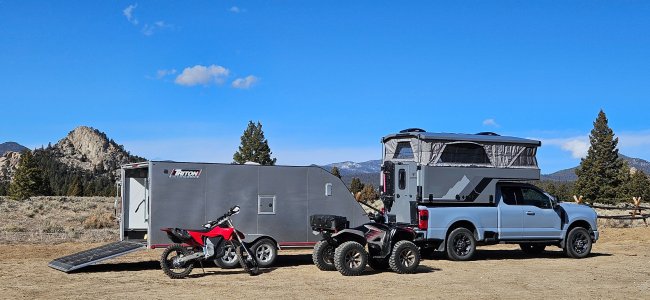
 
Happy Presidents Day to all. Mrs. Chadx had to work, but I had the day off. Montana is not having winter this year, but instead of spending time swapping the trucks little winter tires/wheels back to my summer all-terrains, I went riding. Had both the dirtbike and ATV in the trailer already so brought them both...and road them both. Fun day. It took a great deal of willpower to NOT crawl into the cabover and take a mid-day nap. Ha.

20260216_122112.jpg
 
A three way switch, added to the overhead light circuit, would be a handy mod.

Our particular Flagship was out before the optional dimmer switch was available. So, when we get into bed, we use little Black Diamond Moji lanterns (an old version) that we always find handy to have around as they are small and dimmable and we lay them in the little trays we use as mini nightstands in the cabover. There is also the light build into the Maxxair fan that is easily reachable from the cabover and we occasionally use that. I don't believe the Dometic RTX2000 has a light, so if you have that rather than the Maxxair, in the cabover, you wouldn't have that option.

Regarding the optional dimmer switch, besides the obvious feature of being able to dim the lights, it also allows you to set a timer for the interior LED lights to turn off automatically after a selected duration.
To set the timer: You press and hold the dimmer switch until it flashes. Each flash adds one minute to the timer. You can set it from 1 to 5 minutes duration by releasing after the desired number of flashes.

We plan to add the dimmer switch, but not sure how often we'll use the timer as the little lanterns are a nice, dim, pleasant light to get settled and we'll likely prefer that over full overhead timed lights flicking off abruptly. Plus, once laying in the cabover, we find the reflected light easier on the eyes than the direct light of the regular ceiling lights or Maxxair fan light.

You can wire in an aftermarket dimmer to the stock single lights switch. Most economical Pulse Width Modulation (PWM) dials will work. We may do that since it's much more economical and I kind of like how that would work better than the optional dimmer switch from STC. With the STC one, I believe every time you turn it on, you have to hold it to ramp the lights up to the desired brightness and also hold it while it dims down to completely off. You lose the immediate click on/click off of the standard switch. If you wire a PWM dial, it will stay at whatever setting/brightness you you leave it at and the main switch will click on and off immediately to that setting/brightness. You splice the PWM dial into the existing light circuit somewhere along it's path, or you could extend a loop to wherever you want to locate the dimmer dial. If you are extending the circuit and wiring in a three way switch, you could wire in a dimmer dial anywhere along that circuit. So you could put it someplace out in the open and handy, or tuck it inside a cabinet and out of the way. Sorry, just kind of thinking as I type on that last paragraph. And I may have just talked myself out of the STC dimmer switch.
A small black diamond lantern is exactly what I have been using as well. Ours hangs beside the bed off the ceiling L track. As you said it works fine. I am definitely looking forward to the dimmer switch. Those interior lights are like the sun at night lol.

And yes no light on my AC unit, we rarely use the light on the rear fan but I think the front light would have been handy. Well i guess you can’t have it all.

I’m definitely looking forward to all my coming up grades, end of April is around when I’ll be getting them down.
 
A three way switch, added to the overhead light circuit, would be a handy mod.

Our particular Flagship was out before the optional dimmer switch was available. So, when we get into bed, we use little Black Diamond Moji lanterns (an old version) that we always find handy to have around as they are small and dimmable and we lay them in the little trays we use as mini nightstands in the cabover. There is also the light build into the Maxxair fan that is easily reachable from the cabover and we occasionally use that. I don't believe the Dometic RTX2000 has a light, so if you have that rather than the Maxxair, in the cabover, you wouldn't have that option.

Regarding the optional dimmer switch, besides the obvious feature of being able to dim the lights, it also allows you to set a timer for the interior LED lights to turn off automatically after a selected duration.
To set the timer: You press and hold the dimmer switch until it flashes. Each flash adds one minute to the timer. You can set it from 1 to 5 minutes duration by releasing after the desired number of flashes.

We plan to add the dimmer switch, but not sure how often we'll use the timer as the little lanterns are a nice, dim, pleasant light to get settled and we'll likely prefer that over full overhead timed lights flicking off abruptly. Plus, once laying in the cabover, we find the reflected light easier on the eyes than the direct light of the regular ceiling lights or Maxxair fan light.

You can wire in an aftermarket dimmer to the stock single lights switch. Most economical Pulse Width Modulation (PWM) dials will work. We may do that since it's much more economical and I kind of like how that would work better than the optional dimmer switch from STC. With the STC one, I believe every time you turn it on, you have to hold it to ramp the lights up to the desired brightness and also hold it while it dims down to completely off. You lose the immediate click on/click off of the standard switch. If you wire a PWM dial, it will stay at whatever setting/brightness you you leave it at and the main switch will click on and off immediately to that setting/brightness. You splice the PWM dial into the existing light circuit somewhere along it's path, or you could extend a loop to wherever you want to locate the dimmer dial. If you are extending the circuit and wiring in a three way switch, you could wire in a dimmer dial anywhere along that circuit. So you could put it someplace out in the open and handy, or tuck it inside a cabinet and out of the way. Sorry, just kind of thinking as I type on that last paragraph. And I may have just talked myself out of the STC dimmer switch.

Chad, do you know where ST is installing the dimmer? I assume they are replacing the existing ON-OFF rocker with the Blue Sea dimmer. Thanks!
 
Chad, do you know where ST is installing the dimmer? I assume they are replacing the existing ON-OFF rocker with the Blue Sea dimmer. Thanks!

Yes, the STC solution replaces the existing on/off so it is located in original location. Last I checked, part of the reason for that options pricepoint was because the dimmer switch was only available with a white outer, so, even on a new build, they have to buy both the on/off switch and the dimmer switch and then swap the on/off switch rocker/cover over to the dimmer switch.
 
Yes, the STC solution replaces the existing on/off so it is located in original location. Last I checked, part of the reason for that options pricepoint was because the dimmer switch was only available with a white outer, so, even on a new build, they have to buy both the on/off switch and the dimmer switch and then swap the on/off switch rocker/cover over to the dimmer switch.
Small price to pay to having matching switches. I think my upgrade price is north of $300. Oh well! I can’t wait for all of it!
 
Good call on the upgrades. I had them add an external 12v plug to run a laptop when working outside/12v lights for awning/shower cube/starlink if I want to take it off the roof an move it to spot w/ a clear view of the sky. Would recommend. Also, ask them if they would install a 3 way switch with the dimmer so you can turn off the lights in bed.


View attachment 909219
Can you explain a bit how you can take Starlink off the roof and move it? Did you install that yourself?
A three way switch, added to the overhead light circuit, would be a handy mod.

Our particular Flagship was out before the optional dimmer switch was available. So, when we get into bed, we use little Black Diamond Moji lanterns (an old version) that we always find handy to have around as they are small and dimmable and we lay them in the little trays we use as mini nightstands in the cabover. There is also the light build into the Maxxair fan that is easily reachable from the cabover and we occasionally use that. I don't believe the Dometic RTX2000 has a light, so if you have that rather than the Maxxair, in the cabover, you wouldn't have that option.

Regarding the optional dimmer switch, besides the obvious feature of being able to dim the lights, it also allows you to set a timer for the interior LED lights to turn off automatically after a selected duration.
To set the timer: You press and hold the dimmer switch until it flashes. Each flash adds one minute to the timer. You can set it from 1 to 5 minutes duration by releasing after the desired number of flashes.

We plan to add the dimmer switch, but not sure how often we'll use the timer as the little lanterns are a nice, dim, pleasant light to get settled and we'll likely prefer that over full overhead timed lights flicking off abruptly. Plus, once laying in the cabover, we find the reflected light easier on the eyes than the direct light of the regular ceiling lights or Maxxair fan light.

You can wire in an aftermarket dimmer to the stock single lights switch. Most economical Pulse Width Modulation (PWM) dials will work. We may do that since it's much more economical and I kind of like how that would work better than the optional dimmer switch from STC. With the STC one, I believe every time you turn it on, you have to hold it to ramp the lights up to the desired brightness and also hold it while it dims down to completely off. You lose the immediate click on/click off of the standard switch. If you wire a PWM dial, it will stay at whatever setting/brightness you you leave it at and the main switch will click on and off immediately to that setting/brightness. You splice the PWM dial into the existing light circuit somewhere along it's path, or you could extend a loop to wherever you want to locate the dimmer dial. If you are extending the circuit and wiring in a three way switch, you could wire in a dimmer dial anywhere along that circuit. So you could put it someplace out in the open and handy, or tuck it inside a cabinet and out of the way. Sorry, just kind of thinking as I type on that last paragraph. And I may have just talked myself out of the STC dimmer switch.
I had no idea it had a timer function, I need to try that out thank you.

We went out this weekend. The exposure here makes it look brighter than it is, but it was nice to have the amber backlight. It got down to around 35F and the propane heat kept it nice inside, but the sleeping area does get noticeably colder than the main camper area. I ordered a heated sleeping pad to run off the 12V plug. My hope is that should let me keep the temp on the heater lower overnight while still staying warm while sleeping.
 

Attachments

  • IMG_2199.jpeg
    IMG_2199.jpeg
    56 KB · Views: 9
...We went out this weekend. The exposure here makes it look brighter than it is, but it was nice to have the amber backlight. It got down to around 35F and the propane heat kept it nice inside, but the sleeping area does get noticeably colder than the main camper area. I ordered a heated sleeping pad to run off the 12V plug. My hope is that should let me keep the temp on the heater lower overnight while still staying warm while sleeping.

On the couple of winter trips this year, we resorted to bringing an old electric blanket to preheat our custom mattress. In low temps, the memory foam gets pretty firm. Body heat will soften it up...but so will electric heat. Without the side effect of feeling it suck the heat out of you for the first 10 minutes we are in bed. Ha. We turn it off and remove it before going to bed as we use individual down hammock top quilts (think sleeping bag with no zipper and that opening goes to the bottom. So there is a footbox up to your knees then open back). But it does a nice job of pre-heating and pulls very little power. We click it on setting 1 or 3 a couple hours before bed. Uses hardly any power.

If it's bitter cold, we also drive with the heater on, set to 45F - 50F, so camper isn't totally cold soaked when we arrive at camp. Have considered heated camping pad and might go that route if as we do more winter camping.
 
Fellow Trampers:

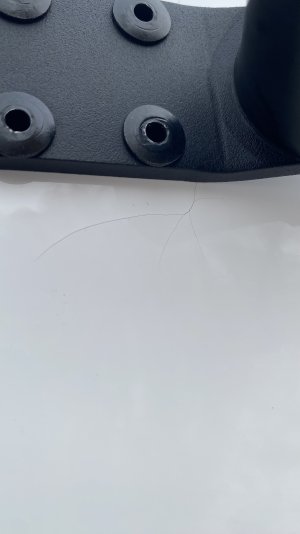
Have any owners of the LT or HT experienced stress cracks directly around the entry door rubber socket metal mounting plate that is riveted to the shell and sub structure? I’ve reached out to STC and for now I’m told that it is normal for settling cracks to occur in the shell. Patiently waiting for more elaboration regarding this issue as it is sent up the chain.

Our barely used LT experienced this cracking at less than a month old. For reference, the flexing occurs at the contact point where the rubber socket’s mounting plate is riveted to the composite shell when the ball is slowly withdrawn from the rubber socket. You can actually see the movement in the composite and metal plate junction by slowly engaging and disengaging the ball and socket. Also, by watching the painted surface reflection, I can confirm movement. The rubber socket’s mounting plate should definitely be a more robust connection to the shell to prevent any movement, possibly a broader plate on the exterior and interior of the shell with a through-bolted connection instead of four pop rivets. At some point during the purchase decision process and inquiring about construction techniques, I remember asking if this camper will develop stress cracking. I was told it would not. I’ll attach some photos for reference. Curious to hear if others are experiencing this.
CheersIMG_4871.jpegIMG_4872.jpeg
 
Fellow Trampers:

Have any owners of the LT or HT experienced stress cracks directly around the entry door rubber socket metal mounting plate that is riveted to the shell and sub structure? I’ve reached out to STC and for now I’m told that it is normal for settling cracks to occur in the shell. Patiently waiting for more elaboration regarding this issue as it is sent up the chain.

Our barely used LT experienced this cracking at less than a month old. For reference, the flexing occurs at the contact point where the rubber socket’s mounting plate is riveted to the composite shell when the ball is slowly withdrawn from the rubber socket. You can actually see the movement in the composite and metal plate junction by slowly engaging and disengaging the ball and socket. Also, by watching the painted surface reflection, I can confirm movement. The rubber socket’s mounting plate should definitely be a more robust connection to the shell to prevent any movement, possibly a broader plate on the exterior and interior of the shell with a through-bolted connection instead of four pop rivets. At some point during the purchase decision process and inquiring about construction techniques, I remember asking if this camper will develop stress cracking. I was told it would not. I’ll attach some photos for reference. Curious to hear if others are experiencing this.
Cheers

@twowheels19 That certainly doesn’t seem normal and, since I've never seen anyone post about cracks there or in other places, I don't think it's common. I looked at where our bracket is mounted and have no cracks at nearly two years old. When I first looked at your pics on my phone, I couldn't really see the detail of the cracks or if it was perhaps limited to a surface coating or in the shell itself. Looking at those images on my home computer, it appears those cracks are in the shell itself and not a coating. When you run your fingernail across them, can you feel them and the cracks are open all the way to the surface with no coating over them? It is fairly common for fiberglass boats and campers to get very fine cosmetic, non-structural surface cracking, called 'crazing', that is only in the gelcoat or clearcoat and not in the fiberglass laminate itself. And it is a random pattern/location and not radiating out from a stress point or penetration like in your example.

Our camper has the gray paint. I don't believe there is any surface coatings (paint or clearcoat) on the white campers. I assumed STC campers have a gelcoat, which are typically applied to the mold surface, but I haven't discussed coatings much with STC. Now I'm curious and will ask when I get the chance. It's common for molded fiberglass to get a gelcoat as part of the molding process, but their are alternatives so not sure what STC uses. White may still get some type of coating post processing; just not the paint of the colored campers. While there is the possibility that a paint or surface coating could remain intact even if hairline cracks occur in the material underneath, I would think in most cases, cracks would present through the paint. When I looked at our camper this morning, I pulled and pushed very hard on the bracket and could not see any flex whatsoever in the fiberglass. I'd be curious to know how much material the pop rivets are sandwiching in that location on a typical camper and if a variance in your particular camper had the rivets sandwich too little material. That could cause a more superficial attachment and, with less supporting material, allow flexing that could lead to cracks. Speculation on my part and perhaps others can chime in regarding their camper exhibiting cracks in this area (or any area) and if they get surface flex from pushing/pulling on their bracket.

The only issue I've run into with our door holder is the two interfacing rubber pieces (ball and socket for lack of better description) are quite loose. They originally seemed to hold well, but now are loose enough that the slightest breeze allows the door to pop loose from the holder and swing. When I'm down in CO in early May, at a friends doing suspension work, I'm stopping by STC anyway to get Phase 2 of the actuator fix performed, so will see if they have replacement door holder rubbers available.
 
Yikes!! That’s the first reported cracking I’ve seen as well. My camper is white and even a little older than @Chadx ‘s camper and mine is completely fine.

I pulled in mine a bit and don’t see any movement. I’ve actually been pretty happy with that as a retention device though i armor all mine so it slides in and out easily.

I’m sorry that happened to you and I hope you get it sorted out. Perhaps there’s a backing plate in that camper in there that isn’t anchored down or something? (Purely speculation).

Good luck and let us know!
 

Forum statistics

Threads
191,256
Messages
2,934,778
Members
235,218
Latest member
MOLLYmaz

Members online

Top