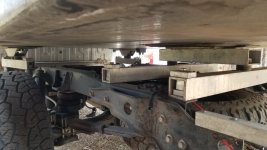
Demountable composite box to flatbed mounting system without pivoting subframe.

@rruff Can you post some photos of your pivoting system? Would love to see what you came up with!!
Here is an old one. The beams are 6061. I used the 8 bed mount locations, with 6 isolators.

PivotingMech_01.jpg


I guess I need a refresher on your system. I thought your box was direct mounted and not removable.
If I take those 8 bolts loose, it'll come right off! :p

But I guess you are looking for something easier. What do you want the bed to be like when the camper is removed?

Montypower did a lot of offroading with a slide in on a F250, and he just used the regular spring loaded tiedowns as I recall... but it was a newer F250 with the boxed frame, so not such a good example.

The tiedown concept is similar to using springs to allow movement between the subframe and the chassis. No reason why it couldn't work.
 
Last edited:
It's important to know what you want to do with the truck and bed with the camper removed. You can make a simple and light system that pivots and supports the camper, but it won't be a "bed" really. If you want double duty it will weigh more. Or maybe you could make a "bed" that mounts to the pivot/support part like the camper, but you only have one on at a time.
 
It's important to know what you want to do with the truck and bed with the camper removed. You can make a simple and light system that pivots and supports the camper, but it won't be a "bed" really. If you want double duty it will weigh more. Or maybe you could make a "bed" that mounts to the pivot/support part like the camper, but you only have one on at a time.
Many years ago I had imagined a system along those lines and I believe others have suggested and or developed similar concepts. A universal tray receiver that accepts campers, utility bodies, truck beds etc. Anything you would want to mount on a truck could be easily swapped on and off. Somewhere in the vein of the roll off dumpster box system.

It appears from Victorian's input and looking at OEV, a regular flatbed for composite boxes 8' and under works fine and a fancy solution isn't required.

Even if not required, it's still fun to throw spitballs. What if a mounting system like OEV's went a step further and incorporated a removable pivot point on the front the camper instead of the 2 hard mount points. The camper would have to have some integral support built in that ties to the mounting point. Think something similar to a fifth wheel hitch type removable coupler. Maybe it could be some brackets attached to the trucks frame that pass through a flatbed where a removable pivot could mount.

Your working prototype mounting system suggests it could be done.

Responding to an earlier question about why someone would remove a camper. One big reason is that on some newer diesel pickup trucks that need service, it is common to remove the cab to get to the engine.
 
Last edited:
The second video shows that they do not have any way of dealing with frame twist... which wouldn't be needed on a boxed frame like that one, but would on C-channel.
 
Victorian's comment about the flat bed adding rigidity might make up for the difference between C channel and boxed frame. All flat beds not being created equal is a factor for consideration.
If a stiff subframe is hard mounted to a C-channel frame, the forward mounting area will see high stress when twisting, at the sudden transition between stiff and not. But... a lot of people seem to get away with this with service bodies, and the frame could be reinforced in this area to help somewhat. I think it's better to let the frame twist as it's designed, though... especially if you'll be on challenging roads. Victorian is more concerned about the TC camper being protected, as he should be.
 
If a stiff subframe is hard mounted to a C-channel frame, the forward mounting area will see high stress when twisting, at the sudden transition between stiff and not. But... a lot of people seem to get away with this with service bodies, and the frame could be reinforced in this area to help somewhat. I think it's better to let the frame twist as it's designed, though... especially if you'll be on challenging roads. Victorian is more concerned about the TC camper being protected, as he should be.
I was thinking about that as well.
I don't know all the various manufacturer's frame configurations. Are Modern GM 2500 and 3500 boxed from the front bumper to the rear of the cab and then switch to C running to the rear bumper?
 
Are Modern GM 2500 and 3500 boxed from the front bumper to the rear of the cab and then switch to C running to the rear bumper?
I think all recent pickup frames are fully boxed... and all cab-chassis frames are C behind the cab. True for domestics and imports in the US.
 
Watch the next 60 seconds of this video:


This is true for every truck frame, unibody car chassis, mountain bike, trophy truck, side-by-side, go-kart, race car and trailer on the planet. A frame/chassis is not suspension, neither is a 3 or 4 point mount. Both are undamped springs.

Focus on proper suspension, instead of frame twist or allowing a 2,000 to 3,000-pound box to flop side-to-side.

Millions of lorries/box trucks travel millions of collective miles each year with U-bolts holding boxes, which often sit on hardwood timbers, to heavy frame rails.

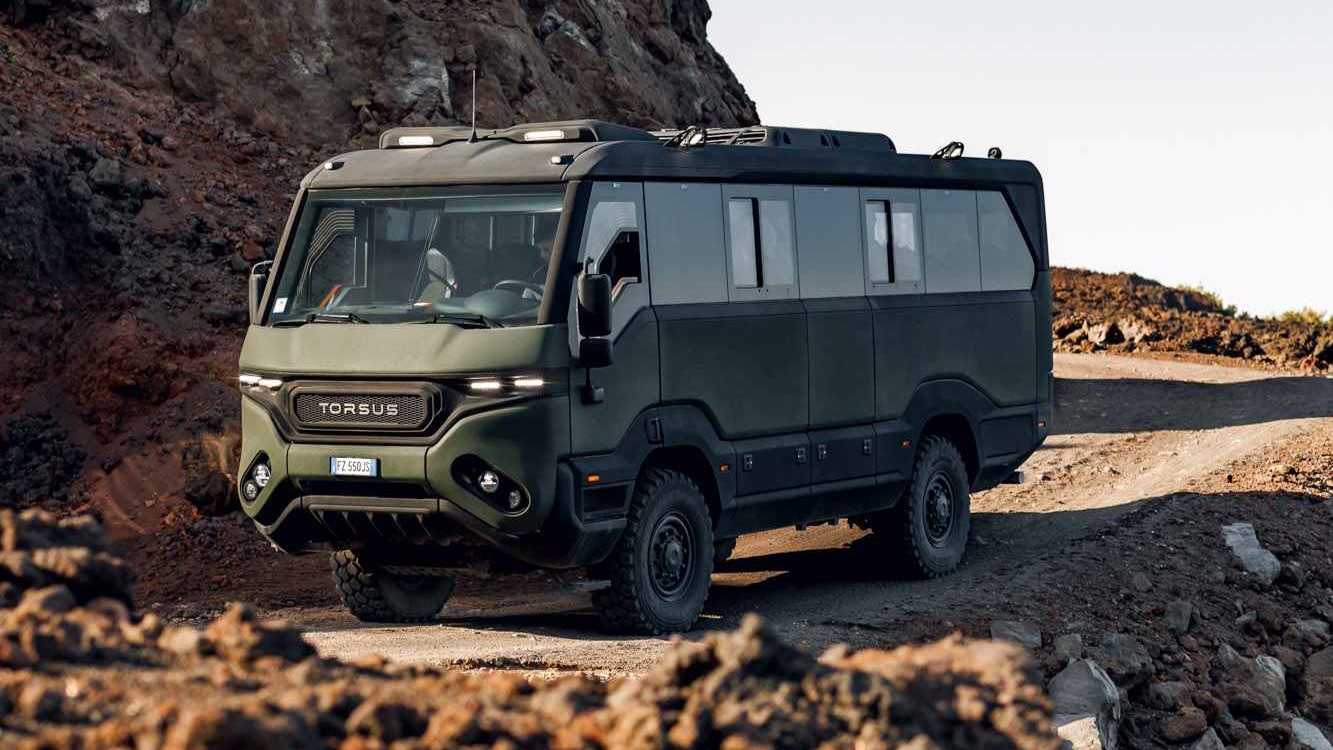
Do LMTV/FMTV or old Deuce and a half type trucks have a 4-point sub frame? Does a bus or motor coach have one? Does a HEMTT, HET, HMWWV, or Caiman/MRAP have one? Does the multi-time Dakar-winning Kamaz Master Team truck have one? How about Torsus' Praetorian?

To the best of my knowledge, not a single one of them does. All of them either carry heavy loads or travel off road, or in some cases, do both.


Don't get caught up in doing what hegemony tells you to do.
 
Your cabin/camper construction really has a lot to do with how much it will put up with, with regard to chassis flex.
And provided you stick to the basic truck camper program, with a traditional 3-point pivot with two pivots up front to limit movement with regards to cab....
You WILL NOT have any side-to-side flopping.

My camper is entirely wood built, stick framed, marine ply & glass. Its awfully tough and terribly rigid, but "delicate"
This setup allows the camper and bed to work together remaining flat (not twisted) as it floats on the 3-point mount.
I would never expect it to provide additional strength to the chassis in order to LIMIT chassis flex.
But nor would I expect ANY sort of camper construction to provide enough strength to do the same.

We run a 2011 Superduty, with the equivalent of a 10' bed. I added about 2' to the rear most frame rails to allow a true 8' bed AND the cross body box.
The frame is much stiffer than previous models, but nowhere near stiff like the fully boxed frames that are used currently.
But looking to run this long term (already have 6 years on this truck & bed)) I would much rather put faith in a heavy duty C-channel frame than a thinner fully boxed frame.

For the record, this camper was built and on the road in 2012 (on old powerstroke). This truck went live with the "new" bed & camper in 2019.

So your mileage may vary, but I would strongly advise a torsion free mount and potentially a pivoting subframe if you are on top of a traditional C-channel frame.
Anything shorter than 6', you are likely okay. But 8' and longer? An absolute YES.

Some photos to show, all photos can be seen here.

Stock stock stock.....
30275073648_8174758468_c.jpg


Pivoting subframe + bed
29352969227_d0ae3158a0_c.jpg


Flex test to check clearances, notice how parallel the bed is to the cab and the lack of parallel of the bed & chassis

44568357485_0af5349d6f_c.jpg


44568358675_c235b7591d_b.jpg
 

Forum statistics

Threads
190,880
Messages
2,929,837
Members
234,743
Latest member
Jlbeats
Top