haven said:I'm concerned about your body mounts. It appears that they are bolted onto the sides of the frame rails in a manner that carries the weight of the camper on the bolts that pass horizontally through the body mount and the frame.
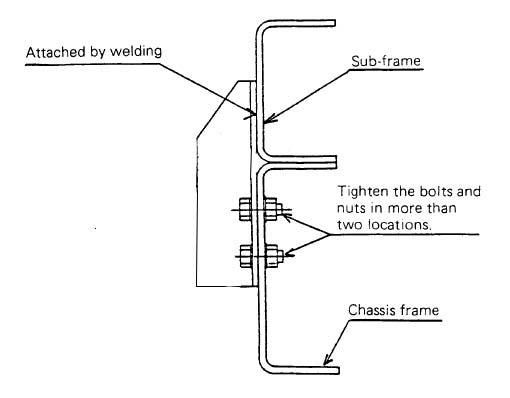
The Mitsubishi body builders guide says the weight of the camper sub-frame should rest on top of the truck chassis. The bolts should position the sub-frame on the chassis, but not be the major load-bearing element
![]()
The company that built Michel Szulc Krzyzanowski's Fuso camper used the bolts are the weight bearing element. The bolts failed after relatively few miles.
I hope I'm mis-interpreting your photos!
Chip Haven
mcgovski said:Doesnt look like you are pretending to me! Nice work. Keep the pics coming!
Question: Are you going to have a portal through from cab to living space?
Looks awesome
haven said:Brent,
Here's how I read the information in the Mitsubishi Body Builders Guide.
Figure 3.1 refers to a bracket that supports an accessory like a second battery or a gas tank. The weight of the accessory attached to the bracket exerts force on the threads of the bolt. That's why the bolts are described as under tension.
Figure 3.2 shows how you're supposed to attach the subframe that supports the truck body. Here most of the weight of the subframe is resting on the truck chassis. But some weight is carried on the shaft of the bolt, creating a shearing force.
Section 4.4 of the Body Builders Guide says that if you can't use U-bolts to hold the subframe to the truck chassis, then you're supposed to use a setup like Figure 3.2.
I hope you're correct that enough of the weight of the camper subframe will be carried by other points of attachment, making the Grade 8 bolts strong enough to carry the rest of the load. I suggest closely monitoring the bolts to see if they are starting to score or bend.
Chip Haven
ntsqd said:Brent, I gather that you have already or plan to torque those bolts? I don't discount the value of friction induced by a torqued bolt pattern. Flywheels in general would never stay on if it were strictly up to bolt shear. I do worry (my GF says I do that too much) about bolt quality since there is no on-going QA done by SAE to insure that a bolt marked G8 actually conforms to G8 standards, and about long term loss of torque due to stretch. Consider possibly going to F911 hex bolts instead?
What about adding a structural tab to those brackets that sits on top of the frame rail? Sort of a "belt and suspenders" approach. Should the undesireable happen and those bolts were to fail in some way that mount wouldn't drop down & tweak the box.
On a much smaller scale (bicycle trailer) I worked out thin walled structural aluminum vs. steel in a strength vs. weight comparo and steel won. Had bicycle wall thickness' been easily available to me the results might have been different.
In any event I'm interested in following how this build goes.

ntsqd said:FWIW when I was in the High Vacuum Industry we used He to leak test our chambers. He would go right past an O-ring seal or a TIG weld in 316 Stainless in a large enough volume that a mass spectrometer could identify it. That's not alot, but sealing would be a large issue.