Home Build Composite Panel Flatbed Truck Camper

smokejumper98

New member
I've spent a lot of time over the years researching composite panels and DIY camper builds and gotten a lot of inspiration. I finally decided to start my camper build and thought I would give back a bit to help others who may be interested in tackling the same project.
My wife and I have had several other trailers (1958 Silver Streak Clipper) and truck campers (Alaskan, Northern Lite) over the years. I decided that I wanted to build my own to accomplish some goals that are now easily found in commercially produced campers.

-Under $20K total cost
-Under 3k pounds fully loaded
-4 season, Hard sided, flatbed design with as low a profile as possible

This thread was very inspirational for me and I thank all that participated to help guide my build. I don't want to rehash all of the discussions and debates within that build, I just wanted to lay out what I did.
tempImageL7uXOu.jpg
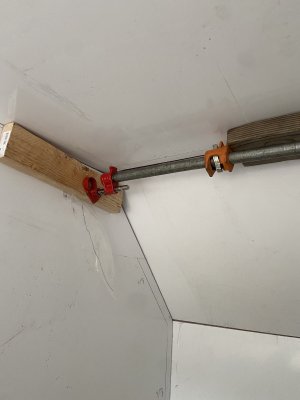
This TC will have a 10' floor space with departure angle, North/South Cabover sleeping platform 84" wide x 77" long, total camper width of 84" and camper height of 80".
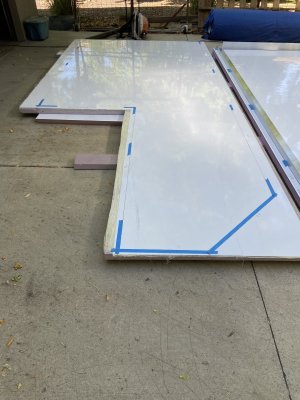
As you can see from the photo, I started with building the full size composite panels. Panels were made from FRP and XPS 250 PSI 4x8 foam sheets. The composites were adhered with single part polyurethane glue. I went back and forth between polyurethane glue and epoxy but finally settled on the poly after reading several good reports about its successful use and considering other aspects like temperature at which I was doing the build. In the next post I will lay out the products I used.
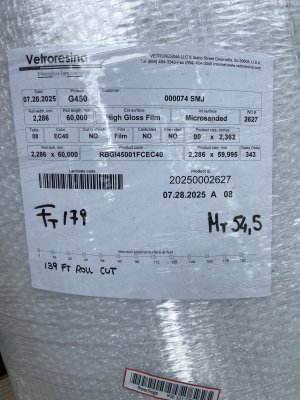
 
As many of you have used before, I sourced my FRP from Vetroresina in South Carolina. I used there G450 High Gloss product. They require a minimum of a 200' roll order at any width, so I ordered a 200'x90" roll delivered to Boise, ID. The product I used cost about $1.56/sq. ft when I ordered mine so total cost was about $2300 for the roll. I also paid $850 for shipping to Boise.

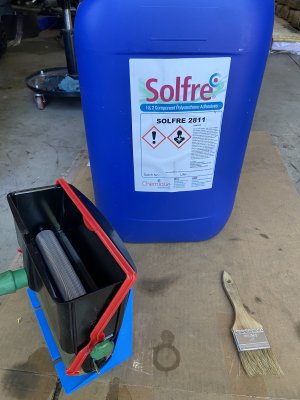
The Polyurethane glue was from a Georgia company called Chemique Adhesives. This was a single part Polyurethane that simplified its application. The salesman recommended that I purchase two six gallon containers. Each container cost $325 for a total of $650 for the adhesive. Additionally, I purchased an 8" glue applicator that was VERY useful to apply the adhesive quickly over large area. The applicator cost $280 and was well worth it. The product I used was Solfre 2811 Neutral. It was about $300 to ship the 140 pounds to Boise. Total cost for adhesive, applicator and shipping was $1243.

Foam was sourced locally at Home Depot and each sheet cost $50ish after my Veteran discount. I used about 18 sheets for a total of about $900. I looked at using other products, but they were way too expensive and went against the goal of staying under $20K for the build. I mitigated the potential strength issue of using the 250psi foam by using a welded aluminum exoskeleton to adhere the panels into. I will get to that in a later post. tempImagebIfDGf.jpgtempImage7JJo23.jpg
 
The process to make the panel was not difficult but time sensitive. Polyurethane adhesive is temperature sensitive. The warmer the temperature, the faster it sets up. Luckily, I was making the panels during the Boise fall when morning temperatures are near 50 degrees. At that temperature you have about 2 hours to assemble everything and apply your pressure. The process for making panels was as follows:

-Cut two pieces of FRP for top and bottom skin of panels.
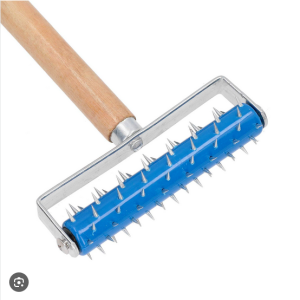
-Prep the foam by sanding both sides with 60 grit on a DA or orbital sander. Additionally, I used a carpet seam roller to dimple the foam to improve adhesion. I also sanded the FRP with the same 60 grit.
-Clean the FRP and foam with compressed air and then wipe down the sanded FRP with wax and grease remover.
-Lay out bottom skin of FRP on flat surface (I did my laminations on the concrete floor of my shop).
-Roll out adhesive on one surface of the foam, mist with water to speed set up of the adhesive and then place that down on the FRP. The process for the other side of the foam is the same and then the FRP top skin is applied. On the first panel I made I tried to use the adhesive applicator on the FRP, but with it' surface being smooth, the glue did not roll out in sufficient quantity. It was much more successful to apply the adhesive to both sides of the foam.
-Once the laminations were all in place, I used two pallets of 60# concrete bags to add weight to the panels. The panels would cure for 24 hours and then I was ready to make the next one.


Sanding the foam boards with 60 grit.


tempImage0hKDAp.jpg
tempImagedltsNG.jpg
Using the carpet seam roller to add dimples to the foam to add adhesion.
tempImagewvIBfJ.jpg
On the top sheet of FRP I added a few sheets of 3/4" plywood to help distribute the concrete load. On larger panels I used up to two pallets of concrete (112 bags) for weight with the addition of the plywood and some large tires I had laying around. My goal was to get to 1/2# /sq. ft.
tempImageTSNTVf.jpg
I continued making panels one on top of the other.
 
tempImagepkMOzN.jpg
Next, I turned my attention to welding up the aluminum exoskeleton. The exoskeleton was made from 4x2x1/8 aluminum 6061 angle iron. I used 4x2 so that all faces of the panels could be adhered to the frame. I used my spool gun and Millermatic 220 to weld the frame. I first made the sides of the exoskeleton and laid them on the corresponding panel to draw the profile. I then welded the cross members to the side to create the entire exoskeleton.tempImageeC1h7G.jpg
 
Attaching the panels to the inside of the exoskeleton takes a plan. You have to place the panels inside the frame in a precise manner to ensure you can get them all in. I started with the floor followed by the roof, cab front and sleeper front, sides, sleeper platform and lastly the two rear panels.
The panels were adhered to the inside of the exoskeleton with three separate items. Sikaflex 252 was the primary adhesive technique. To ensure that the Sikaflex had enough room and wasn't squished entirely out of the joint, I first applied 3M VHB 491 half inch tape to the joint. This tape is just over 2mm thick which kept the sikaflex from being sqeezed out. Finally, I used 3/16 blind rivets every 6" to help hold the joints in place.
tempImageFaeDae.jpgtempImage5va2gX.jpg
The black is Sikaflex 207 primer used to help the adhesion process.
tempImageW6dyBu.jpg
You can see the VHB tape and sikaflex primer on the panel before it was installed.
tempImageLMsm8u.jpg
I also sanded the edges of the FRP where the VHB and sikaflex 252 was going to be used.
tempImagewEfWcv.jpg
This was the corner of one of the panels that was cut off. I peeled them apart with considerable effort. You can see how will the dimpling helped the adhesion. The nice thing about the polyurethane is that it foams a tiny bit after you apply a misting of water, helping to fill all the dimple holes.
 
Allway great to see a foam glass build
At that cost for skin why did you not make your own? i believe you could have done for less than shipping.
on the holes, we like to go all the way through on a bit of an angle for the bite. .
How do you like the spacing at 6'' on rivets ? We've been going 3'', but think going out to 6 '' would be better. The best part of glass foam is never having rot. It is good to see wou use the wider edge trim to spread out the load .Sadley to many use 1.5 by 1.5 i dont think it spreads the load out . Much easy to damage when hit . we went 2 by 3 hand layed fiberglass angle.
 
Last edited:
Looks like a great start. Looking forward to following along.

Looking at the concrete bags I can see they are 60 pounds. Estimating the dimensions and calculating the load, you are way higher than a half pound per square feet under one bag. I know you don't have 100% coverage of two rows of bags.
 

Forum statistics

Threads
190,772
Messages
2,931,475
Members
234,542
Latest member
jasper.mullins
Top