Isuzu npr 4wd

Earthcruiser doesn't have many on their Core. But it will depend on how strong and stiff your subframe and springs are, I'd think.

 
Earthcruiser doesn't have many on their Core. But it will depend on how strong and stiff your subframe and springs are, I'd think.


Water weight stored 42 inches off the ground can cause rear sway.
My 60 gallons of water is stored under the dinette benches.
 
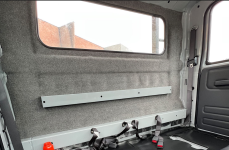
Changing my decisions on the rear truck cab passthrough engineering

I don't like this rear window obstacle, where as I must deal with a "T" shaped hole.

I'm considering a cut out in the rear of the truck cab, 36" high by width of the rear window.

1764166282541.png
 
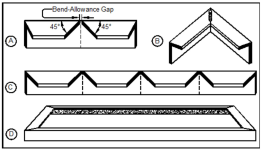
I found 12 gauge angle 4"x1.75".

This will be the frame I weld to form the insert into the rear of the truck cab. This creates a nice flat surface for my door, and provides for a prefect placement.

1764166851876.png
 
Last edited:
More and more I see other builders with crew cab rigs, put some real thought into how they set up this back area. A combination of seats and storage.
 
Gray water management when boondocking in the Western USA is a non issue. Just dont dump near water sources, and be a good neighbor. A dash of bleach kills any odor. When parked for several days, use a longer hose to avoid mud and odor near the vehicle. When using a vehicle in more populous areas in the United States dump stations are readily available in most areas.

A significant number of full timers that I know have a remote actuated dump valve with a smaller orifice on their gray tank. When driving down a empty road they simply flip a switch in the tank slowly drains over about 10 minutes and many miles.

Many established campgrounds prohibit dumping of gray water within their grounds. For good reason as over time the odor and food particles build up.

Always use a strainer on your sink, and deposit any solid waste into your trash bin.

If using a composting toilet which separates urine into your gray tank, bleach tablets can be used to eliminate the urine odor prior to dumping. Otherwise having a yellow tank and being more judicious about disposal may be called for.

When disposing of the solids from a composting toilet, use a trash receptacle, or follow local procedures for burying human excrement.

 
Last edited:
A significant number of full timers that I know have a remote actuated dump valve with a smaller orifice on their gray tank. When driving down a empty road they simply flip a switch in the tank slowly drains over about 10 minutes and many miles.
It is illegal in Australia to drop anything on the road. I suggest that this applies to ESPECIALLY grey water.
Ask any motorcyclist why.

My favorite place is to stop on the verge of a gravel road, close to the edge where no one drives and there is no native vegetation.
Cheers,
Peter
OKA196 motorhome
 
Last edited:
I have a 12v - 148 liter fridge freezer in the habitat. It is a wall upright model with a freezer drawer with separate door at the bottom. To be safe I need to check on the airflow ventilation engineering. A safety check.

Does anyone know how I should test this?

The fridge manufacturer should have documented the minimum ventilation requirements. The simplest is to follow those. In my case, the builder didn't provide enough ventilation (not enough space above the fridge) and the fridge efficiency would drop off significantly in hot weather, as the space above the fridge would sometimes be warmer than the fridge coils.

I ended up meeting vent requirements by measuring the temperature differential from top to bottom of the space behind the fridge and designing fan-forced ducts to draw hot air from the space above the fridge whenever the temperature differential is more than a certain amount (I.E. 5deg F). I'm using temperature probes and PWM-controlled computer fans to move the air.

I also re-designed the space behind the fridge so as to provide an unobstructed, shallow ducted path from bottom to top, to minimize random air movements in that space.

My fridge is vented to the inside - which for me is ideal, because we rarely if camp in hot weather, so capturing the waste heat from the fridge helps warm the interior.
 
My fridge is vented to the inside - which for me is ideal, because we rarely if camp in hot weather, so capturing the waste heat from the fridge helps warm the interior.
It doesn't hurt... but I think it must be insignificant A good 12v fridge will average ~15 W consumption at room temp and that will be converted to heat... compared to a human at rest which gives off 100 W.

For air circulation I think a computer fan would be a good choice... efficient and silent.

EDIT: A fridge is a heat pump, so it rejects more energy than it consumes... figure 2-3x. So ~30-45 W average.
 
Last edited:
EDIT: A fridge is a heat pump, so it rejects more energy than it consumes... figure 2-3x. So ~30-45 W average.
That's not quite accurate in this case, you need to look at the habitat as a closed system over a longer time period.

The fridge coils may be pumping out 30-45w on average, but the fridge is also absorbing heat since it's cold. The average power consumption from the battery/inverter is the actual energy entering the habitat as heat. Which for a smallish 12v fridge is the 15w you mention.
 

Forum statistics

Threads
190,794
Messages
2,931,775
Members
234,541
Latest member
jasper.mullins
Top