Isuzu npr 4wd

It varies a lot for fridge energy usage. In hot weather some less well insulated small fridges will use about 30W average over a day.

As for ventilation, a 120mm computer fan works (choose one with a ball bearing, and put it where it can be cleaned periodically). Make sure you have a make-up air hole on the opposite side of the compartment.

Many fridges with secop/danfoss compressors have enough margin on their fan control outputs to slave this second compartment fan without issue. Thus the fan will only run when the compressor is.
 
Mine is a mystery . I guess I get a 12v fan and look to see how I can add ventilation. There are two undersized vents. So some airflow would force air out.
 
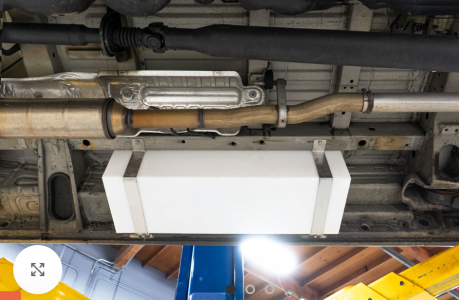
Calculating weight and front - rear distribution, it seems I can't install a aux freshwater tank at the rear. Water is heavy.

Now I think along frame mounted saddleback tank(s) close to the cab or underneath it.

1764957482838.png
 
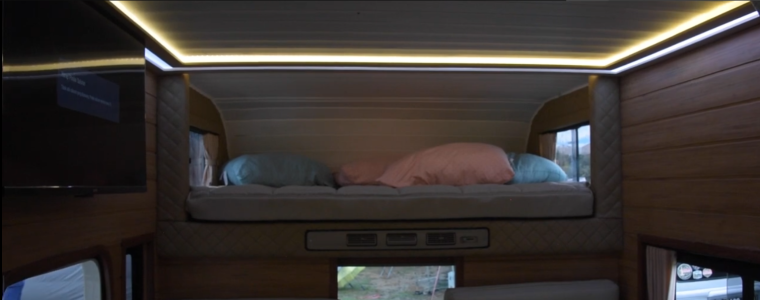
Evaluating the dinette choice.

Rear dinette

(seats six - folds down to a bed)

vs

Side dinette

(seats two - squeeze in four - advantage larger open floor space)
 
Last edited:
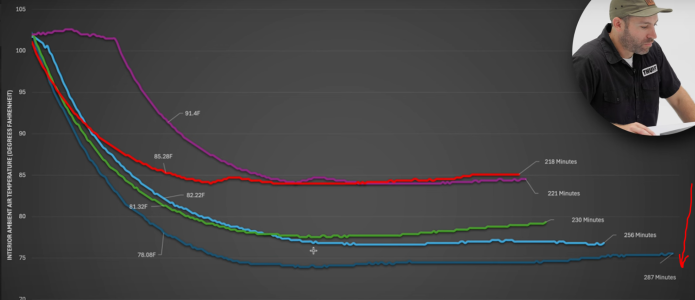
Dometic RTX 2000 12v A/C

Far superior to the rest

Start temp 100 F, maintained temp 75 F

With a 200 amp hr battery - 287 minutes

Avg draw 41 amps - much less after reaching the 75 F level.

1765038485082.png
 
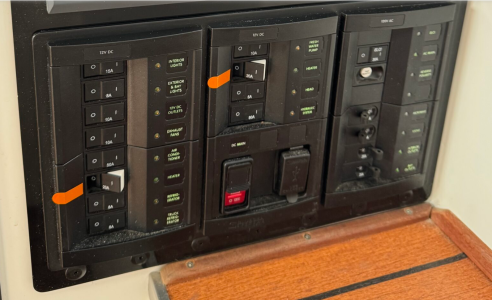
My main switch panel has many switches for electrical items and in addition lights. Several independently switched. I would like to slice in a 2nd bathroom switch for nighttime visits. I really don't want to alter the main panel.

I suppose there is a way to intersect the rear wire and add a dimmer.

What is the suggestion?

1765238248830.png
 
I study a competitors panel shown below and try to analyze if I'm missing something.
Yes you are.
You are missing the point that your build is likely different from other people's and therefore the electrical layout will also be different.
The main difference that I see with "your competitor" is that they are likely using higher quality equipment than you are.

Personally, I skimp on many things in my build, in an attempt to reduce the overall costs, but one thing I don't skimp on is anything electrical related.
Cheap quality electrical equipment is more likely to fail, and if that failure results in a fire (which is definitely possible in high power scenarios), then that can be life threatening in an RV.

Keeping costs down is a valid pursuit, but doing so in a way that could potentially endanger your life is not something I am willing to do.
Sometimes name brand, higher quantity equipment is justified. Well... it is in my mind.
 
  • Like
Reactions: mog
Yes you are.
You are missing the point that your build is likely different from other people's and therefore the electrical layout will also be different.
The main difference that I see with "your competitor" is that they are likely using higher quality equipment than you are.

Personally, I skimp on many things in my build, in an attempt to reduce the overall costs, but one thing I don't skimp on is anything electrical related.
Cheap quality electrical equipment is more likely to fail, and if that failure results in a fire (which is definitely possible in high power scenarios), then that can be life threatening in an RV.

Keeping costs down is a valid pursuit, but doing so in a way that could potentially endanger your life is not something I am willing to do.
Sometimes name brand, higher quantity equipment is justified. Well... it is in my mind.

I see no evidence of quality differences, in switches, fuses, wire quality nor major electrical equipment. You guess wrong from 7500 miles away.

Layout differences is obvious. What I do see, is 12v wiring looms and 110 vac wiring looms are segregated. There is no shared fuse panel as I see in blue sea products.


My 110 vac fuse, main cutoff switch, all inputs and outputs as as well as shore power is all centric to a - management component - as part of a combo sine wave converter. With its own management panel mounted external to the sine wave converter. But the two were engineered as part of one product.

Missing something? So far not discovered.

Wishlist - yes, I found BT modules on the MPPT controller(s), but I will replace my shunt with a smart shunt, with a Android app. And I'm converting my smart TV to DC.
 
Last edited:
EV chargers in public and habitat charging via shore power

I'm interested in a kit, and have the engineering design.

Types of Slow Public Chargers
  • Level 1 (L1): Uses standard 120V household outlets, very slow (3-5 miles/hour), often found in homes or occasional public spots.
  • Level 2 (L2): Uses 240V (like a dryer outlet), much faster (4-10 hours for 80% charge), common in public (workplaces, malls, hotels) and home settings.

Where You Find Them
  • Workplaces & Businesses: For employee or customer convenience.
  • Hotels & Lodging: Overnight charging for travelers.
  • Retail & Shopping Centers: Destination charging while you shop.
Requires

Since you have:
  • 120 V 30 A shore inlet
  • Lithium system
  • Don’t want to pay for RV park hookups
You can safely and affordably do this:
StepEquipmentPurpose
1J1772-to-NEMA 14-50 adapter (with pilot handshake)Lets public charger energize
23–5 kVA step-down transformer (240 V → 120 V)Converts voltage safely
3Short cord NEMA 5-30 or TT-30 to your inletConnects to RV
 

Forum statistics

Threads
190,887
Messages
2,929,909
Members
234,743
Latest member
Jlbeats
Top