Sorry to clutter up your thread Sean, I don't mind if you want to remove this stuff.
Not quite right.
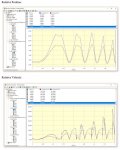
The motion ratio changes across the travel, you are thinking about the overall motion ratio and not considering the angle. On my cantilever setup the angle of motion goes from 24 degrees at full droop to 90 degrees at full bump meaning that axle travel to shock travel is 1: 1:1 at full bump. For instance, 1 inch of shock travel moves the wheel 2.263 inches when the shock moves from 9 to 10 inches of extension. When the shock goes from 0 to 1 inches of extension the wheel moves 1.174 inches. This ratio also applies to velocities and accelerations as well as the position. That is basic kinematics/dynamics. In between these two points it is a transition.
Progressive valving and digressive valving of the shock itself can help to compensate for a changing shock angle but its a workaround for bad geometry. On standard shocks the damping rate is dependent on the shock shim stack and its based on the fluid pressure created when the shock moves. As you mentioned, this is dependent on the velocity of the shock itself which is ultimately dependent on the motion ratio of the shock compared to the axle. 1:1 means that if the axle moves at 13 ft/s then the shock piston is also going to move at 13 ft/s since the shocks on most vehicles are setup with a negative motion ratio ( a 10 inch shock to travel 14 inches ) they have to be placed at an angle which means that the vertical axle travel is 14 inches but the shock is not in the same axis, it becomes the hypotenuse of the triangle to deal with the increased motion. This is a less than ideal setup (I know because that is how my rear end was setup before I built the cantilever) As the axle neared full compression the effective damping rate dropped off to next to nothing regardless of how stiff it was valved.
Icon shocks are not inherently digressive since they use the same shim stack valve setup that everyone else uses. Any shock can be setup to use a flutter stack to attempt to dial out high frequency low amplitude osculations but that is not digressive valving. Bypass shocks can be digressive since they allow for position based bleeding but it is still a workaround much like closing the topmost bypass tube to create a bump zone.
As far as tuning the system, the only difficult part is making sure you don't buck the rear end when you lighten up the rebound to work well across the varying motion ratio.
Let me know if that makes sense,
Sean