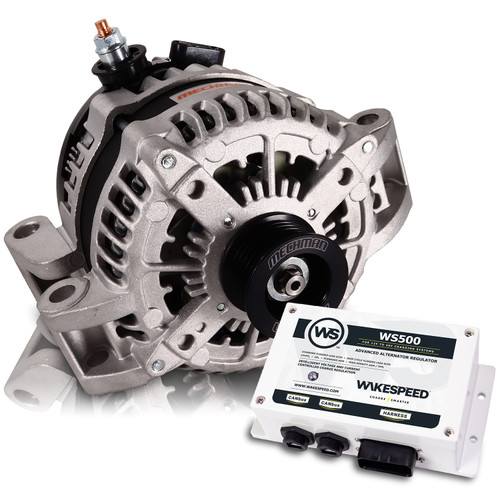
DC-DC charging, everyone talks about it. NO one outlines the FULL cost, then compares that to alternatives. Regardless of rig choice.
I haven't decided for sure what route I am going, but I did spot this 48V option which can be made to fit the second alternator spot on the Ford 7.3l gas engine. 4-5kw of output is pretty darn good, and with a 9-12kwhr battery pack should meet 98% of our usage when combined with ~1-1.4kw of solar.
![]()
48-Volt Elite Alternator (LiFePO4) for Ford T-Mount Housing W/ 6-groove pulley - Externally Regulated
Shop Mechman 48-Volt Elite Alternator (LiFePO4) for Ford T-Mount Housing W/ 6-groove pulley - Externally Regulated 775048V-LFP, best prices, fast ship time & top notch customer service! @ Mechman Alternatorsmechman.com
I don't have a ton of 12 volt chassis loads, so the stock to 250A single alternator will work fine. With a dedicated second alternator charging the house battery I think that's the way to go. I think I'll install a 48v-12v dcdc to keep the chassis battery topped up.
Spend $550 for 30 amp charging a few hours a week. Hard to justify that.
Huh, what are you talking about?

I don't have a ton of 12 volt chassis loads, so the stock to 250A single alternator will work fine. With a dedicated second alternator charging the house battery I think that's the way to go. I think I'll install a 48v-12v dcdc to keep the chassis battery topped up.
LOL there is a lot of confidence here for someone who hasn’t yet had a trip yet.Lets see
4 AWG wiring kit $100
Alternator $250
Victron DC-DC charger $200
Here is $550 without labor
Charges at 30 amps
Drive time five hours a week
At a basic level, charge added (in amp-hours) is:
Amps × Time
So:
30 amps × 5 hours = 150 amp-hours (Ah)
What that means in practice
- Ideal / theoretical: 150 Ah added
- Real-world: usually 120–140 Ah, because:
- DC-DC chargers taper current as batteries approach full
- Charging efficiency is ~85–95%
- Voltage and temperature can reduce sustained output
If you want to think in energy (watts)
Assuming a typical 12V battery system:
- 30A × ~14V charging ≈ 420 watts
- 420W × 5h ≈ 2.1 kWh
Quick sanity check examples
++++++++++++++++++++++++++++++++++++++++++
- 100Ah lithium battery at 20% → nearly full in ~3 hours
- 200Ah lithium battery at 20% → ~80–90% full after 5 hours
For me
Less money, less complexity, almost no labor
Add a parallel battery to your battery bank - charge before leaving home

That literally has nothing to do with the setup I am discussing, and even then there are a bunch of assumptions that only apply to what appear to be your usage case.Lets see
4 AWG wiring kit $100
Alternator $250
Victron DC-DC charger $200
Here is $550 without labor
Charges at 30 amps
Drive time five hours a week
At a basic level, charge added (in amp-hours) is:
Amps × Time
So:
30 amps × 5 hours = 150 amp-hours (Ah)
What that means in practice
- Ideal / theoretical: 150 Ah added
- Real-world: usually 120–140 Ah, because:
- DC-DC chargers taper current as batteries approach full
- Charging efficiency is ~85–95%
- Voltage and temperature can reduce sustained output
If you want to think in energy (watts)
Assuming a typical 12V battery system:
- 30A × ~14V charging ≈ 420 watts
- 420W × 5h ≈ 2.1 kWh
Quick sanity check examples
++++++++++++++++++++++++++++++++++++++++++
- 100Ah lithium battery at 20% → nearly full in ~3 hours
- 200Ah lithium battery at 20% → ~80–90% full after 5 hours
For me
Less money, less complexity, almost no labor
Add a parallel battery to your battery bank - charge before leaving home
View attachment 904442
If there's a 50/100Ah 12V Lithium house battery you'll need a 48-12 DC-DC for that. Given the 14+ volts needed to charge Lithium a 3 way battery switch on the output of the DC-DC would allow charging of the FLA starter battery in an emergency.