E-Series is Best for Overlanding; here's proof

When you overland, what drives your decision making process?

  • The adventure to go and stay in places others can't.

    Votes: 7 70.0%
  • To get away off-grid so I am not weighted down by home and utilities.

    Votes: 1 10.0%
  • To work in peaceful surroundings, and enjoy a quiet life after work.

    Votes: 1 10.0%
  • The traveling journey to see and do something new nearly every day.

    Votes: 7 70.0%
  • To be the one that is in charge of my own destiny; dependant only to myself and who travels with me.

    Votes: 2 20.0%

  • Total voters
    10
The main problem with cutaway vans is that the cabin is not nearly as comfortable to cover big miles in as a F-series pick up truck. There are definitely advantages to how much shorter overall these can be. That said, if folks don't mind the doghouse taking up the majority of the cab, the noise from having the engine in your lap, the challenging access to said engine for service, and limited trim and options available, cutaway vans are great in certain use cases.

- Vans are MUCH more comfortable than F series trucks because you sit in an actual chair with feet below you rather than closer to the floor with feet out in front. This is how commercial trucks are made and one of the reasons they are so much more comfortable to drive over the road than other layouts.
- We are past the days of loud diesels like the 7.3, I hope. I've had many vans and several V10's as well as about every make. Can't hear them any more than any other layout in any vehicle, unless you put a loud aftermarket exhaust on them.
- I find it much easier to pull the doghouse and get to the rear of the engine in a van than in any full sized truck I've had in my life, and that's been a lot of them.
- Limited trim and options, you win there. Vans get no love from OEMs. Can't get around that one.
- There is no substitute in any truck for the way swivel seats can open up a van. Completely changes the vehicle. If the goal is more house in less space, which is the goal for almost everyone of us, but equal usability of the vehicle as a vehicle then a van with swivels trumps trucks by a large margin in this respect.
- I have never had a passenger complain about feet and leg space. Most are just so happy they can get up and walk to the fridge or the porta potty while moving that they don't even think of such things.

Yep, total threadjack. Sorry.
 
Although a 4x4 conversion on an E-Series has a definite cool-factor, the big detractors in my view are:
- It is a Frankenstein of parts. Transmission tailshaft housing, transfer case, drive shafts, front axle/brakes, front suspension, etc. Warranty issues would be exponentially more difficult than an F-Series. I also assume the level of mechanical and safety integration of those custom parts is not going to go through the level of rigor that Ford has for F-Series.
- Much less aftermarket support for suspension, interior, and exterior mods
- Fewer factory options. The F-Series can be built from utilitarian to luxury depending on your budget and desires. The F-Series also has the 10-speed vs. 6-speed tranny of the E-Series.
- Harder to buy. You can walk into any Ford dealership and either pick an F-Series off the lot or custom-order one. E-Series are not as broadly available.
- Safety. The F-Series has much more comprehensive safety features.
- Cost. One of the more popular conversion outfitters advertises "turn key 4×4 swaps here start at ~$35K". You could obviously do it cheaper if you sourced your own axles and provided the labor, but that brings its own set of headaches.

In my view saving 3 feet of vehicle length isn't worth it....but if I won the Powerball I'd be all over it. .
 
- Cost. One of the more popular conversion outfitters advertises "turn key 4×4 swaps here start at ~$35K". You could obviously do it cheaper if you sourced your own axles and provided the labor, but that brings its own set of headaches.
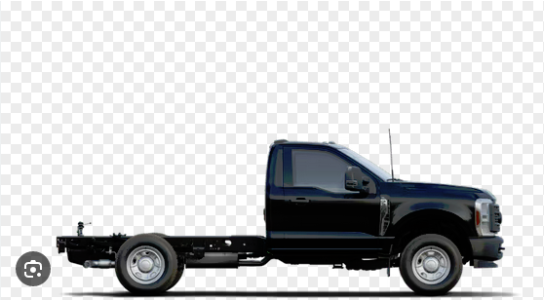
Man, price of everything is going up. I looked at Ford's MSRPs and got a $18k difference between the E350 and cheapest 4wd F350 cab-chassis, so the 4wd swap on the E350 isn't that terrible.
In my view saving 3 feet of vehicle length isn't worth it....but if I won the Powerball I'd be all over it. .
31" to be exact. But it appears that the E has no length behind the seats, while the F does, so it's a bit less difference in reality. Probably ~2'.

1764868576285.png

The lower cab height of the F series facilitates having a decent sleeping berth which comes in handy for space. Tradeoffs...
 
Last edited:
- Vans are MUCH more comfortable than F series trucks because you sit in an actual chair with feet below you rather than closer to the floor with feet out in front. This is how commercial trucks are made and one of the reasons they are so much more comfortable to drive over the road than other layouts.
- We are past the days of loud diesels like the 7.3, I hope. I've had many vans and several V10's as well as about every make. Can't hear them any more than any other layout in any vehicle, unless you put a loud aftermarket exhaust on them.
- I find it much easier to pull the doghouse and get to the rear of the engine in a van than in any full sized truck I've had in my life, and that's been a lot of them.
- Limited trim and options, you win there. Vans get no love from OEMs. Can't get around that one.
- There is no substitute in any truck for the way swivel seats can open up a van. Completely changes the vehicle. If the goal is more house in less space, which is the goal for almost everyone of us, but equal usability of the vehicle as a vehicle then a van with swivels trumps trucks by a large margin in this respect.
- I have never had a passenger complain about feet and leg space. Most are just so happy they can get up and walk to the fridge or the porta potty while moving that they don't even think of such things.

Yep, total threadjack. Sorry.

Couldn't agree more! Bought my first van (an Econoline 100) in 1972 and have owned a van ever since. Currently in a 2007 Quigley with the V-10. I own several other vehicles including a truck with a cabover camper on the back but when its time to explore the outback the van wins every time. Can't beat the amount of enclosed space and the agility off pavement.

DSC01223erexpforum7-9-24.jpg
 
It sounds like the main point the OP is initially making is that frame flex on an E series translates to more suspension travel than a boxed frame on F series non chassis cab.

More suspension travel equals more tire contact on uneven ground and better traction. Generally accepted principle. Less important with 4x4 and locked differentials.

The E series requires more subframe articulation to compensate for its higher degree of frame flex.

The F series might be ok without needing a subframe on flatbeds up to 8' and additional suspension travel could be achieved with suspension modifications.

How much more travel do you get with a stock cutaway van of equal chassis length to a F series pickup truck? Still apples to oranges because it is dependent on whatever fancy custom suspension goes on the E series based on 4x4 conversion. Is the new fancy E suspension being pitted against a stock F?

I would argue that the converted 4x4 E series with articulating subframe is way more expensive than an F series pickup and would leave a lot of room for suspension mods on the pickup.

If it is being stated that E series cutaways offer more advantages due to form factor than it's back to apples and oranges.

I like the idea of my family traveling in the crash tested envelope of a pickup truck. Less so on a cutaway with the possibility of loose objects or objects coming loose and flying into the cabin. Also the additional road noise coming through the cutaway is less desirable.

A completely custom E with 4x4 conversion may use a lot of factory ford parts but good luck swinging into a conventional repair center and having a simple straight forward transaction.

Either way, my opinion is that big heavy campers on really rough uneven terrain is kind of dumb.
Let's look at the UNIMOG for an example. It is highly sought after because of it's ability to traverse difficult terrain without losing traction... same could be said about the US Military HUMVEE. The UNIMOG with the 4-point torsion free pivot system allows the truck's frame to maneuver freely, whereas the HUMVEE has to rely upon independent suspension for wheel travel as the body and bed are bolted to the frame. Saying it is "less important with 4x4 and locked differentials" is true, but conflating the issue. A stiff frame is still less capable of maintaining tire ground contact in uneven terrain.

What does a flatbed do for the F-series? It locks the frame in place, just like the bed would, decreasing it's ability to flex and making it less capable off road. You might be happy to know that Globe Trekker also provides pivot systems for some flatbed models like Bowen Customs or Pariah Flatbeds, once again freeing up the F-series locked potential... but you are still limited to the size of camper by the short 8' bed. At the most, a 10' cabover camper (8' floor with 2' departure angle), but the door would have to be on the side and not the rear.

The E-series, if you read my post and watched the video I linked, has a 22 degree frame flex capability. The F-series is not suited for this type of full WALK THROUGH, seat swiveling, etc., camper, because it does not have a cutaway option. And the F-series will not flex the 22 degrees because the frame is not long enough to reach this mark (bed removed). If on a flatbed or with the bed installed, the F-series won't flex much... as already stated, these things tend to lock the frame travel down.

The expense of converting an E-series to a 4x4 than a stock F-series is hard to argue if you don't do any research. Companies like U-Joint Off Road and Quigley Motor Company have E-Series lined up for the conversion. Maybe the cost difference and the added bonuses I have mentioned are a great value to a lot of people, even though it may not be right for you. And that is okay. My work here to announce another option to enhance the overall Overland Community has been accomplished.

By the way, Ford Motor Company is blessing off this entire project by putting their finance department behind it. They will finance the chassis, subframe/camper, assembly, 4x4 and super single conversion, and Trail Ready accessories. Is Ford backing this? Yes, they are.
 
Last edited:
While there is no perfect solution that fits neatly into everyone's wants and needs, the E-Series chassis has greater flexibility than the F-Series, making it more capable off-road, so long as the frame is able to twist. The F-Series frame is purposely built stiff, since the industry decided to use this as a selling point to prove who had the better and stronger truck (stiff non-twisting frame equals strong truck). Failing to realize that stiff framed trucks tricycle off-road, making them less capable. This is what this post is about. Actual off-roading... not traveling great distances on road. Thank you for continuing the story and your feedback.
If your argument is that the dynamic mounting mandated by the flexible chassis on the E-series makes it more capable than fixed mounting a bed on an F series, what happens when you dynamically mount the flatbed and or camper on series, as I have done? I would argue you get the best of both worlds. The shorter overall length of a E series is definitely a selling point, but the small, limited foot well space due to the doghouse and lack of provision for additional backseat passengers (along with the associated active safety measures such as airbags) definitely makes series better for us, and more likely, better for most people traveling with more than one to two people.

What is strange to me is the idea that there is somehow empiric proof behind the idea that one specific van is the best. An E series is great for the right people, but it is definitely not "the best”.
 
There's no argument that the actual camp space is better in a van. My biggest critique is you got to listen to all your stuff rattle going down the road.

I'm with @2025 deleted member The seating position in the E series is awful. I suppose if you did a seat swap to actually get good seats in it might be better but I'm still a little skeptical. The only two people I know who've had E-Series campers both sold them in large part because of how uncomfortable they were going down the road. Both people went back to full size trucks with slide in campers. Both have their pros and cons but I wouldn't say one is flat out better than the other.
 
Let's look at the UNIMOG for an example. It is highly sought after because of it's ability to traverse difficult terrain without losing traction... same could be said about the US Military HUMVEE. The UNIMOG with the 4-point torsion free pivot system allows the truck's frame to maneuver freely, whereas the HUMVEE has to rely upon independent suspension for wheel travel as the body and bed are bolted to the frame. Saying it is "less important with 4x4 and locked differentials" is true, but conflating the issue. A stiff frame is still less capable of maintaining tire ground contact in uneven terrain.

What does a flatbed do for the F-series? It locks the frame in place, just like the bed would, decreasing it's ability to flex and making it less capable off road. You might be happy to know that Globe Trekker also provides pivot systems for some flatbed models like Bowen Customs or Pariah Flatbeds, once again freeing up the F-series locked potential... but you are still limited to the size of camper by the short 8' bed. At the most, a 10' cabover camper (8' floor with 2' departure angle), but the door would have to be on the side and not the rear.

The E-series, if you read my post and watched the video I linked, has a 22 degree frame flex capability. The F-series is not suited for this type of full WALK THROUGH, seat swiveling, etc., camper, because it does not have a cutaway option. And the F-series will not flex the 22 degrees because the frame is not long enough to reach this mark (bed removed). If on a flatbed or with the bed installed, the F-series won't flex much... as already stated, these things tend to lock the frame travel down.

The expense of converting an E-series to a 4x4 than a stock F-series is hard to argue if you don't do any research. Companies like U-Joint Off Road and Quigley Motor Company have E-Series lined up for the conversion. Maybe the cost difference and the added bonuses I have mentioned are a great value to a lot of people, even though it may not be right for you. And that is okay. My work here to announce another option to enhance the overall Overland Community has been accomplished.

By the way, Ford Motor Company is blessing off this entire project by putting their finance department behind it. They will finance the chassis, subframe/camper, assembly, 4x4 and super single conversion, and Trail Ready accessories. Is Ford backing this? Yes, they are.
You have me curious what your "off-road" experience is.

I would also argue that what a small number of Aussies do with off-road campers is way more extreme than what Americans do including traversing Baja. Most high dollar "offroad" machines in this country are mall crawlers.
 
Last edited:

Forum statistics

Threads
190,785
Messages
2,931,644
Members
234,541
Latest member
jasper.mullins
Top