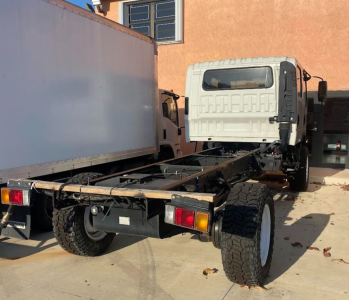
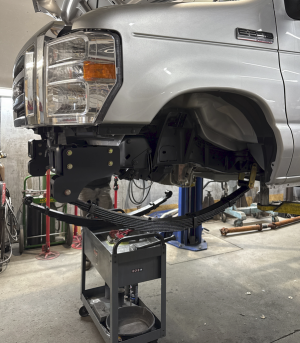
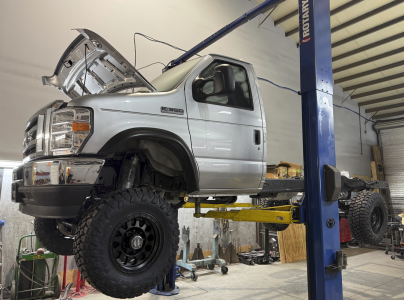
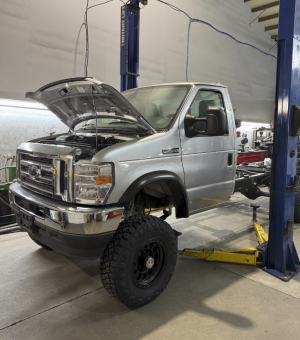
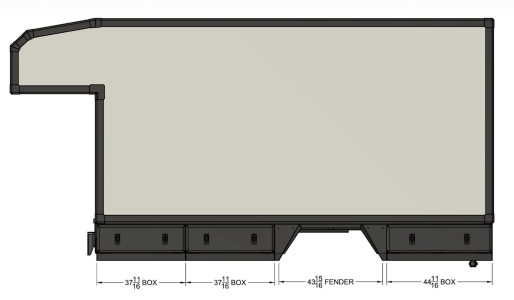
E350/450 Cab-Chassis w/ Composite Box Body

There are several posts above, including one with a weight distribution spreadsheet. So yes, I am paying attention to axle weights.

What is the source for the specific 82% value (18% de-rate)?

12ply is a leftover from the equivalent ply ratings for bias-play tires, it isn't very useful. Load index is by far the best choice for tire comparisons in LT tire ranges.

Typical real-world percentages​

Use case% of tire max load typically used
Passenger vehicles (P-metric tires)70–80%
Light trucks / vans (LT tires)75–85%
SUVs at GVWR80–85%
Trailers (ST tires)85–90% (less margin by design)
If a tire were routinely loaded at 100%, it would overheat and fail under real driving conditions.
 

Typical real-world percentages​

Use case% of tire max load typically used
Passenger vehicles (P-metric tires)70–80%
Light trucks / vans (LT tires)75–85%
SUVs at GVWR80–85%
Trailers (ST tires)85–90% (less margin by design)

But where did you source those tables from? (I sincerely hope it wasn't from an AI summary).

I am not arguing against safety margins, but 18% is a very specific and fairly high margin.

The wheel and tire manufacturers load tables for commercial and LT tires already have some safety margin baked in.
 
Last edited:
These are numbers I'm trying to reach.

My rear axle is rated at 11,000lbs, truck weight is 6900 lbs, dry.

My tires are rated at 3970lbs per tire.

Water and fuel is heavy. As I engineer AUX fuel tanks and freshwater tanks, I try to move them forward when possible.

1767067589905.png
 
So you don't have a source, and those are your personal targets. It is totally fine to have personal design goals, but please don't go around telling folks to derate their tires 18% without that caveat. If you got that data from an AI summary, I strongly advise to find some better first sources, ideally industry specs, regulations, etc.

I would also note that "moving weight forward" blindly can cause just as much of a problem. Overloading the front axle worst case. Though less of an issue on a medium duty truck. Much better is to actually measure curb weights, and the CG of the box. Then calculate the adjusted CG for the added weight (engineering vs guessing).
 
Last edited:
So you don't have a source, and those are your personal targets. It is totally fine to have personal design goals, but please don't go around telling folks to derate their tires 18% without that caveat. If you got that data from an AI summary, I strongly advise to find some better first sources, ideally industry specs, regulations, etc.

I would also note that "moving weight forward" blindly can cause just as much of a problem. Overloading the front axle worst case. Though less of an issue on a medium duty truck. Much better is to actually measure curb weights, and the CG of the box. Then calculate the adjusted CG for the added weight (engineering vs guessing).

Seems like you are fine with being overweight on LT tires, not me
 
Seems like you are fine with being overweight on LT tires, not me


*Citation needed

First off, I never told you my target completed weight. I could be 30% under the tire rating for all you know.
Secondly, you now appear to be claiming that a tires rated load is now "overweight".

There are in fact de-rate factors when using tires in certain applications. P-metric tires for example need to be de-rated by about 10% when used in an LT application. However, I am not aware of any global de-rate factors for LT tires, aside from when used in dually configurations.

Now if you have some extensive experience, or data to backup a global 18% de-rate for LT tires, by all means please post it. You are welcome to have your own opinion on safety, but please label it as such. You don't get to arbitrarily redefine "overweight", at least not without pushback, and especially not when there is published standards for allowable load. This is doubly so when you are posting in someone else's thread providing unsolicited feedback.

For comparison I have seen many LT vehicles with published GAWR which are identical to the tires combined load rating. If a manufacturer is comfortable with that, I see that is good evidence that tire ratings should be taken seriously.
 

Forum statistics

Threads
190,895
Messages
2,930,013
Members
234,743
Latest member
Jlbeats
Top