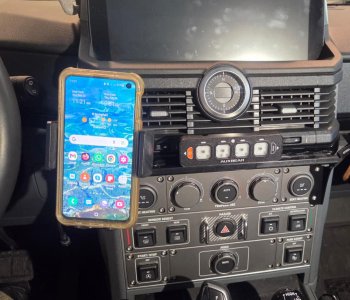
Outfitting my Grenadier Trialmaster

We spent the last few days in the Moab, Utah area. Yesterday we explored Arches National Park, we hadn't been there in about 16 years even though we've been back to Moab almost every year for either East Jeep Safari or for solo trails.

MoabBalancedRock.jpg

Today we did about 40 miles of trails. The Grenadier did just fine and went anywhere I pointed it. I did bottom out on a few high ledges; on one trail there was several hundred feet of deep mud so I took what appeared to be a bypass and it was, but there were a few tall ledges to go down to get back to the main trail. No apparent damage though. Didn't bother taking too many photos but here are two.

MoabTrail1.jpg

MoabTrail2.jpg

Currently in Glenwood Springs, Colorado enjoying the hot springs here, tomorrow begins the trek back east to Delaware.
 
A friend sent me photos of window basket panels he installed on the rear doors of his Grenadier and I thought it was a good place to find some extra storage because you can't really see out of the bottom halves of the rear door windows anyway. But it seemed to me that with the combination of metal panels, plastic door panels and glass windows, anything you put in there would rattle unless is was in a cloth bag or some other soft wrap. And the metal panel installs with screws, which require making holes in the door panel:

RearWindowBaskets.jpg

Why not eliminate the metal panel and have bags that fit in the same location, so I designed bags that mount inside the recess around the windows and don't require screws, double-sided Velcro tape or any other fastening method that might damage the panel to secure them in place. To prove and test the design, I sewed one for the window in the small rear door. It mounts very securely without damaging the door panel and removes and leaves no trace that it was there. It's just a quick proof-of-concept prototype for testing; next I'll work on a bag for the wide rear door.

POCWindowBag1.jpg
 
So how do they attach?
It looks like Overland Outfitters is going to put these in production so probably I shouldn't post those details until they're ready to release. Don't want anyone ripping off the idea before it gets into production.
 
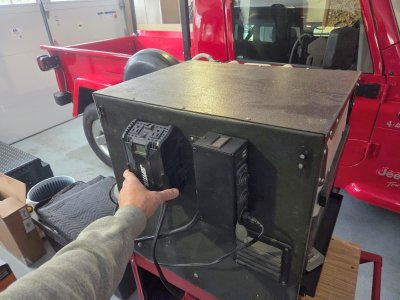
A lot of people install on board air in their offroad/expedition vehicles and it's a good idea. I considered that for the Grenadier but decided on a portable compressor instead. I did this for several reasons - at the SEMA Show a few weeks ago I was given a high-spec dual compressor by a compressor company I've helped with some design projects over the years - it's a great compressor but it's slightly too big to fit in the typical Grenadier OBA locations - under the back seat or under the front passenger seat. Second, I've always used a portable compressor with my three Jeeps and that made sense because I didn't need to have three compressors - I just put the compressor bag in whatever Jeep I was using at the time. So I'm using the new dual compressor as a portable and it will serve in my Grenadier and all of the Jeeps as needed. This is the new compressor, it's mounted to a base for installation in the compressor bag and I've added a disconnect fitting for the air hose:

Compressor5.jpg

I installed it in an Overland Outfitters compressor bag, this green one is actually the preproduction prototype that I sewed for them some years ago, the production bag they offer is the same but black instead of green. A key feature of this bag is that the compressor permanently mounts to the floor of the bag and the bag zips open diagonally to provide enough airflow to keep the compressor cool without removing it from the bag:

CompressorBag.jpg

The 25' Flexzilla hose below is in the bag in the photo above but it's a tight fit with the larger compressor so I'll be looking for a slimmer air hose.

CompressorBagOpen.jpg

I added an Anderson 175 plug to the compressor's wiring harness. It's way overkill for the current the compressor draws, but all of my Jeeps and my Grenadier have these plugs in the engine compartment so to power the compressor I just have to plug it in to whatever vehicle I'm using.

CompressorHarness.jpg

Plugged into the Grenadier:

CompressorGrenadier.jpg

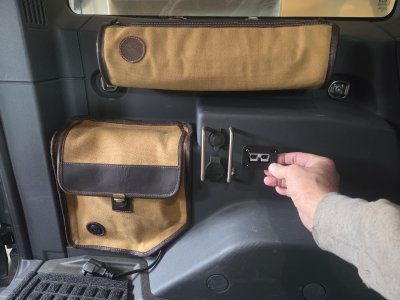
I use the Anderson connection in the Jeeps for powering my winch, which I also share between all three Jeeps on a receiver mount, and for jump starting. I added the same connection to the Grenadier for the same reasons. More on that installation is here: https://forum.expeditionportal.com/threads/outfitting-my-grenadier-trialmaster.247640/post-3217592
 
Are you sourcing the Anderson connectors off Amazon or elsewhere?
I've sourced them on Amazon and eBay, sometimes genuine Anderson, sometimes clones. Both have worked fine. Used 175's and 50's for various connections.
 
During my recent camping trip in Death Valley, it would have been handy to have a table that I could use when the kitchen with its work surfaces wasn't deployed. It would also be useful when the kitchen was deployed, for example it could be set up as a condiment table. I wanted something that could set up in seconds and wouldn't take up much storage space when it wasn't in use. On the long drive back home to Delaware, I thought about it and came up with a design.

It's a simple side table which mounts to the Utility Belt. A mounting rail attaches to the Utility Belt with thumbscrews and a rail on the edge of the table that slips over the mounting rail. The mounting rail installs in seconds and can either be carried inside the vehicle until needed or it can be installed at the beginning of a trip for instant use:

URTableRail.jpg

For now I've left the mounting rail long; other things could be hung on the free ends but I may cut it just outside the thumbscrews.

The table slips onto the mounting rail:

URTableBothRails.jpg

URTable.jpg

The table is a $12.99 Ikea bamboo cutting board: https://www.ikea.com/us/en/p/aptitlig-cutting-board-bamboo-80233430/. A larger or different table could be used but for the price this one works nicely.

The table doesn't support too much weight with just the mounting hardware on the edge, so I added two supports made from webbing, they hook over the drip rail and are adjustable.

URTableStraps1.jpg

URTableStraps2.jpg

I left the Ikea branding...

URTableIkea2.jpg

Next I'll sew a simple storage bag for it.
 
More details about the "Ikea Utility Belt Table" for people who want to build their own.

The mounting rail is a common extrusion used in the RV industry in the U.S. for mounting tables to walls. I found the piece I used on eBay, but here's an RV components supplier that carries it: https://www.rvupgradestore.com/AP-Products-013-164922-RV-Table-Wall-Mount-Support-p/20-3700.htm.

Both pieces have mounting holes and it turns out these are spaced properly for L-Track. I used L-Track studs I found on eBay: https://www.ebay.com/itm/365909329483 and all I had to do to fit the rail to the Utility Belt is drill out two of the holes with a 3/8" drill to fit the stud. I drill the holes that would be closest to the sides of the table board I was using and I didn't cut off the extra length of the rail in case I decided there was something else I wanted to hang there.

URTableRail.jpg

The table is a cutting board from Ikea (https://www.ikea.com/us/en/p/aptitlig-cutting-board-bamboo-80233430/). This board has angled sides so to mount the rail to it I trimmed one side to 90 degrees on the table saw. There are other boards at Ikea that don't have these angles sides if you don't have a way to trim the edge. I used 5 stainless steel wood screws to mount the rail, drilling a small pilot hole fo each screw to avoid splitting the wood. The 90-degree trimmed edge with the rail mounted, you can see the angled edge on the side of the board, the edge where the rail is attached was the same way before I trimmed it to 90 degrees.

BoardEdgeTrimmed.jpg

The table needs supports for anything but the very lightest loads, so I made straps that use the drip rail for support. On one end of the strap is a hook to for the drip rail. This isn't the one I used, but they're available from many sources, here's one: https://www.strapworks.com/1-inch-stainless-steel-flat-hook. The hooks I had on hand are plastic-coated so they won't scratch the paint on the drip rail. A little bit of sewing it used to secure the hook and adjuster to the webbing. I also put a strap adjuster near that end. The drip rail end of the straps:

StrapDripRailEnd.jpg

I put a snap socket on the other end and snap studs on the underside of each corner of the table. I used a snap stud with a screw mount, these are available at places like West Marine: https://www.westmarine.com/west-mar...ton-studs-with-tapping-screws-P008680084.html

StrapTableEnd.jpg

Finished project:

URTableStraps1.jpg

Because I do a lot of sewing, I had all of the strap materials on hand for this project; the straps took me maybe 15 minutes to make and drilling the vehicle side rail and mounting the table side rail took maybe another 15 minutes, so this was a 30-minute project.
 

Forum statistics

Threads
190,761
Messages
2,931,245
Members
234,542
Latest member
jasper.mullins

Members online

Top