this thread really draws 'em in.
Google my a$$crack - you'll find a free body diagram holding a beer from my time in the physics program :elkgrin: Are we wheelin' a tractor here? I didn't think so. here's an exercise for you - since you seem willing to learn.
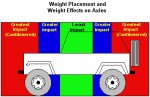
Centers of gravity are a 3-axis deal. Keeping it over the tail is a compromise from moving it too high on the Y axis, giving up a bit over the X axis. If the cans are balanced around the spare then Z axis is happy. The truck weighs over 5k lbs, and you're talking about 200lbs of stuff. 2 fuel cans = roughly 10 gallons x 6lbs/gallon = 60'ish lbs. Plus a hi-lift, maybe 30lbs. That's 90lbs plus the weight of the steel in the carrier arm. Maybe we're talking an extra 100~120 lbs over what is already there. Please put together a free body diagram for a static case, and calculate roughly how many inches backward that 100'ish lbs moved the COG on 5,000lb + truck.
We're balancing the cans, so lucky for you that's back to 2-axis diagram. We don't need to consider ground pressure on each tire but each axle, via the tires, are pushing up so that will factor in to your calculation, as you'll need to calculate the torque at the rear axle exerted longitudinally along the chassis due to the unbalanced weight. No need to account for spring rates - just assume they are fixed. there is already a small amount of torque - if you look up the front and rear axle GVW's you should be able to calculate the percentage difference and get a ball-park number. you will also have to "google" the distance from the center of the stock spare tire to the axle center-line in the chassis since I'm sure you don't have a DII, to get an idea of how long your lever is. Now that you have a base case, and you know the weight each axle is pushing up with, and the amount of torque exerted on the rear axle to the rest of the chassis - put the whole deal on a 15% grade and recalculate the forces on the axles pushing back up and compare it to stock. For extra credit, why doncha throw a big ol' winch and heavy front bumper on the front axle and see what that did to your torque on the rear axle by calculating the torque exerted on the chassis by the lever of the front bumper.
It's been 15+ years for me and I'm not digging out the books after a couple beers, but you seem to have spunk and a willingness to learn something via google, as opposed to us poor bastards who had to sit in class. Go on now and come back to us with how much of a difference this really makes, so we can see if Rob is still justified in doing it this way. I have boxes to unpack and and am too annoyed to actually draw this up.
drunk'ish SeaRubi owwwt