E-Series is Best for Overlanding; here's proof

When you overland, what drives your decision making process?

  • The adventure to go and stay in places others can't.

    Votes: 11 64.7%
  • To get away off-grid so I am not weighted down by home and utilities.

    Votes: 5 29.4%
  • To work in peaceful surroundings, and enjoy a quiet life after work.

    Votes: 2 11.8%
  • The traveling journey to see and do something new nearly every day.

    Votes: 11 64.7%
  • To be the one that is in charge of my own destiny; dependant only to myself and who travels with me.

    Votes: 3 17.6%

  • Total voters
    17
😂😂 So, for the best “overlanding” experience, I need to throw $250k at a van? No, thanks.

My almost stock truck and Jeep with a tent and food in the back gives me what I need.

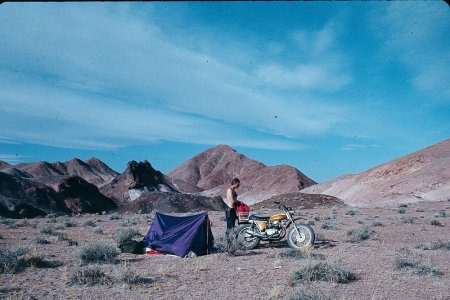
I guess we all have our preferences as to what makes a comfortable camp. And those preferences change as we age. 60 years ago all I needed was a ratty old sleeping bag on a ground sheet rolled up on the back of the bike. That changed to carrying a small tent - mainly to keep out the "creepy-crawlies". At 80 years old if I were to sleep on the ground today with only a ground sheet beneath me, someone would have to help me up off the ground and I'd be sore for the next two weeks.

When I folded up my tent from this camp 50+ years ago I found three very pissed-off scorpions underneath it!

camp Alkali Hot Springs 5-12-74 enhancedr.jpg

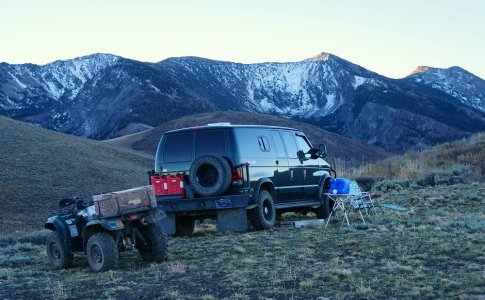
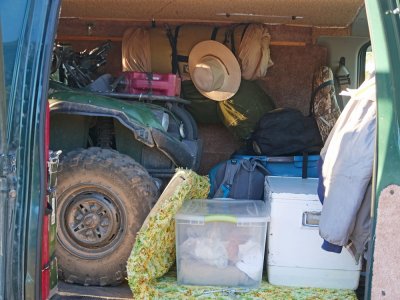
And it not necessary to throw $250k at a van to use it for overlanding. How much you spend depends on how you want to configure it to meet your expectations. I haul my dirt bike or quad inside so the main addition was insulation. I've less than $40k (including the purchase price) in this van - and I've been driving it for 18 years. And I find it very comfortable to live in.

P1004337ermarusia.jpg

P1001290erexpfrm12-31-25.jpg
 
Agreed, I did my own conversion from a passenger van and have about 60k total in the van I think. Started with a bone stock 2011 Quigley with 100k miles, paid $20k.

Biggest expense for me by far was the pop top.
 
Someone mentioned flexing? Just bolt a 12' long and 6' high aluminum box on the back. Stiffens it right up. ;)
First real off pavement trip after I bought it 6 years ago.

View attachment 904957
Whaddaya know, a giant monocoque!

The stiffest, most rigid, most torsionally resistant 'beam' is one that maximises the amount of material furthest from the neutral axis. It is for this reason that a larger diameter tube with thinner walls is more resistant to deformation, save local buckling, than a smaller diameter tube with thicker walls.

Your 5-6' tall aluminum ambulance box is a '5 foot tall frame rail'. A floppy box mounted on a sub frame is not. Why have most OEMs moved away from body on frame construction? Buyers want comfort, low NVH and great street manners. A unibody SUV, car or wagon is a 2-3 foot tall 'frame rail'.

Try to break a twig with your hands, now try to break a 2x4 or a 2" diameter PVC pipe. This is basic physics that seems to be lost on so many people. Could Ford make a 16" tall frame rail? Sure, they've no incentive to do that, even thought that would create a REALLY stiff chassis. You may as well use the box, it's there and you are carrying it everywhere you go.

1568126353_finished-chassis_mmthumb.PNG
 
Do you have a granted patent number or published application number I can reference? I'd love to read more about it.

I searched across web sources, patent databases (including Google Patents, USPTO granted patents via patft.uspto.gov, and patent applications via appft.uspto.gov), company website content, social media, forums, and videos. Despite my efforts, no granted patents were found directly associated with Globe Trekker, their Zero-Torsion subframe, or the E-Flex variant. Thank you Dave.


If you aren't familiar with box-mounting options or the person explaining the system does not describe it correctly, it's easy to get confused. The speaker says, "Patent Pending" which would explain why it cannot yet be found, then says, "Patented". The two are quite different.

Further, he goes on to explain that there is a "torsion free sub-frame". All three point/four point-based mounting systems use a torsion free sub-frame. That is the whole idea. Think of a shoe box, now glue some 1/2" x 1/2" sticks to the bottom of it and set that whole assembly on a cushion or a spring of some kind. The sub-frame, the grid of sticks glued to to the bottom of the shoe box is torsion free, meaning it does not twist. This does not change the characteristics of the frame or chassis of the truck and is not relative to the pivots or springs on top of which it rests. It is the foundation of the box itself, which often does not have proper mounting integrated during construction. So, a bolt-on or bonded sub-frame is installed. This is the interface between the box and the truck frame, not the box itself.

For proponents of this system, the idea is to ensure the box is well-supported and allow it to flop around -I've never seen shocks or dampers on a box, only simple springs or rubbers, on its own, while the chassis twists under it, possibly at a different rate or to a varying degree or extent.

If the idea is to allow a stand-alone box (Unicat, Action Mobil, Bilss, etc) to move relative to the frame of a cabover truck (MAN, Unimog, Atego, etc), mounts are generally constructed appropriately. Affixing a body to a van cab, as if you are making a Transit van or a Sprinter van out of an E-series, then expecting that rear section to flex separately, is asking for trouble, IMO. Maybe there is a soft coupling or something else I am missing, but this seems like marketing hash or poor design, to me.

Just build a box the right way, ditch the pass through, it weakens the structure considerably and leaks heat, light and sound, and be done. If you are stopped in a place that is so unsafe you fear you may need to jump into the cab and drive away, maybe you should reconsider where you park or vehicle-based travel, in general.

If you can't get out of the cab to open another door in the cold or rain, see notes above and consider moving to NYC or LA. There are loads of vacancies in both places.

 
Subj: monocoque and suspension mounting/travel

An up-to-the-minute, real world use case scenario for you:

Watch the next minute or so of this, and listen carefully.


This is how Sprinter and Transit vans are built (unibody/monocoque), An E-Series is body-on-frame, like a 4Runner/Surf/LandCruiser/Prado.

JLR chose a unibody, effectively an aluminum monocoque, not a body on frame vehicle, to race Dakar. I am no JLR fan, by any means, but when you have millions of dollars to blow, racing and a modicum of desire to win, you choose the best platform for the job, and that my friends, is a monocoque.

Finally, at the 10:15 mark, the engineer comments that a strut tower brace was added and that the roll/safety cage was tied into the strut tower. Why? To stiffen the monocoque even further, which allows the suspension to be tuned properly. The next segment of the video covers what? Suspension....

14:18 - "What we've done is created a new structure in the back of the car to enhance the already stiff Defender body." (which is an aluminum monocoque).

Hopefully, you are beginning to see why a 50-year old van platform is NOT the ultimate "over lander".
 
Last edited:
Hopefully, you are beginning to see why a 50-year old van platform is NOT the ultimate "over lander".

There is no such thing as an "ultimate overlander"

And of the long list of hopefuls a one off race vehicle full of rollbars and reinforcing bracing checks very few boxes for most people.

Most unibody vehicles are not durable enough for heavy offroad use. Nothing against their design as ship, aircraft and military vehicles like tanks are also kind of unibody... just the target audience for said unibody vehicles generally don't need the durability.
 
Title of this thread:

E-Series is Best for Overlanding; here's proof​

The title of the thread is not, "Best Compromise", "Best under $50k", "Best for a single guy with a dog" or anything else.

If you claim the E-Series is THE BEST platform for overlanding, you better bring some data to back that up claim.

So that people don't get caught up in the marketing schtick and do something dumb like buy a Sprinter or an Iveco Daily, :) I am attempting to bring a different perspective to the 'decision making process table'.
 
Last edited:
Very few builds can be done without significant compromises for under $100K. With the budget of $100K to $130K there are many. Yet many of those DIY builds are simply not worth the asking prices.
 
Very few builds can be done without significant compromises for under $100K. With the budget of $100K to $130K there are many. Yet many of those DIY builds are simply not worth the asking prices.

My AEV Prospector and Four Wheel Camper combo cost me $75k total, everything brand new. The truck was a 2021 RAM 3500 SRW Tradesman and cost $42k, the AEV Prospector package installed at AEV in Wixom, Michigan, cost $18k, my Four Wheel Camper Grandy shell cost $15k.

And yes, I've added close to $25k in upgrades that I have designed and installed myself to include a 500 watt solar system with DC-DC and shorepower using all Victron Energy components, Ancor wire, fittings, etc.; a Wallas Nordic DT diesel cooktop/heater with 30-gallon auxiliary tank, a full time on-board air system using a ExtremeAire Magnum 1.5 HP compressor, ARB tank, Milton, Parker, Ashcroft, Continental, etc.

All of this was very easy and only required research combined with exercising of our mind and body. Any man can do what I did - all the details and pictures are in my link below. And the best thing is, I live and travel full time in my own creation for under $100k.


RC 25-558.jpg
 
Failing to realise that a truck frame is NOT suspension is common in this community. It is an undamped spring. Speak with any race car, mountain bike or vehicle engineer worth his salt and he will tell you, if he's honest, that tuning a suspension on a flexible chassis, frame, tub or monocoque is a nightmare. The stiffer the frame, the better the suspension works.

The reason that these heavy-duty trucks "tricycle" which is a noun, not a verb, is that the suspension is designed to carry heavy loads with minimal wheel travel. These vehicles, e.g. Ford's F-550, do this very very well. If they were designed to articulate or have massive wheel travel (Can Am X3, downhill mountain bike or trophy truck), then they would do that very well. That was not the design brief.

Don't conflate a bone stock or mildly modified truck designed for carrying heavy loads (work truck, ambulance, roll back wrecker, agricultural use, heavy towing, etc.) with a rock crawler or even a Unimog. The latter has absolutely abysmal suspension. Have you ever ridden in or driven one? They are dump trucks compared to a modern light duty truck or SUV. Mercedes designed the frame to flex because the engineers could not figure out how to carry heavy loads AND make the suspension flexible at the same time way back in the 1950s and 60s.

A flexible frame is an undamped spring. It is not suspension; it does not suspend anything. That is the job of everything below the frame, e.g. leaf springs, link suspension with coil overs, air bags, etc. A leaf spring is also an undamped spring, which is why it's always paired with a damper or shock absorber (a shockie for our truncating Australian friends).

Big heavy trucks ride like crap because they are designed to carry heavy loads, by the OEM. They are not designed to ride like a Rolls Royce Ghost or to bomb down a dirt road at 60 MPH.

Horses for courses.

P.S. You may wish to read Doug Hackney's posts to see what happens when a heavy frame flexes one too many times.

Agreed, a flexible frame often actively interferes with ride, as well as handling. It can improve off-road performance in low speed scenarios, but given that most of these vehicles spend the vast majority of their time moving at speed on maintained roads, I am not sure its worth the trade off. I briefly considered punching in a rough model of a box, chassis, and pivoting subframe with dampers between the subframe and chassis frame. But getting my ancient software to work on windows 11 was too much work. Accurately simulating and controlling a floppy noodle frame, tied to a heavy load, with many hundreds of pounds in unsprung axle weight? Ooof, that sounds like an exercise in futility.

The E-series has some advantages in form factor. But other than that, pretty much every other category there are better options in pickup, or medium duty commercial truck offerings. However one must evaluate the entire package compared to the usage case. When chassis length, and cab accessibility are critical design considerations, the E-series cutaway can be a viable contender. I would also note its curb weight to payload ratio is pretty good, which can be an important factor when trying to control weight, and avoid more exotic wheel/tire combos.

----------------------

I am not sure the warranty issues will be that major. I had a brief talk with a local to me Ford dealership that does some commercial vehicle warranty/service. He was fairly open to working on the vehicle. Obviously the axles and suspension wouldn't be covered, but as along as the modifications to the chassis were done in accordance with the Ford chassis builders guide (ideally by a certified shop), they wouldn't blanket reject warranty service on the frame etc. As for the trans, it depends on the wheelbase. The longer wheelbases don't need the trans torn down to put the Tcase on. My understanding its that the Tcase is a bolt-on, and a standard Ford par (just not used on this platform). The shortest wheelbase has to have the output shaft swapped, which means breaking the case open. There is some warranty concern there, and it depends on corporate and the dealer making the claim. The Magnuson-Moss warranty act is pretty clear the onus is on the Manufacturer to prove warranty ineligibility, but of course its david vs goliath if they decided to stonewall you.

As for the emissions and engine, I they aren't typically touched by the 4x4 conversion, and thus should be covered as normal.

Given how modified your typical pickup will be once its been "overland-ified", some of the warranty issues apply to both.

--------------------------------

As for leaf spring vs coils, A well designed (expensive) leaf spring will ride similar to coils, at least with the same axle. Damping profile will likely be different. But custom leaf springs (actual parabolic variable thickness types) are expensive and not common. Constant thickness leaves are the standard for most custom springs, and they have internal friction, and a variable rate that isn't as good as is achievable with a typical custom coil spring.

Of course then there is the IFS vs solid axle debate, but that's another thread altogether.
 
Last edited:
My AEV Prospector and Four Wheel Camper combo cost me $75k total, everything brand new. The truck was a 2021 RAM 3500 SRW Tradesman and cost $42k, the AEV Prospector package installed at AEV in Wixom, Michigan, cost $18k, my Four Wheel Camper Grandy shell cost $15k.

And yes, I've added close to $25k in upgrades that I have designed and installed myself to include a 500 watt solar system with DC-DC and shorepower using all Victron Energy components, Ancor wire, fittings, etc.; a Wallas Nordic DT diesel cooktop/heater with 30-gallon auxiliary tank, a full time on-board air system using a ExtremeAire Magnum 1.5 HP compressor, ARB tank, Milton, Parker, Ashcroft, Continental, etc.

All of this was very easy and only required research combined with exercising of our mind and body. Any man can do what I did - all the details and pictures are in my link below. And the best thing is, I live and travel full time in my own creation for under $100k.


View attachment 905309
That’s an awesome setup
 
My AEV Prospector and Four Wheel Camper combo cost me $75k total, everything brand new. The truck was a 2021 RAM 3500 SRW Tradesman and cost $42k, the AEV Prospector package installed at AEV in Wixom, Michigan, cost $18k, my Four Wheel Camper Grandy shell cost $15k.

And yes, I've added close to $25k in upgrades that I have designed and installed myself to include a 500 watt solar system with DC-DC and shorepower using all Victron Energy components, Ancor wire, fittings, etc.; a Wallas Nordic DT diesel cooktop/heater with 30-gallon auxiliary tank, a full time on-board air system using a ExtremeAire Magnum 1.5 HP compressor, ARB tank, Milton, Parker, Ashcroft, Continental, etc.

All of this was very easy and only required research combined with exercising of our mind and body. Any man can do what I did - all the details and pictures are in my link below. And the best thing is, I live and travel full time in my own creation for under $100k.


View attachment 905309

Its a camper shell
 
I've lusted after E-Series builds for many years. I lived in Austin back in the late 2000's and just around the corner from me was Sportsmobile. I'd drive by there daily, drooling over their creations. I still kick around the idea of building one, but I'll be into it some $70K+ for something I'll use a few weeks out of the year at best. If I come across a great deal on an old Sportsmobile or Quigley conversion, I might be tempted. But at the end of the day, it's just so much easier and affordable to throw a FWC in the bed of my already modified truck and use it at will with very little effort and without committing to a dedicated platform.
 
Dedicated campers have their place for sure. But for folks that aren't long term or full time, a multi-use vehicle makes more sense.

In that way a van that can do double duty as a 4-5 person hauler, or be converted to carry some cargo, makes more sense. I honestly think a high roof van has more utility than a pickup for many uses. A crew option with removable seat especially.

To be a comfortable long term habitation, you really need some permanent cabinetry in my view. Which limits the multi-use options some.

The pickup bed campers are a good compromise for many folks. Vehicles aren't cheap after all! But for long term habitation the trade offs in overall height, and interior space start to add up.

Like most folks, I think "best" really depends on the person's usage case. Especially their budget. In my opinion, "best" is whatever lets you get out there and enjoy your hobby. If thats rocking down trails with the jeeps, tailgating at your favorite teams games, or backpacking all over the rockies, great! If your hobby is the vehicles themselves? Go for it! Upgrade and modify to your hearts content.

If you full time, and want a comfortable home, that's great too! But let's not pretend there is a singular overland/camping/outdoor culture. There is a vast range of paradigms in the field, and each has its own needs, concepts, etc.

As long as the gatekeeping is kept to a minimum, and folks appreciate that their "best" isn't universal, I am cool with it.

I, for one, very much appreciate the range and variety of options available to me in North America for vehicles. The fact there is such range that it allows debate, is not lost upon me.
 

Forum statistics

Threads
190,950
Messages
2,930,735
Members
234,813
Latest member
rocksandtrails
Top